Key answers at a glance
The short version: automation buys consistency and speed, hands-on control buys ceiling and craft. Here is how the two paths answer the usual questions.
Question | Short answer |
|---|---|
Which is easier every morning? | The automatic path: the grinder, dosing, tamping, and brewing are built into one button press. |
Which gives you more control? | The hands-on path: grind, dose, and shot time are yours to adjust, and the cup tracks your technique. |
Which covers more drinks at one touch? | Super-automatics, which usually include several milk drinks and long coffees as presets. |
Which handles milk more consistently? | An automatic milk system, because it repeats the same texture and temperature every time. |
Which is less work to own? | Neither is free. Automation moves cleaning into machine cycles; manual work moves it to the sink. |
Which one should you buy? | The one that matches how many milk drinks you make each week and who operates the machine on a weekday morning. |
That table is brand shorthand, not a verdict. Both companies sell machines at several price points, and the exact model decides most of these answers. Before buying, confirm the operation type, the milk system, and the cleaning routine on the manufacturer's own page for the model in front of you.
Automatic vs semi-automatic operation
The operating model decides how much of your morning the machine owns. A super-automatic grinds, doses, tamps, and brews at the press of a button; a manual or semi-automatic machine hands those steps back to you. The first trades control for consistency and speed. The second trades convenience for adjustment, and the cup improves as your technique does.
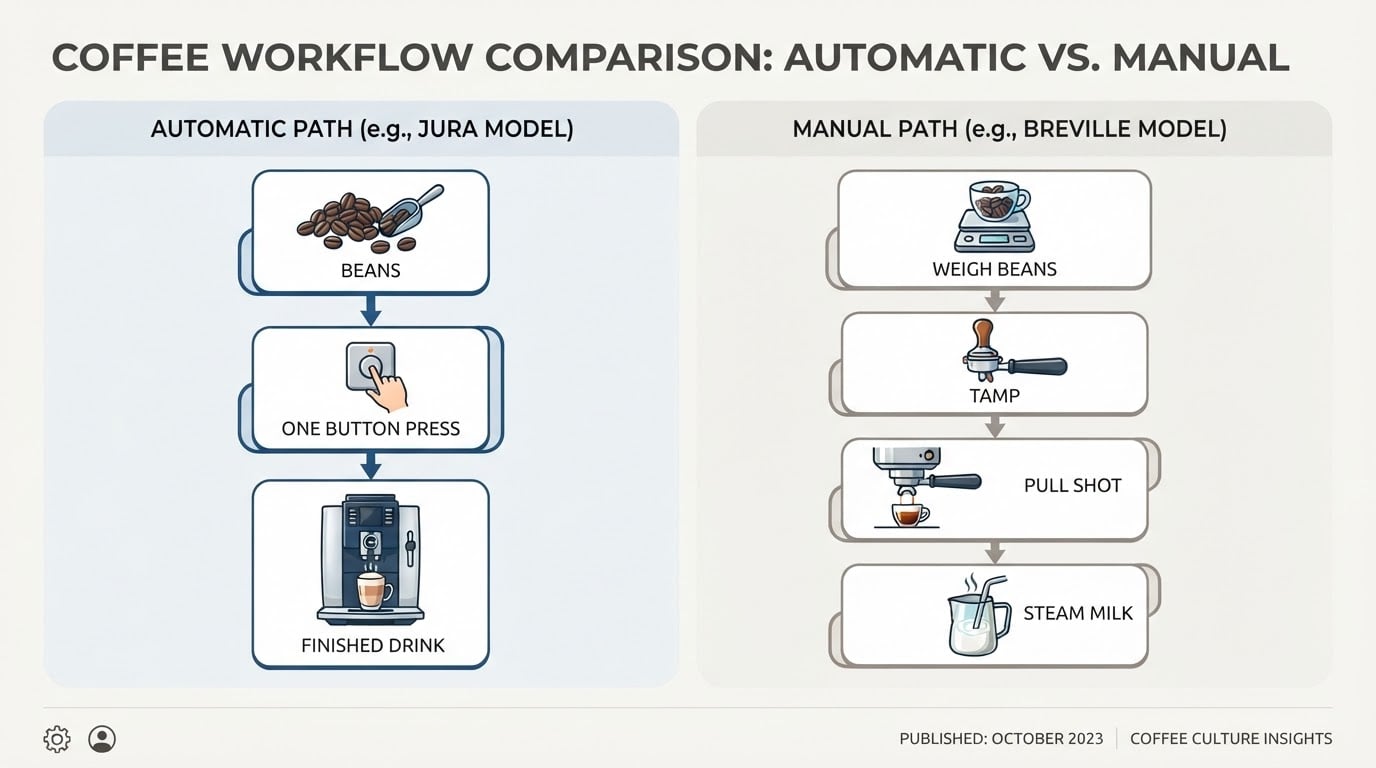
Jura's home lineup is closely associated with the first category. Breville's reputation rests mostly on the second, even though both brands sell models that blur the line. That is why brand-level shorthand is only a starting point: two machines from the same company can behave very differently if one runs the whole process and the other expects a portafilter in your hand.
Four details settle which camp a given model belongs to:
- Does the machine grind and dose for you, or do you need a separate grinder?
- Does the machine handle the puck, or do you tamp and lock it in yourself?
- Can you adjust grind size and brew temperature without a service visit?
- Does it brew and steam at the same time, or do you wait for one step to finish?
Drink range: what each design can pour
A super-automatic covers a longer drink menu at one touch. Espresso, long coffee, cappuccino, latte macchiato, and hot water for tea are usually presets, and the machine manages the milk. A manual machine can reach the same menu, but you build each drink: pull the shot, steam the milk, pour, repeat. What changes is not the ceiling so much as the number of steps and how repeatable the result is.
Three checks decide the real range for the model you are considering:
- How many milk drinks can it make before you refill a tank, empty a tray, or rinse a part?
- Can you save strength, temperature, and milk settings per drink?
- Does it handle hot water and tea without a separate kettle?
If most of your week is one drink, either design covers it. If you regularly make several different drinks in a row, the preset menu earns its keep.
Milk handling
Automatic milk systems are hands-off during the pour and hands-on during cleanup; a steam wand is the reverse. A carafe or tube system froths milk to a preset texture and temperature, so the fifth latte tastes like the first. A steam wand puts texture and temperature in your hands, which is why a practiced hand can beat an automatic frother on mouthfeel and why a beginner often cannot.
Test these three things before you buy:
- Milk residue. Automatic systems push milk through internal parts, so daily rinsing and a deeper clean on schedule are part of ownership. A steam wand needs a purge and a wipe after every use, plus a pitcher to wash.
- Your usual milk. Oat, soy, and almond milks foam differently depending on protein and fat content. Check whether the model documents recommended milk types, and try your usual carton if you can.
- Temperature. Some drinkers want a hotter cup than the default settings allow. Confirm the machine lets you adjust milk temperature if that matters to you.
Cleaning and maintenance
Cleaning does not disappear with automation; it moves. A super-automatic runs rinse cycles, asks for cleaning tablets, and needs its milk circuit and water system maintained on a schedule. A manual machine keeps those tasks visible: wipe the steam wand, clean the group head and gasket, and backflush and descale on the manufacturer's cadence. The manual routine takes minutes but happens daily. The automatic routine is mostly hands-off but must not be skipped.
Water is the other long-term factor. Hard water leaves scale, and scale shortens the life of any espresso machine. Check what the model expects: an in-tank filter, a removable water tank, or a plumbed line. Then check the unglamorous parts of ownership, because they decide how a repair goes: is there a service network near you, how long is the warranty, and are gaskets, filters, and milk parts easy to buy?
Who each brand suits
Pick by the person who will actually press the button, not by the badge. The two brands suit two different relationships with the morning routine.
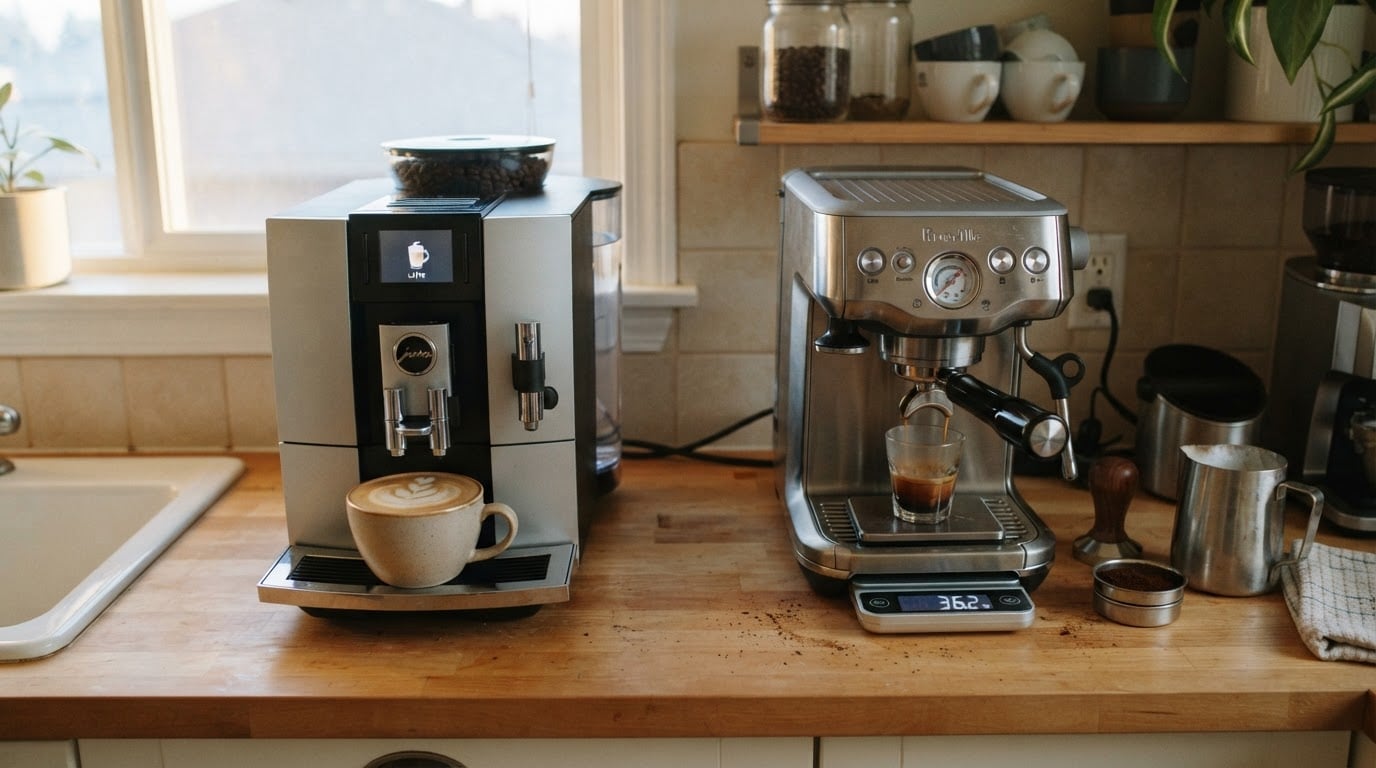
The automatic path is the better fit when you drink milk-based coffee most days, you want the same drink quickly, you would rather not learn to dial in a grinder, and you accept that automated cleaning is part of the deal.
The hands-on path is the better fit when you mostly drink espresso, you like adjusting grind and dose to taste, you are willing to practice milk texturing, and the routine itself is part of the appeal.
Your week | Better fit |
|---|---|
Two or more milk drinks every morning, made by different people | The automatic path |
One espresso on weekdays, longer sessions on weekends | The hands-on path |
A shared office kitchen with mixed skill levels | The automatic path |
A home setup where you want to improve your technique | The hands-on path |
Follow-up questions this choice raises
These are the questions the brand shorthand above leaves open, grouped by what you are actually deciding.
Fit and capability
Can a super-automatic pull a shot as good as a semi-automatic? A super-automatic delivers consistent shots within its settings and is hard to beat for repeatability. A semi-automatic has the higher ceiling if you are willing to adjust grind, dose, and technique, because you can correct what you taste.
Do I need a machine that brews and steams at the same time? It matters if you make several milk drinks back to back, because waiting between brewing and steaming slows every drink. If you make one or two drinks a day, brewing and steaming in sequence is rarely a problem.
Is a built-in grinder a downgrade? A built-in grinder saves counter space and steps and keeps the machine self-contained. A separate grinder gives you more upgrade paths and easier cleaning, at the cost of another appliance and a longer routine.
Ownership and cleaning
How much cleaning does each design add per week? Expect a daily rinse or wipe plus a deeper clean on either design. Automatic milk systems add parts that must be rinsed, and manual machines add a pitcher and a wand. Budget a few minutes a day either way.
What happens if the milk system clogs? Milk residue is the usual cause, so follow the rinse schedule and use the recommended cleaning products. If a part wears out, how easy it is to replace matters more than the brand name, which is another reason to check the parts list before buying.
Does hard water really shorten machine life? Scale is the main long-term enemy of any espresso machine, and the harder your water, the more often you need to filter or descale. Check the water treatment requirements and how easy that maintenance is to run yourself.
Buying and value
Why do similar-looking machines differ so much in cost? Price tracks the level of automation, the grinder and brewing hardware, the milk system, the materials, and the support behind the brand. Decide which of those you are paying for, then compare models at the same level of automation rather than at the same price.
What should I check before buying a used machine? Ask for the service history, the age of the grinder burrs, whether the milk system was cleaned on schedule, and whether the model is still supported with parts and filters. A machine with no service history is a project, not a bargain.
What does the warranty actually cover? Warranty terms vary by model and region, so read the fine print for the machine you are considering: what is covered, for how long, who arranges service, and whether consumables such as filters and cleaning tablets are excluded.
How to decide in one sitting
Run this sequence once and the shortlist usually falls out of it.
- Count the milk drinks you make in a normal week. Two or more pushes you toward automation.
- Name the person who will operate the machine on a weekday morning. Their tolerance for steps decides as much as yours.
- Pick the operating model from those two answers, then shortlist two or three current models at that level.
- Confirm the details no brand-level comparison can settle for you: operation type, milk system parts, cleaning steps, water treatment, warranty, and local service.
- Score the shortlist against the criteria you just wrote down. Stop when one model clears every criterion and the runner-up fails on something you would resent every morning.
You are done when one machine wins on your criteria and you can name the compromise the others require.
The bottom line
There is no universal winner in Jura vs Breville. There is a winner for your kitchen: automation if you want the drink without the process, hands-on control if the process is the point. Model names, prices, and features change faster than any comparison can track, so verify the current spec sheet before you buy.