The short verdict
The E8 is a super-automatic. It grinds, doses, and runs a drink program for you, and its milk system is built to finish a milk drink in one sequence. That single fact explains both sides of the purchase: you get repeatable drinks with no technique, and you give up the routine decisions that a hands-on setup would leave with you.
The useful question is not whether the machine can make good coffee. It is whether its defaults line up with the drinks you actually order. A machine that nails your daily latte and is clumsy on a rare ristretto is a better buy than one that is technically superb at drinks you never make.
The E8 is a strong fit when:
- You want milk drinks every morning without grinding, tamping, or watching a scale.
- Two or more people share the machine and need it to work the same way for each of them.
- You would rather clean a milk path than learn to dial in a grinder.
- Counter space is limited enough that a separate grinder is unwelcome.
Look at a different direction when:
- Espresso is the hobby itself and you want to steer pressure, pre-infusion, or ratio shot by shot.
- You mostly drink black coffee in small volumes and do not need a milk system at all.
- You will not commit to a cleaning routine, since a milk-carrying automatic is only as good as its hygiene.
- You want the lowest possible cost per drink and are happy to accept less convenience.
Drink range and one-touch milk drinks
Start by writing down the last ten drinks you ordered. If eight of them involve milk, the milk programs will decide whether you enjoy this machine; if eight are black, you may be paying for hardware you will rarely use.
Ask the retailer for the exact program list on the revision they stock. Confirm four things in person: whether milk drinks are genuinely single-press or need a second step, whether hot water for an Americano is a separate program, whether you can save a modified drink under your own name, and whether a tall travel mug fits under the spouts. Those four answers change daily use far more than any headline specification.
Grind and dose control: what the machine decides for you
A super-automatic owns the dose. You choose a grind setting and often a strength or volume, but there is no scale in the loop and no puck to inspect. That is the trade: fewer levers, fewer mistakes, less control over the last five percent of a shot.
Two practical checks. First, ask whether the machine accepts pre-ground coffee through a bypass, which matters if you keep a bag of decaf for evenings. Second, taste the same beans at two grind settings during a demo. If the difference is muddy rather than clear, the grinder's adjustment range will frustrate you later.
Espresso and milk texture: what a good result looks like
Judge a demo by outcomes, not by feature names. For espresso, a common starting point is roughly a 1:2 brew ratio by weight in about 25 to 30 seconds, adjusted for taste rather than chased as a target. Ask what the shot weighs and how long it ran, then decide whether the flavour is balanced or sharp and thin.
For milk, look for glossy microfoam with no visible bubbles, a texture that holds a shape for a few seconds, and a temperature you can drink immediately. Ask whether milk temperature is adjustable and whether the machine can texture without dispensing coffee, because that single capability decides whether kids' hot chocolate is easy or annoying.
The interface and your daily workflow
Walk through a full morning before you buy. Fill the water tank, check the beans, switch on, wait for warm-up, choose a drink, then rinse the milk path. Time each step in the store instead of trusting a product page.
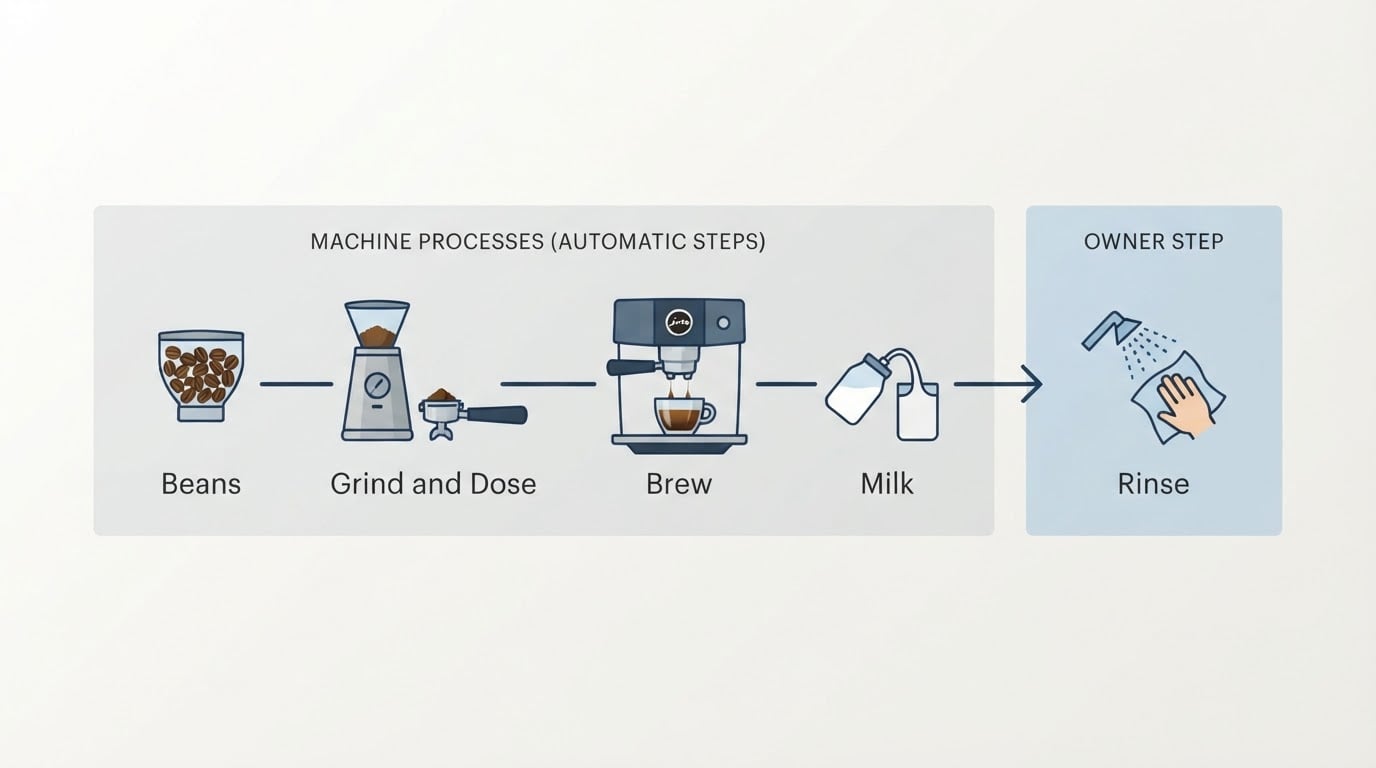
Ask three questions about the interface: how long the machine takes to reach brewing temperature, whether it runs an automatic rinse when it wakes, and where the water tank fills from. A front-filling tank is a small detail that becomes a daily irritant in a tight kitchen if you have to pull the machine out.
Water, beans, and the routine between refills
Water quality drives both taste and scale. Test your tap water hardness before you buy, then ask what the machine expects: a water filter, a descaling schedule, or both. Confirm how the machine tells you a filter or descale is due, and how long the reminder can be deferred before it refuses to brew.
For beans, confirm whether the hopper is removable, since a hopper you can lift off is easier to empty before switching roasts. Medium roasts treat automatic grinders well, and oily dark roasts tend to gum up any grinder over time, so ask what the manual says about oily beans before you commit to your favourite bag.
Cleaning and descaling: the real ownership burden
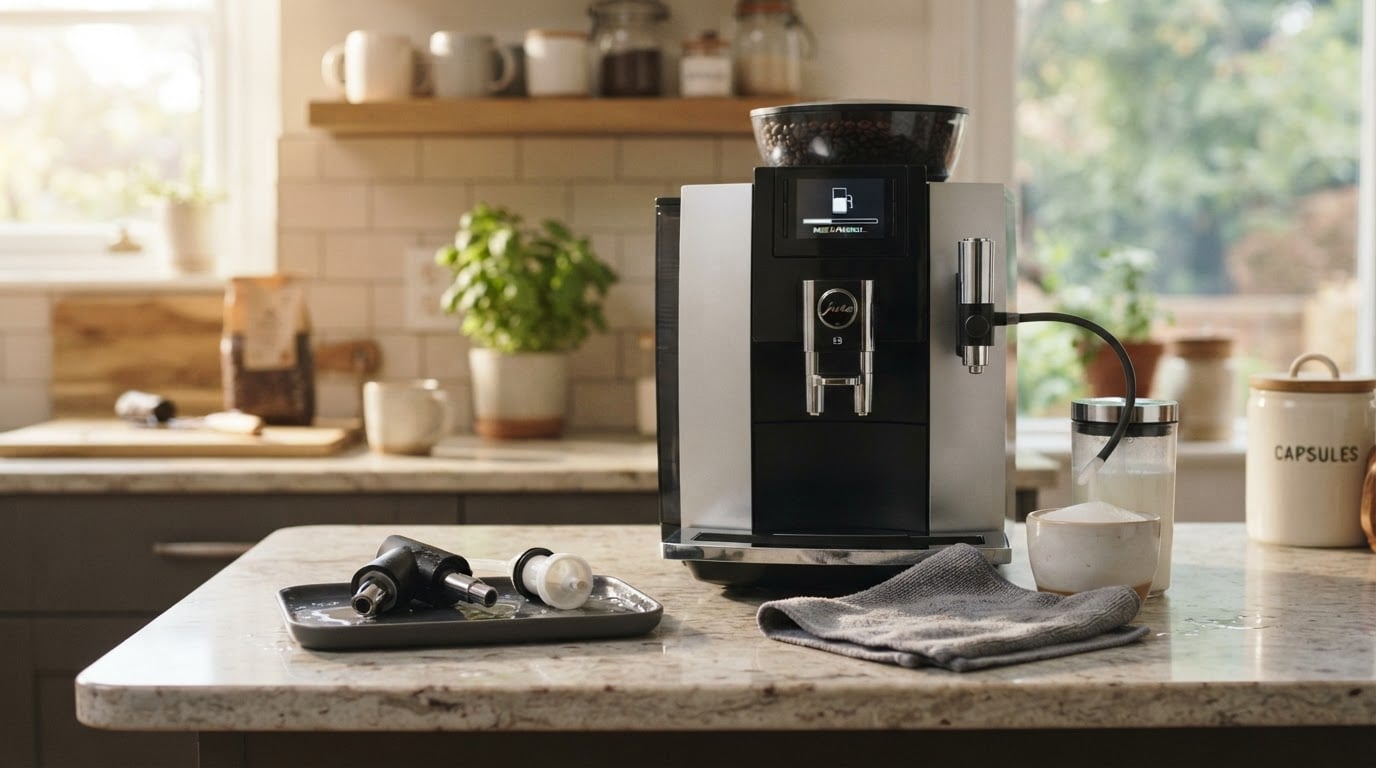
Milk residue is the part of the routine that decides how the machine smells and tastes six months in. Every automatic with a milk system expects a rinse after the last milk drink of the day, a deeper weekly clean of the milk parts, and periodic cleaning tablets for the brew unit.
Build a routine you would actually keep on a Tuesday, not an ideal one. Ask the retailer to show the rinse sequence, the cleaning program, and the descaling program, then price the consumables: cleaning tablets, milk-system cleaner, water filters, and descaling solution. A machine with cheap hardware and expensive routine is not cheap. The article is doing its job when the checklist matches the drawer of supplies you will really keep.
Footprint, noise, and counter logistics
Measure your counter and the height to the underside of your cabinets before you compare anything else. Confirm the machine's dimensions, required clearance above for filling, and the swing space the door or spout needs from the manual rather than from photos.
Noise matters more than buyers expect, because grinding is the loudest part of any automatic's morning. Ask for a live demo with beans in the hopper, and stand where you would stand while waiting. In an open-plan kitchen, that thirty seconds of grinding sets the tone for the whole routine.
Build quality and long-term service
The questions that protect your money are unglamorous. What is the warranty length and what does it exclude? Who performs repairs in your state, and does the machine ship away or get serviced locally? What does a typical out-of-warranty repair cost, and are the brew unit and milk parts user-removable for rinsing?
Get the service model in writing before you pay. Automatic espresso machines fail most often in exactly the places routine maintenance touches, so a nearby service option is worth more than an extra program on the menu.
Pros and cons, honestly stated
Pros
- One sequence from beans to a finished milk drink, repeatable for every household member.
- Consistent output even when nobody wants to think about grind, dose, or timing.
- A milk system that removes the steepest part of the home-café learning curve.
- A compact single unit that replaces a grinder, a machine, and a milk workflow.
Cons
- Limited manual control over the details that experienced espresso drinkers want to tune.
- Real ongoing cost and attention for filters, cleaners, and descaling.
- Grinder noise in the morning and a warm-up wait before the first cup.
- Repair and parts risk concentrated in an expensive appliance, so service access matters.
When a semi-automatic or a pod setup serves you better
The E8 competes with two very different alternatives. Compare them on the job, not on the spec sheet.
Setup | Best when | What you give up | What to confirm before buying |
|---|---|---|---|
Jura E8 (super-automatic) | You want milk drinks with a single press and consistent results across several drinkers | Shot-level control, and some counter space, plus a consumables routine | The revision's program list, milk-system parts, cleaning schedule, and local service options |
Semi-automatic plus grinder | Espresso is the hobby and you want to steer grind, dose, and ratio | Speed and repeatability, and you will need a workflow and a scale | Grinder adjustment range, machine warm-up time, and whether the pair fits your counter |
Pod machine | You want minimum effort, minimum mess, and no cleaning routine beyond a rinse | Cost per drink, drink variety, and any real control over strength | Pod availability and price locally, and how much waste you are willing to handle |
Ownership-cost checklist: questions to ask before you pay
Treat this as the completion standard for your research. When every question has a written answer, you are ready to decide.
- What is the final price for the exact revision in stock, and what is included in the box?
- Which consumables does the manual require, and what do they cost per year at your usage rate?
- How often does the machine ask for descaling or a new filter, and what happens if you defer?
- What is the warranty length, what does it exclude, and who honours it?
- Where is the nearest authorised service point, and what is the turnaround?
- Are milk-system parts and the brew unit available as spare parts?
- What is the return window, and does opening the sealed water filter or cleaning kit void it?
- Can you see a live demo of one milk drink and one black coffee before you commit?
FAQ
What should a Jura E8 review cover before you trust it?
It should state which revision it tested, whether the milk system was included, what the reviewer measured, and what was merely observed. Reviews that skip the revision are hard to apply, because listings reuse the same model name across revisions.
Where do owners discuss this machine?
Owner threads and video walkthroughs are useful for workflow complaints, cleaning friction, and service stories. Read them as a list of things to verify rather than as specification sources, since a complaint usually depends on a revision, a water hardness, or a user's routine.
How do you check the current Jura E8 price?
Check the price at the retailer you would actually buy from, for the exact revision and bundle, on the day you decide. Prices move with promotions, included milk systems, and starter consumable kits, so any figure quoted in an older article or video should be treated as historical.
How do you know which revision a retailer is selling?
Ask for the model and revision identifier from the carton or the machine's rating plate, not from the marketing photos. Then confirm that the manual you downloaded matches that identifier, and that the program list in the listing matches the manual.
Are older reviews still useful?
Partly. Older reviews remain useful for workflow, cleaning burden, and service experience, which change slowly. Anything tied to programs, interface, or consumables should be re-checked against the current manual, because those are the parts that shift between revisions.
Who fixes it if something goes wrong?
Ask before you buy. Confirm the warranty terms, whether repairs go through the retailer or a service partner, and what shipping or travel is involved. A local service option is often worth more than a small discount from a distant seller.
Does it make sense if you mostly drink black coffee?
Usually not. If your routine is espresso and long blacks, you are paying for a milk system and its cleaning routine without using it. A simpler automatic, or a semi-automatic if you enjoy the process, spends your money on the parts you actually use.
Bottom line
The E8 earns its place when convenience, repeatable milk drinks, and a single compact unit matter more than manual control. It earns its price only if the program list matches your habits, the cleaning routine fits your week, and someone nearby can service it. Confirm those three things at the retailer, and the decision stops being about reviews and becomes about your own kitchen.