The short answer
These two brands build toward different mornings.
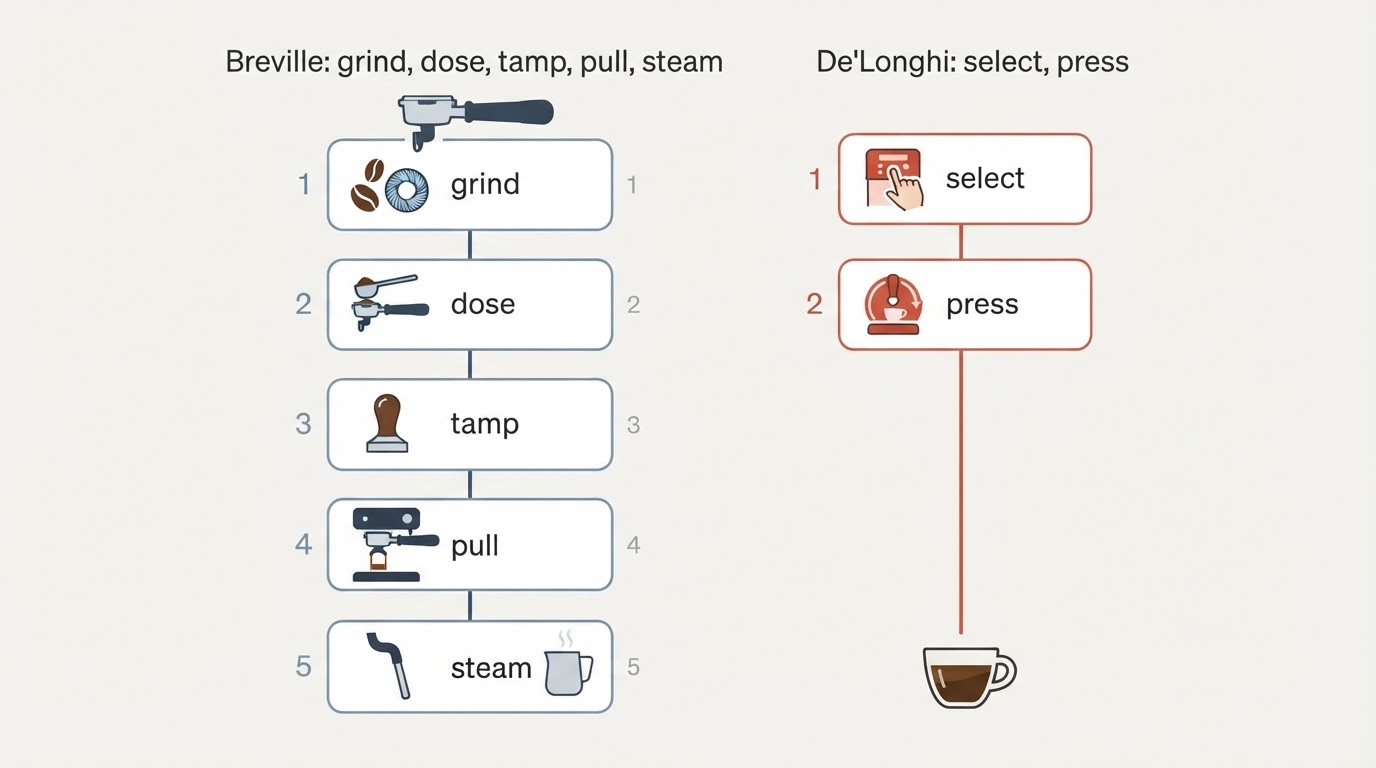
Breville's center of gravity is the espresso workflow. You grind, dose, tamp, pull, and steam, and the machine is laid out to give that sequence more adjustments, more visible feedback, and more places to intervene. De'Longhi's center of gravity is the finished drink. You pick a beverage, the machine grinds and doses, and on the automatic models the milk system does the frothing, so your part shrinks to water, beans, milk, and a button.
That means the honest question is not which brand is better, but which set of steps you are willing to repeat twice a day for the next five years. If you want to taste the difference a small grind change makes, Breville's design language will feel natural. If you want a latte before your first meeting without touching a tamper, De'Longhi's will feel natural.
Three practical consequences follow from that split:
- Learning curve: the hands-on route asks for a few weeks of deliberate practice before drinks become repeatable.
- Attention per drink: the automatic route trades your attention for machine time, so the drink arrives with less of your involvement.
- Cleaning ownership: both brands demand maintenance, but the work moves from washing a pitcher and basket to rinsing a milk circuit and a removable brew group.
What each brand is actually optimizing for
Breville: the operator stays in the loop
Expect a portafilter in your hand, a tamper on the counter, and a control surface built around dose, temperature, and extraction time. The brand's lineup rewards people who treat espresso as a small craft with variables: you change one thing, taste the result, and decide whether to keep the change. When something goes wrong, the cause is usually visible, because you performed most of the steps yourself.
The cost is real. You need a routine, a scale helps, and a bad morning can produce a bad shot. In exchange, you are never guessing what the machine did on your behalf.
De'Longhi: the cup is the interface
Expect a bean hopper, a drink menu, and a milk system designed to be attached, used, and rinsed. The design goal is a short path from "I want a flat white" to a flat white, with the machine absorbing grinding, dosing, and frothing. Controls are fewer and more consequential: bean setting, strength, temperature, drink size.
The cost here is the opposite one. You give up fine-grained control in exchange for consistency with less effort, and maintenance becomes a scheduled ritual rather than something you feel through your hands. You also inherit more parts that need attention, because there are more subsystems doing work for you.
How the tiers stack up inside each brand
Breville's ladder is workflow-first
Across the range, each step up tends to buy you a shorter or more repeatable path from beans to cup. The pattern looks like this:
- Entry tier: a simpler espresso machine, often with a pressurized basket that is forgiving of pre-ground coffee, plus a basic steam wand. Fewer variables, more room for error.
- Mid tier: an integrated grinder joins the workflow, and dose, temperature, or shot timing become adjustable. This is where the brand's philosophy is easiest to feel.
- Upper tier: assistance appears for the parts of the workflow people struggle with, such as tamping or milk texturing, while the operator keeps the decisions.
De'Longhi's ladder is automation-first
Here each step up tends to buy you fewer manual steps and more drink options:
- Entry tier: a bean-to-cup machine, often with a manual steam wand for milk.
- Mid tier: an automatic milk system arrives, so milk drinks become one press plus a rinse.
- Upper tier: more presets, finer milk and strength control, and a sturdier brew unit meant to survive years of daily automatic use.
One trap: De'Longhi also sells semi-automatic espresso machines, so not everything wearing the badge is a bean-to-cup appliance. Read the listing for the words "super-automatic" or "bean-to-cup" before you assume.
Model names in both brands change with each generation and differ by market, so compare by tier and by the features listed in front of you rather than by a name you read in a review from two years ago. Confirm the current lineup on the manufacturer's page or the retailer listing before you commit.
Daily use: where the differences actually bite
Drink outcomes
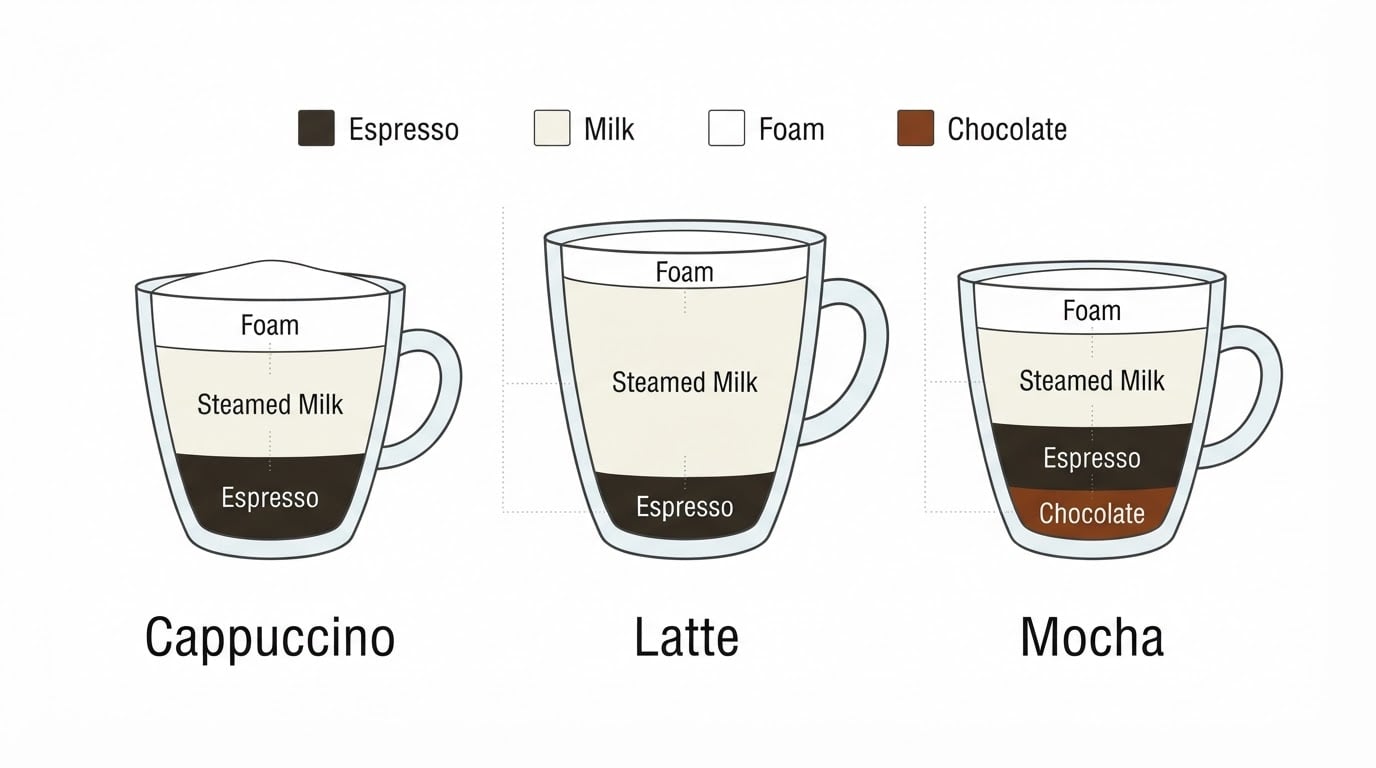
If espresso is the point, Breville gives you the levers that shape it and the feedback to chase a shot you like. If milk drinks are the point, De'Longhi gives you a repeatable milk result with almost no technique. Neither is a quality guarantee: the grinder, the beans, and the freshness of the milk matter more than the badge on the front panel.
Milk workflow
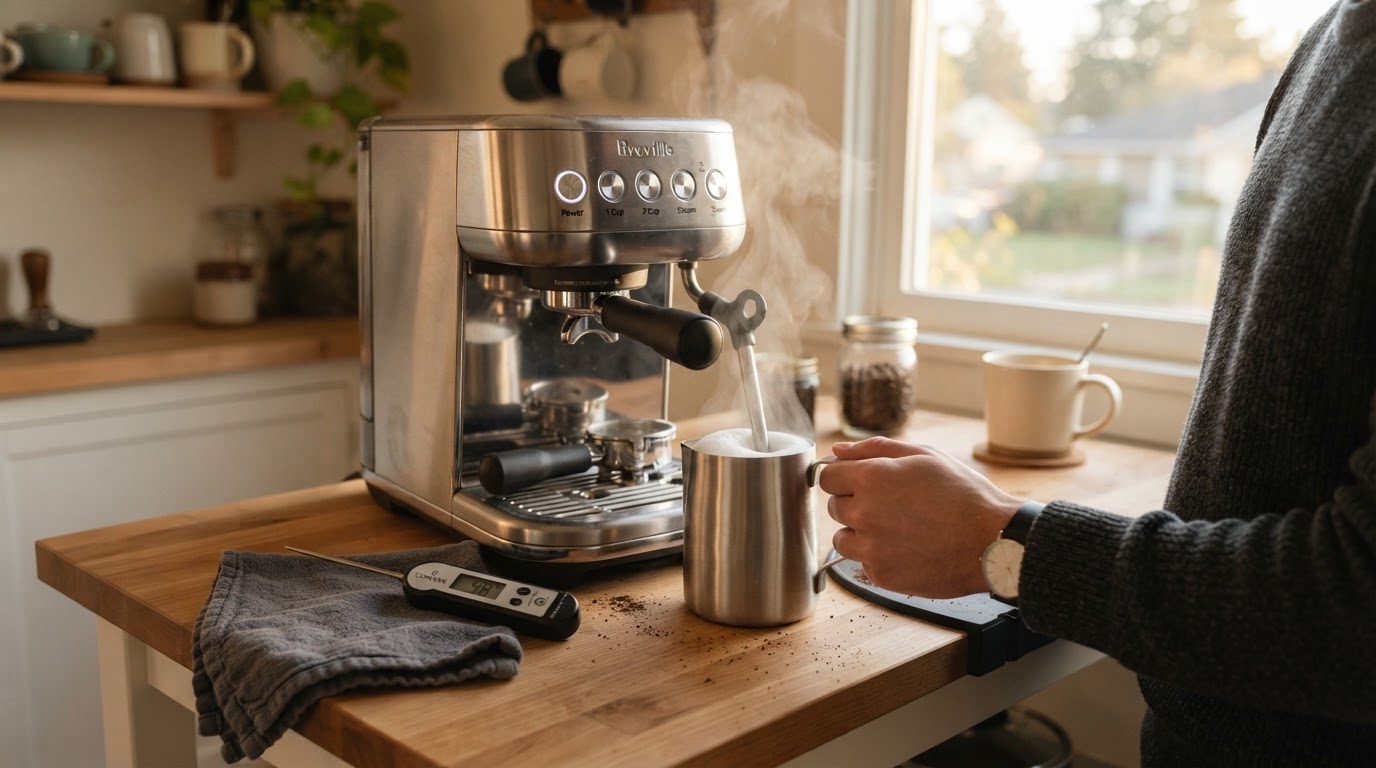
A manual steam wand is a skill. You purge, angle the pitcher, watch the texture, stop at the right moment, and wipe immediately. An automatic milk system replaces that with an attachment and a rinse cycle. Ask yourself which version of that task you will actually perform at 6:45 in the morning, because a milk system you find annoying is worse than a wand you have learned.
Cleaning and descaling burden
This is the criterion that most reviews skip and most owners complain about.
- Hands-on machines: daily flushing, drip tray rinsing, wand wiping, and a periodic deeper clean of the group and basket. Simple parts, visible grime.
- Automatic machines: a removable brew group to rinse, a milk circuit that needs a rinse after milk drinks, and descale prompts tied to water hardness or cycle counts.
Before buying, confirm four things: whether the brew group comes out for rinsing, whether the milk parts are dishwasher-safe, how often the machine asks for descaling, and whether it accepts a water filter. Those four answers predict your weekly effort better than any feature list.
Repairability and parts
Hands-on machines wear through cheap, findable consumables: group gaskets, shower screens, baskets, and portafilters. Automatic machines add a brew unit, O-rings, and milk carafe parts to the list. Either way, the practical question is local: can you buy the part, and is there a service center within reasonable distance? Check parts availability before you buy, not after something leaks.
Counter fit
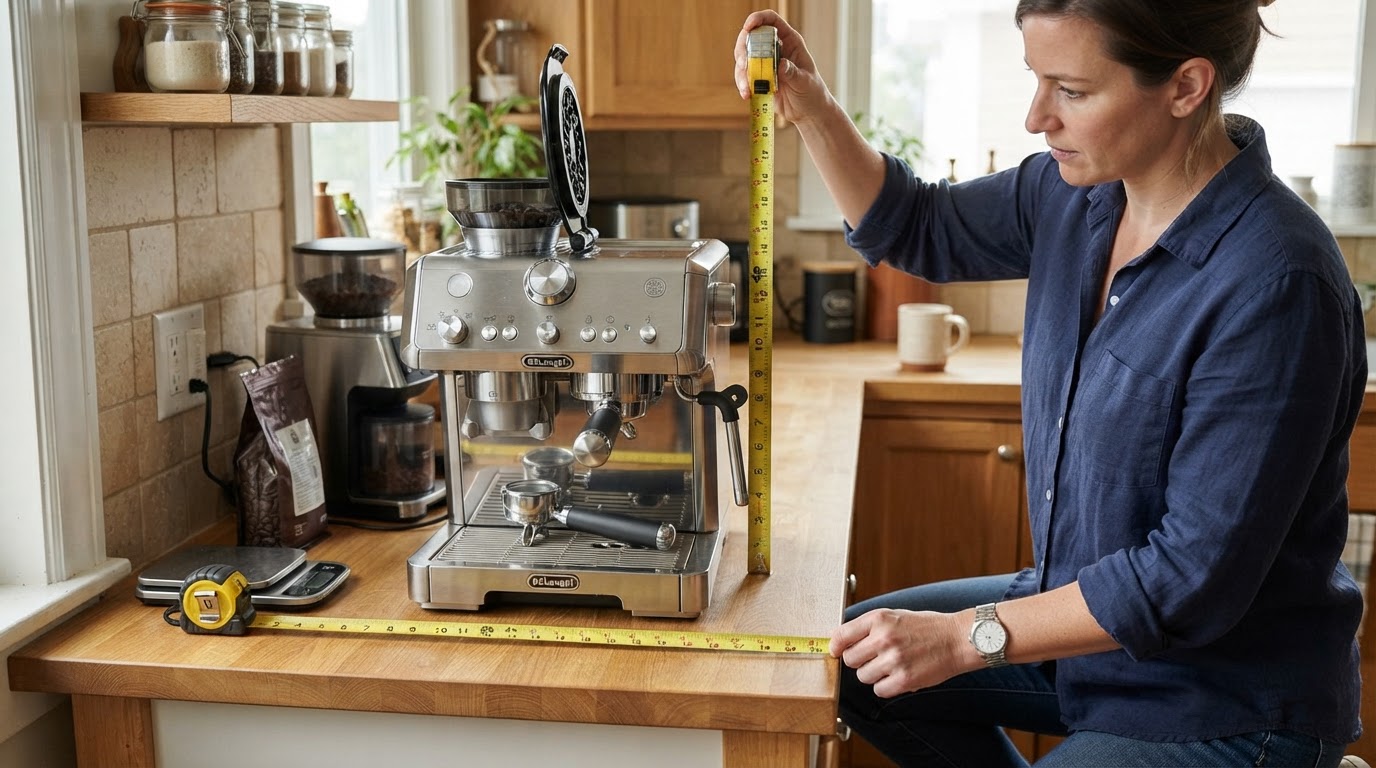
Measure three dimensions, not one: height with the hopper lid open, depth with the portafilter or carafe in place, and side clearance for the steam wand or milk attachment to swing. Add the weight of a full water tank and a full hopper. A machine that technically fits but leaves no room to work will annoy you daily.
Decision table
Criterion | Breville | De'Longhi |
|---|---|---|
Who does the work | You, with machine feedback | The machine, with your drink choice |
Grinder | Often built into the espresso workflow | Built into the bean-to-cup workflow |
Milk | Manual texturing on most models | Often automated on mid and upper tiers |
Espresso adjustability | High; many variables exposed | Moderate; a few important settings |
Cleaning style | Wipe, flush, deep-clean by hand | Rinse cycles plus a removable brew group |
Parts to expect | Gaskets, screens, baskets | Brew unit, O-rings, milk parts |
Typical buyer | Wants to learn and control the shot | Wants the drink with minimal steps |
Use the table to find the two rows you care about most, then let those two rows decide. Buying on a single row, usually price, is how people end up with a machine that fights their routine.
Choose this if...
Choose Breville if you want espresso to be a skill you practice, you are willing to buy or use a scale, and you would rather adjust a grind than accept a preset. It also suits households where one person makes most of the coffee and wants the machine to reflect their preferences.
Choose De'Longhi if your household drinks mostly milk-based drinks, several people use the machine, or you know that a manual routine will collapse on a busy weekday. Automatic milk and a drink menu are genuine conveniences, not compromises, when consistency matters more than exploration.
Choose neither if you mainly want convenience at the lowest cost per cup, in which case a pod machine is worth comparing, or if you already own a grinder you love and would rather pair it with a simpler machine than replace it.
A ten-minute self-check before you buy
- Write down every drink you made this week, with counts. The ratio of espresso to milk drinks usually settles the brand question on its own.
- Count the steps you will tolerate on your worst morning, not your best.
- Measure your counter height, depth, and clearance, then subtract space for a scale, a knock box, or a milk carafe.
- Decide who cleans the machine, and whether that person accepts the cleaning style each brand requires.
- Look up whether service and spare parts are reachable where you live.
- Confirm the current model list, the included accessories, and the return window with the retailer, since bundles and names change.
Questions shoppers ask before deciding
Do I need a separate grinder?
Only if you want to upgrade the grinder independently later. An integrated grinder saves counter space and one purchase; a separate grinder lets you change grind quality without changing machines.
Is automatic milk worth it?
It is worth it if you make milk drinks daily and dislike washing a pitcher, and less worth it if you mostly drink espresso or enjoy texturing milk yourself. Confirm how the milk parts are cleaned before you decide.
Which brand is easier to live with?
The one whose routine matches your mornings. A hands-on machine with a routine you enjoy is easier than an automatic you resent cleaning, and the reverse is equally true.
What should I verify in the listing?
Whether the model is semi-automatic or bean-to-cup, what comes in the box, the descale and filter requirements, the warranty length, and whether the brew group or milk parts are user-removable. Where a spec is missing, treat it as unknown rather than assuming the best case.