Dilution Ratio and Brew Ratio Measure Different Things
The brew ratio sets how much water the coffee grounds steep in. The dilution ratio sets how much liquid you add to the strained concentrate before drinking. Counter Culture's guide, for example, brews at 1:8 coffee to water by weight and treats dilution as a separate final step. Brew-ratio guidance for other methods, such as a French press coffee ratio, is a dose-to-water instruction for grounds and does not transfer to a concentrate.
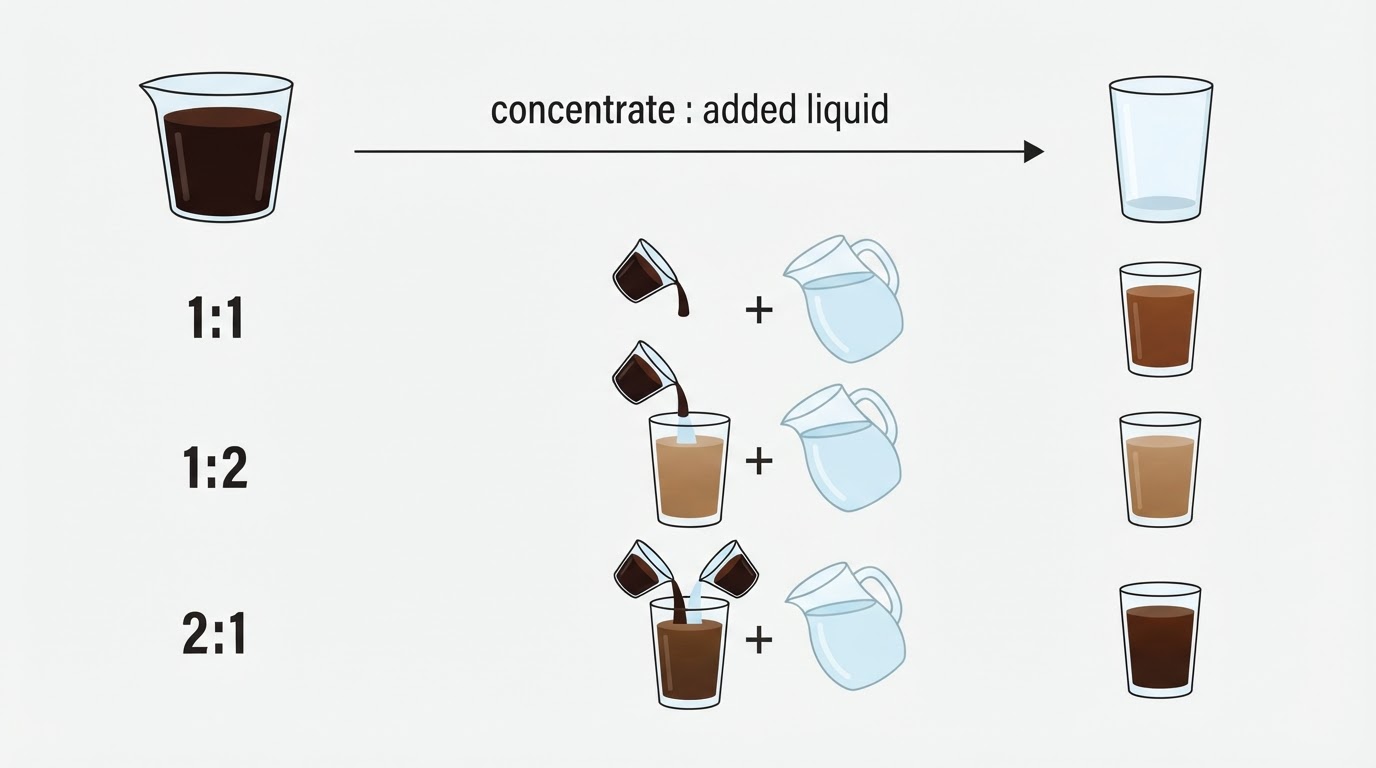
Write the dilution ratio the same way every time: concentrate first, then the liquid you add. In 1:2 the first number is concentrate, so 2:1 from the same bottle is a much stronger drink. A ratio copied without its direction is the usual reason a cup comes out far stronger or weaker than expected.
What 1:1 and 1:2 Mean in the Glass
At 1:1 you add as much liquid as concentrate: 100 mL of concentrate plus 100 mL of water gives 200 mL of drink. At 1:2 the concentrate is one part and the added liquid is two parts: 100 mL of concentrate plus 200 mL of water gives 300 mL.
The step between them is smaller than the numbers suggest. Concentrate makes up half of a 1:1 drink but one third of a 1:2 drink. At 1:3 it is one quarter of the glass.
Concentrate | 1:1 total | 1:2 total | 1:3 total |
|---|---|---|---|
60 mL | 120 mL | 180 mL | 240 mL |
120 mL | 240 mL | 360 mL | 480 mL |
240 mL | 480 mL | 720 mL | 960 mL |
480 mL | 960 mL | 1,440 mL | 1,920 mL |
These totals assume the two volumes simply add up, and they are measured before any ice melts. Combining liquids is a close practical approximation rather than an exact sum, which is fine for a drink you can taste as you pour.
Scale Any Batch With One Formula
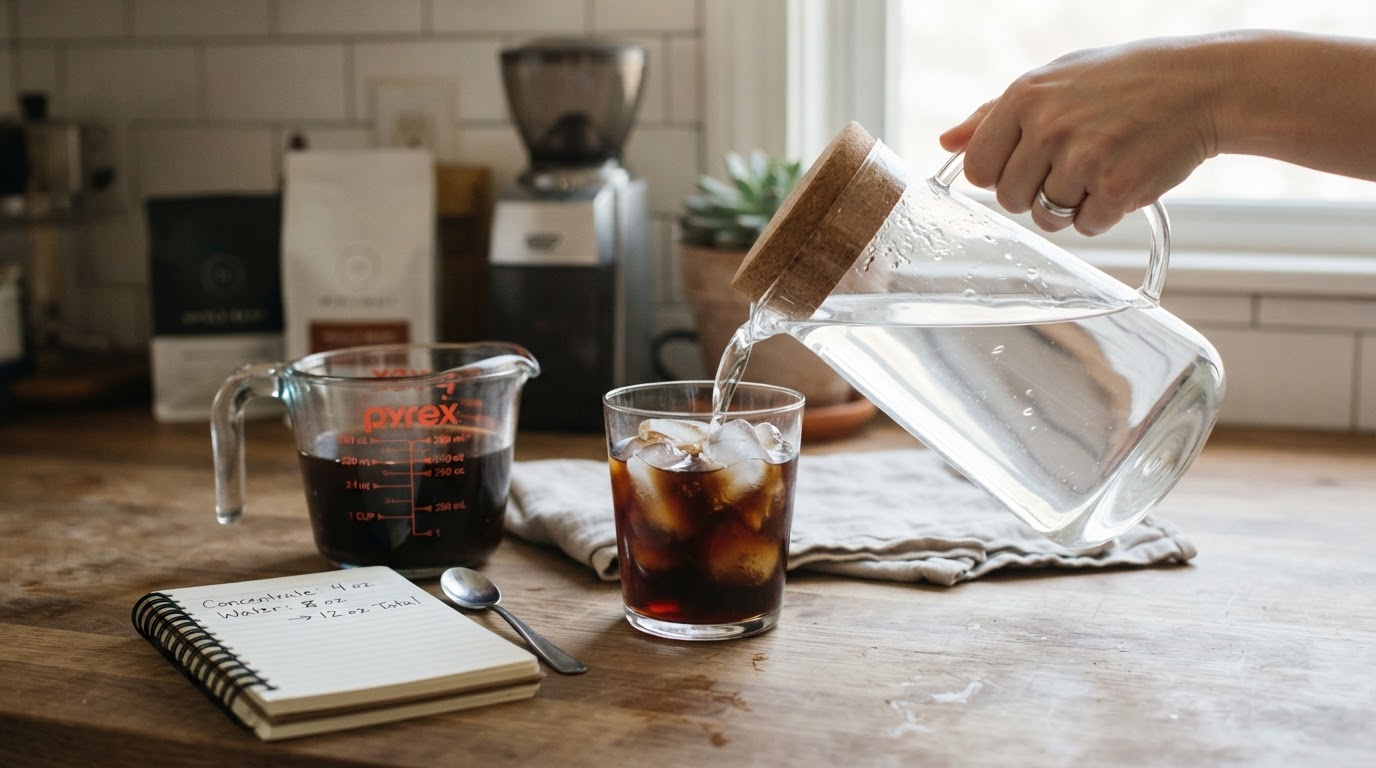
For a target total volume V and a ratio of 1:n, the concentrate you need is V ÷ (1 + n), and the added liquid is n × V ÷ (1 + n). A 300 mL serving at 1:2 therefore takes 100 mL of concentrate and 200 mL of water. A 900 mL pitcher at 1:3 takes 225 mL of concentrate and 675 mL of water, and a 250 mL cup at 1:1 takes 125 mL of each.
Fix the total first, because that is the number you can check at the end. Measure the concentrate, then add the liquid, and keep both amounts written down if you plan to repeat the cup.
Why the Two Recommendations Differ
Counter Culture's guide brews at 1:8 coffee to brew water, about 125 g of coffee per liter, and also describes a 1:11 brew that it drinks without dilution. Toddy's serving instruction of 1 part concentrate to 2 parts water or milk is written for the concentrate its own brewing method produces. The concentrate is the variable: a recipe that leaves more coffee solids in the strained liquid needs more added liquid to reach the same drinking strength, so published dilutions differ along with the brews behind them.
Dilution only ranks strength when the starting concentrate is identical. A 1:2 dilution of one brand's concentrate and a 1:2 dilution of another's are not comparable drinks, and a smaller number on one bottle does not make that drink milder than a larger number on another. Compare within one concentrate, where 1:1 always tastes stronger than 1:2.
Water, Milk, Ice, and Hot Water
Water and milk occupy the same place in the formula, so a 1:2 drink can be one part concentrate and two parts milk instead of water. The volumes stay the same while flavor and body change, and a milk drink is usually judged by taste rather than by matching a water-based number.
Ice belongs to the added-liquid side once it melts, so a glass packed with ice finishes weaker than the same volumes poured without it. Either count the ice you expect to melt as part of the added liquid, or mix slightly less water and pour over fresh ice. For a hot drink, heat the water rather than the concentrate.
A ratio changes concentration, not the total caffeine in the concentrate you poured. Converting a dilution into milligrams of caffeine needs the concentrate's measured caffeine content; the ratio alone cannot supply that number.
When There Is No Recommendation
A bottle with no dilution guidance, or a concentrate of unknown strength, has no published ratio that is validated for it. Mix a small measured sample, write down both volumes, taste, and add more liquid in measured steps until it suits you. Those recorded numbers then define the ratio for that batch. A recipe from the maker who produced the concentrate is a better starting point than a number borrowed from a different one.