An Office Machine Is a Different Problem
A home brewer fails quietly. An office brewer fails in public. At home, a slow shot costs you a minute; at 9:30 in a workplace, the same minute becomes a queue, and a queue is how a serviceable machine earns a reputation for being unreliable. Home equipment is also usually bought by the person who cleans it, while office equipment is bought by someone who may never descale it.
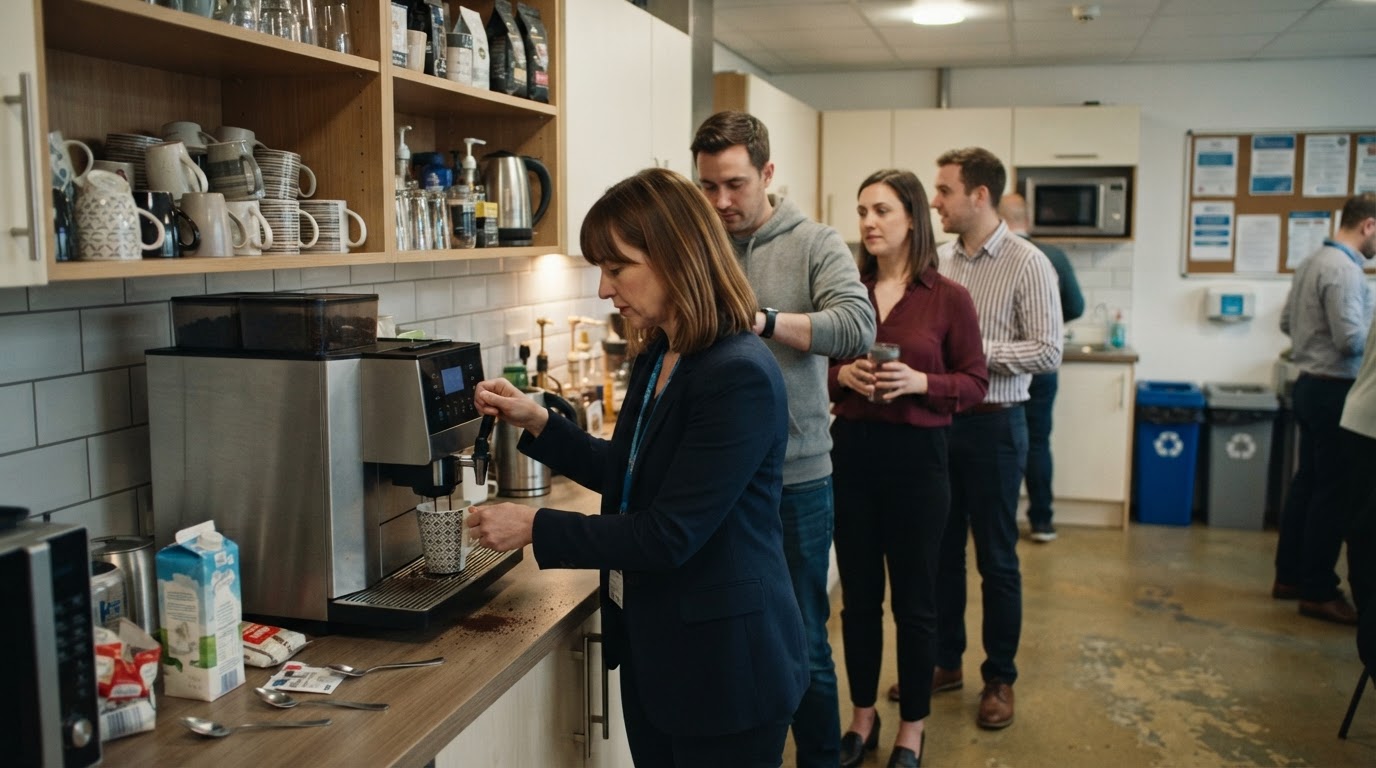
That split, where the buyer, the users, and the person doing the cleaning are three different people, is why a home-buying feature comparison does not transfer cleanly to a shared kitchen. Before you compare categories, write down three figures about your own workplace.
Cups per day. Total drinks, not drinks per person, and not the number you hope people will drink. Count hot-water and tea users too, because they draw from the same tank without drinking coffee.
Peak-hour throughput. The drinks requested in your busiest window, which is almost always the first hour of the working day and often again after lunch. Daily volume sets capacity; peak volume decides whether people stand in a line.
Drink range. How many people want espresso-based drinks, how many want filter-style coffee, and how many want a large drink they can carry to a desk. A team of espresso drinkers and a team split between lattes and filter coffee are two different purchases.
Those three figures are what every category below is actually competing on.
The Nine Criteria That Decide an Office Machine
Use one set of criteria for every category. Otherwise the comparison collapses into whichever machine has the longest feature list, which is rarely the one that survives a shared kitchen.
Criterion | What it decides | What to check before you commit |
|---|---|---|
Cups per day | Whether the machine runs near its limit every morning | The maker's stated daily capacity against your own figure, with margin you are willing to trust |
Peak-hour throughput | Whether your team queues or walks away | Stated hourly capacity and cycle expectations, judged on your busiest drink |
Drink range | Whether most of the team can get their drink without a second machine | Recipe list, milk handling, hot-water function, cup clearance |
Water supply and refills | Who lifts a tank, how often, and from which sink | Tank volume against your peak-hour demand, and the walking distance to a tap |
Plumbing and drainage | Whether water becomes invisible infrastructure or a daily chore | Whether a plumbed kit and a drain line are realistic in your kitchen |
Cleaning and descaling | Whether the machine is maintained by a named person or by goodwill | Which cleaning cycles are mandatory, which parts come out, what the routine involves |
Service and warranty | How many days of downtime a single fault costs you | Local service access, response commitments, what the warranty excludes |
Noise | Whether the machine can sit near desks or needs a room of its own | Grinder and pump noise, listened to in the actual space |
Cost per cup over a year | Which option is genuinely cheaper to own rather than to buy | Machine, installation, coffee, water treatment, cleaning supplies, service, downtime |
Two of those rows decide more outcomes than the rest: water supply and cleaning ownership. They are the two criteria that cannot be fixed later with a better machine, because they are really questions about your kitchen and your team.
The Five Solution Directions, Compared
Every office purchase is one of five bets, and each bet trades one kind of friction for another. The useful comparison is not which machine makes the better cup, since most do, but which failure mode your workplace can live with.
Batch drip or thermal brewer
Coffee is brewed in volume into a carafe or an insulated airpot, so the service step is pouring rather than brewing. That is why batch brewing handles a morning rush better than anything that makes drinks one at a time. The trade is freshness and waste: coffee sitting in a pot goes stale, and a batch brewed for a full room is wasted when half the team is out.
Best for workplaces with a predictable morning spike, a majority of filter-coffee drinkers, and someone willing to brew the second batch.
Pod or capsule system
Capsules remove the grinder, the dosing, and most of the training. Anyone can make an acceptable drink on the first attempt, choice is per person rather than per team, and nothing sits in a pot going stale. The trade-offs sit on the other side of the ledger: the input cost per cup is locked to capsule pricing, the drink menu is limited to what the capsule range covers, capsule waste accumulates visibly in a shared kitchen, and the machine still needs water refills and descaling even though it appears maintenance-free.
Best for small teams with widely different drink preferences, offices without a dedicated kitchen owner, and spaces where training people is the real bottleneck.
Bean-to-cup super-automatic
The machine grinds, doses, and brews per drink, usually with a milk system attached. It comes closest to a café menu without a trained operator: espresso, long coffee, and milk drinks from one footprint. The friction moves into maintenance and service. Milk systems need cleaning on a schedule that a busy office finds easy to skip, brew groups and internal paths collect residue, and more mechanism means more to service. Bean supply, hopper refills, and water filtration become recurring jobs.
Best for teams with mixed preferences where nobody wants to be a barista, and where a named person owns the cleaning routine.
Semi-automatic espresso machine with a separate grinder
This is the highest-ceiling direction and the most dependent on people. A semi-automatic hands the operator control over dose, grind, and extraction, and a separate grinder adds the ability to change beans and drink style. It also puts a human into every drink: grinding, tamping, pulling, steaming milk, knocking out the puck. At peak hour that human is the bottleneck, and when the only willing operator is away, the machine becomes furniture.
Best for small teams where most people drink espresso, someone honestly enjoys the workflow, and speed at peak is not the binding constraint.
Rental or service contract
Rather than buying a machine, you contract for one with maintenance included. The appeal is a predictable operating cost and someone else owning the fault: when the machine goes down, a service visit is the vendor's problem rather than yours. The cost is flexibility. Contract length, per-drink agreements, restrictions on which coffee you may use, and exit conditions matter more than the machine on the counter, so read the termination clause before the brochure.
Best for workplaces that want no capital purchase, no in-house technician, and an agreed service response instead of a phone tree.
A Team-Size Worksheet You Can Fill In
This worksheet converts the three demand figures into a machine decision. It deliberately contains no capacity numbers, because stated capacity varies by model and by drink size, and the number on a spec sheet is not the number your team will experience.
- Daily drinkers (N). Count the people who will actually use the machine, not the headcount on the org chart.
- Drinks per drinker per day (D). Ask rather than assume. The honest answer is usually lower than the buyer expects.
- Daily cups. N multiplied by D.
- Peak share (P). The fraction of daily cups requested in your busiest hour. Observe it for a week instead of estimating it.
- Peak-hour cups. Daily cups multiplied by P. This is the number the machine has to survive without a queue forming.
- Margin. Compare peak-hour cups with the maker's stated capacity and decide how much headroom you want for visitors, meetings, and growth. Capacity you never use is capacity you paid for.
- Refill math. Peak-hour cups multiplied by your typical cup size tells you how much water moves in that hour. If it exceeds the tank volume, someone is refilling mid-rush, and that someone needs a name.
- Growth line. Headcount changes more often than machines do, so check that the next size up is not a jump into a category you cannot clean.
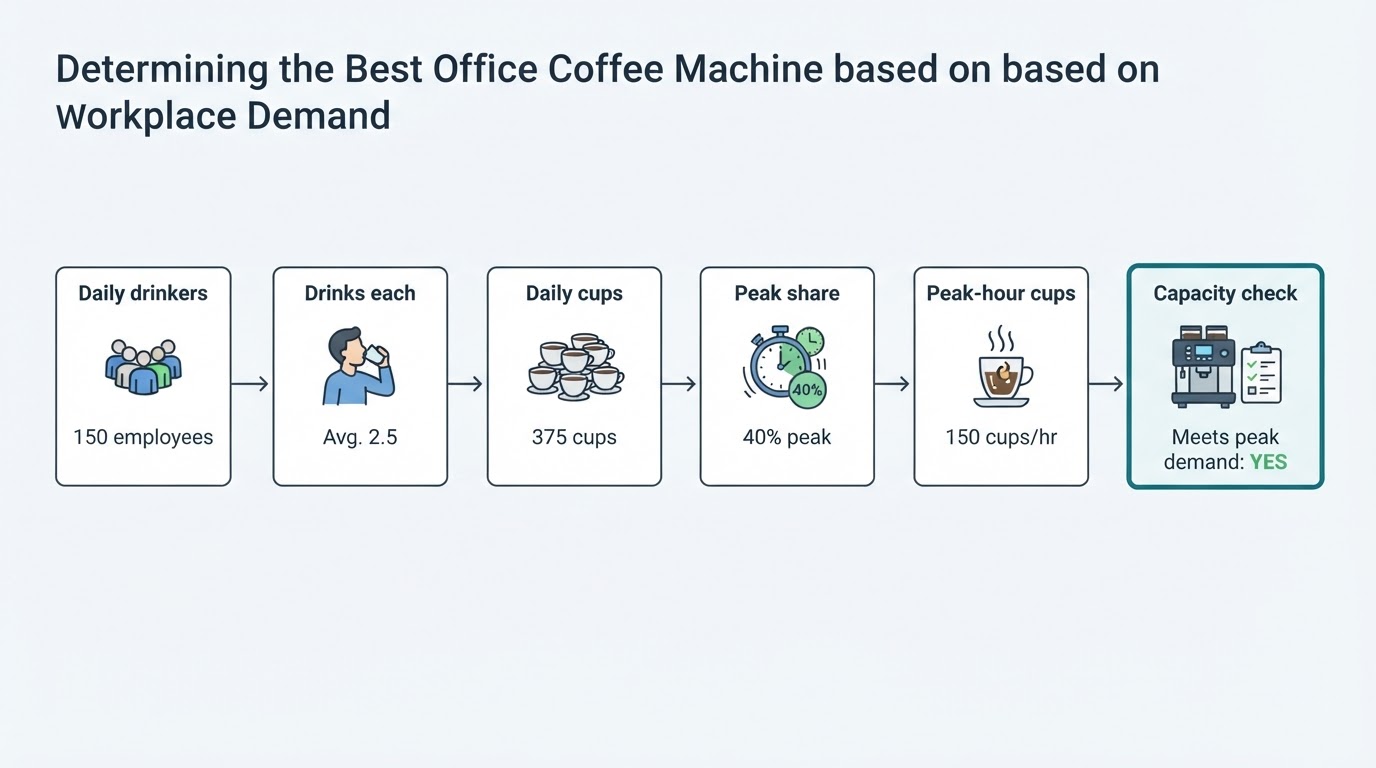
If your peak-hour figure lands far below the capacity of the category you are considering, you are buying insurance rather than throughput. That can be a legitimate choice, as long as you know that is what you are paying for.
Who Cleans It, and How Often
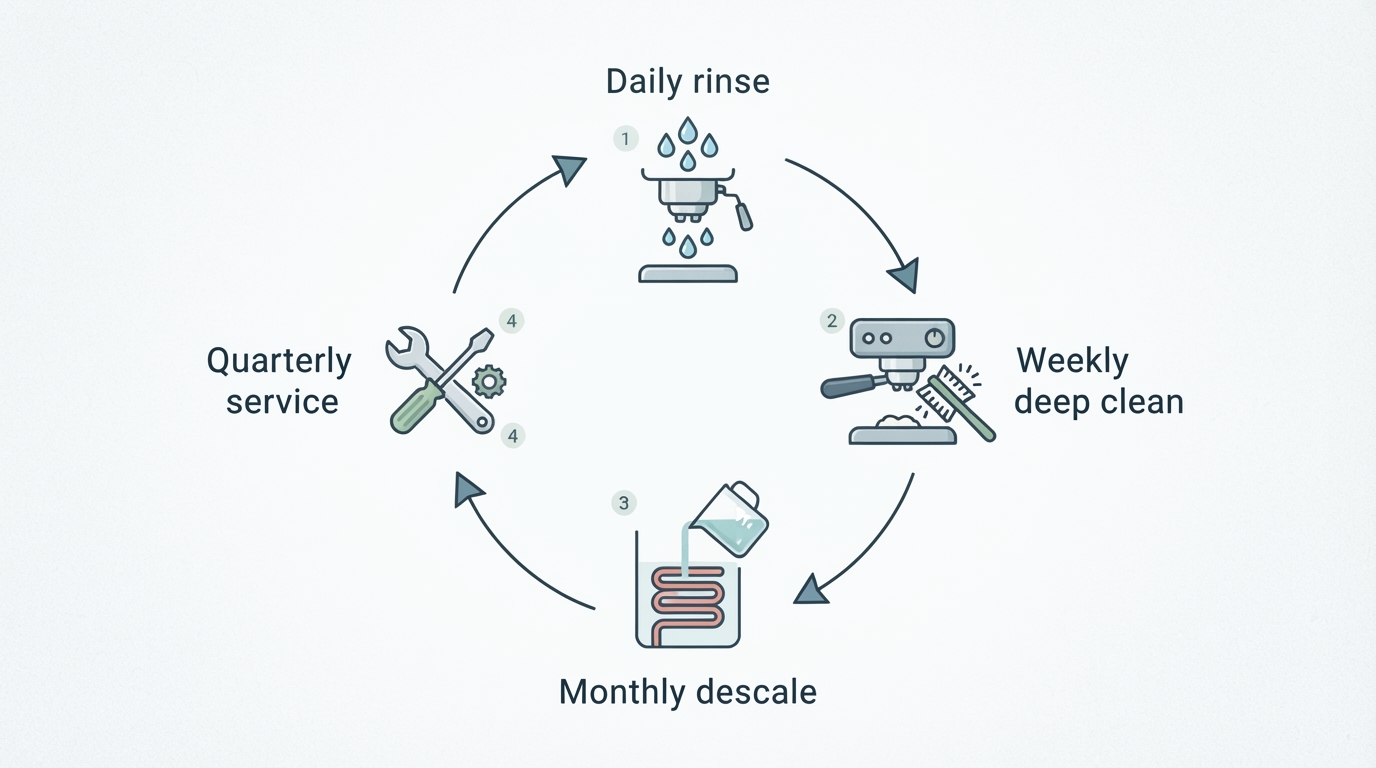
Maintenance is the criterion that decides whether the machine is still good in eighteen months. Write the routine down before the purchase, because it is much harder to invent afterwards.
Frequency | Task | Owner | What degrades if it slips |
|---|---|---|---|
Daily | Empty grounds or pods, rinse the brew path, wipe the steam wand or flush the milk circuit, refill water | Whoever closes the kitchen | Residue, smell, off flavours in the first cup of the next day |
Weekly | Remove and rinse the brew group where the design allows it, deep clean drip tray and milk parts, check filter status | Named office owner | Milk residue and mould, clogged paths |
Monthly | Run the manufacturer's descaling program when the machine prompts it, replace the water filter, lubricate seals where the manual specifies | Named office owner or assigned rota | Scale damage, which is the expensive kind |
Quarterly to yearly | Service inspection, wear-part replacement, consumables stock review | Office owner with the vendor | Unplanned downtime at the worst moment |
Descaling intervals depend on your water hardness and on the machine's own instructions, so follow the prompt rather than a rule of thumb borrowed from someone else's office. Two habits make the whole table survivable: name a primary owner and one backup, so the routine does not die when a single person changes jobs, and put cleaning supplies and filters on a recurring order so a skipped delivery does not become a skipped descale.
Cost Per Cup Without Guessing
The only fair comparison is annual cost divided by annual cups, and showroom comparisons usually omit two of the inputs: consumables beyond coffee, and the labour of maintenance. Build the number from the same line items for every direction:
- Machine cost, amortized across the service life you realistically expect
- Installation, including any plumbing or drainage work
- Coffee, capsules, or beans per cup, at the strength your team actually uses
- Milk and any syrups or powders
- Water filtration and descaling supplies
- Cleaning chemicals and replacement parts
- Service visits, contracts, and expected downtime
Then ask for two things in writing before you sign. First, who services the machine locally and what a response commitment means in practice. Second, what the warranty excludes, with scale damage and consumable wear as the specific questions to raise, and whether a shared-office workload stays inside the warranty's intended use. Rental agreements deserve the same scrutiny as purchases, since the machine is easy to like and the contract is the part that binds you.
FAQ
Is one machine enough for a 20-person office?
Headcount alone does not answer it. Run the worksheet: the question is whether your peak-hour cups fit comfortably inside one machine's capacity with the margin you want. If the peak is the problem and counter space allows, two smaller machines can serve people faster than one large machine, and they also give you a fallback when one is being descaled.
Can a home-grade machine survive office volume?
A home machine is designed around a household's daily cycle, and in a shared kitchen it runs far more cycles while being cleaned by people who did not buy it. If your figures are genuinely office-scale, choose a machine sold for shared or commercial use, and check whether the warranty still applies to that workload.
Is plumbing worth it?
Plumbing removes the refill job and the risk of running dry mid-rush, at the price of installation work and a fixed location. If your peak-hour water demand exceeds what a tank holds, plumbing usually solves the smaller of your two problems.
What breaks first?
The parts that fail first are typically the ones the routine skips: brew groups, milk paths, and anything scale can reach. That makes most early failures a maintenance story rather than a manufacturing story, which is also why the question of who cleans the machine belongs in the buying decision.
Should we keep a backup?
If coffee is load-bearing for the office, plan for at least a stopgap: a kettle and a small batch brewer, a spare airpot, or a service contract whose response commitment you have actually read. A backup is cheaper as a plan than as an emergency.
Putting the Order of Decisions Together
Work through the purchase in this sequence, and the category usually picks itself.
- Fix the three demand figures and the peak-hour number from the worksheet.
- Score the five directions against the nine criteria, marking the rows that are hard constraints in your building: water, drainage, footprint, noise, service access.
- Eliminate anything that fails a hard constraint before you compare quality.
- Compare annual cost per cup for the survivors, including consumables and maintenance labour.
- Name the owner and the routine, then buy cleaning supplies and filters before the machine arrives.
- Put service access and warranty exclusions in writing as part of the purchase.
What that produces in practice is a short verdict list rather than a single winner. A predictable morning spike with a filter-coffee majority points to batch brewing. Mixed preferences with no volunteer barista point to pods at low volume and a bean-to-cup machine once the peak justifies it. A small team of espresso drinkers with a willing operator points to a semi-automatic and a separate grinder. A workplace with no capital budget and no technician points to a rental with written response terms. The best office coffee machine, in other words, is the one whose maintenance your team will actually perform.