A Pen and a Refractometer Report Different Things
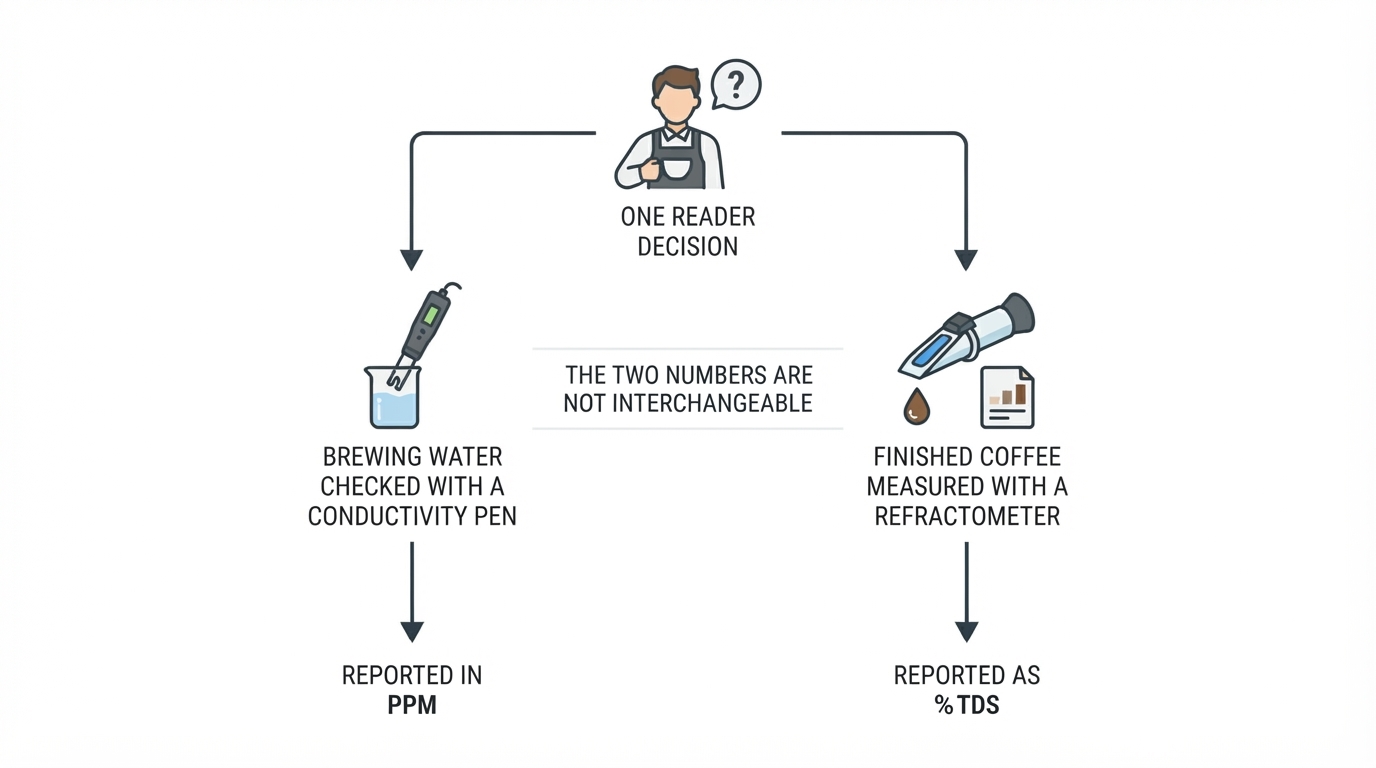
Hanna Instruments makes both types, and its explanation of coffee TDS puts the dividing line at the sensor: conductivity meters determine total dissolved solids in water, while refractometers are preferred for finished coffee (Hanna Instruments, "The Role of TDS in Coffee & the Science Around your Brew").
A conductivity pen measures how well the liquid conducts electricity, then uses a conversion factor to estimate TDS. It does not count ions or independently weigh all dissolved mass.
The same Hanna article names what a conductivity reading misses: poorly conductive and nonionic dissolved solids, such as soluble carbohydrates. That gap matters in coffee, where much of the dissolved material is not ionic. A pen dipped in brewed coffee returns a number, but it is an EC-derived estimate built around mineral salts rather than a complete measure of dissolved coffee solids.
A water TDS reading does not identify individual minerals. Third Wave Water describes its TDS meter as a source-water check and explicitly notes that it cannot tell which minerals are present.
A pen can still be used on brewed coffee, with a narrower claim. Hanna's separate case write-up describes a café measuring brewed coffee with an EC/TDS meter across several sessions to keep strength consistent, using one wide-range meter for both its water and its coffee; the same article notes that many coffee components are non-conductive and therefore unaccounted for. Read that way, an EC reading is a relative signal on one setup over time, not a complete coffee %TDS figure (Hanna Instruments, "The Role of Total Dissolved Solids in Coffee").
Water chemistry is a separate question from coffee concentration. If you are changing the water rather than the coffee, hardness and alkalinity are the numbers to check, and the guide to coffee water hardness vs alkalinity covers what each one measures.
What a Coffee Refractometer Reads
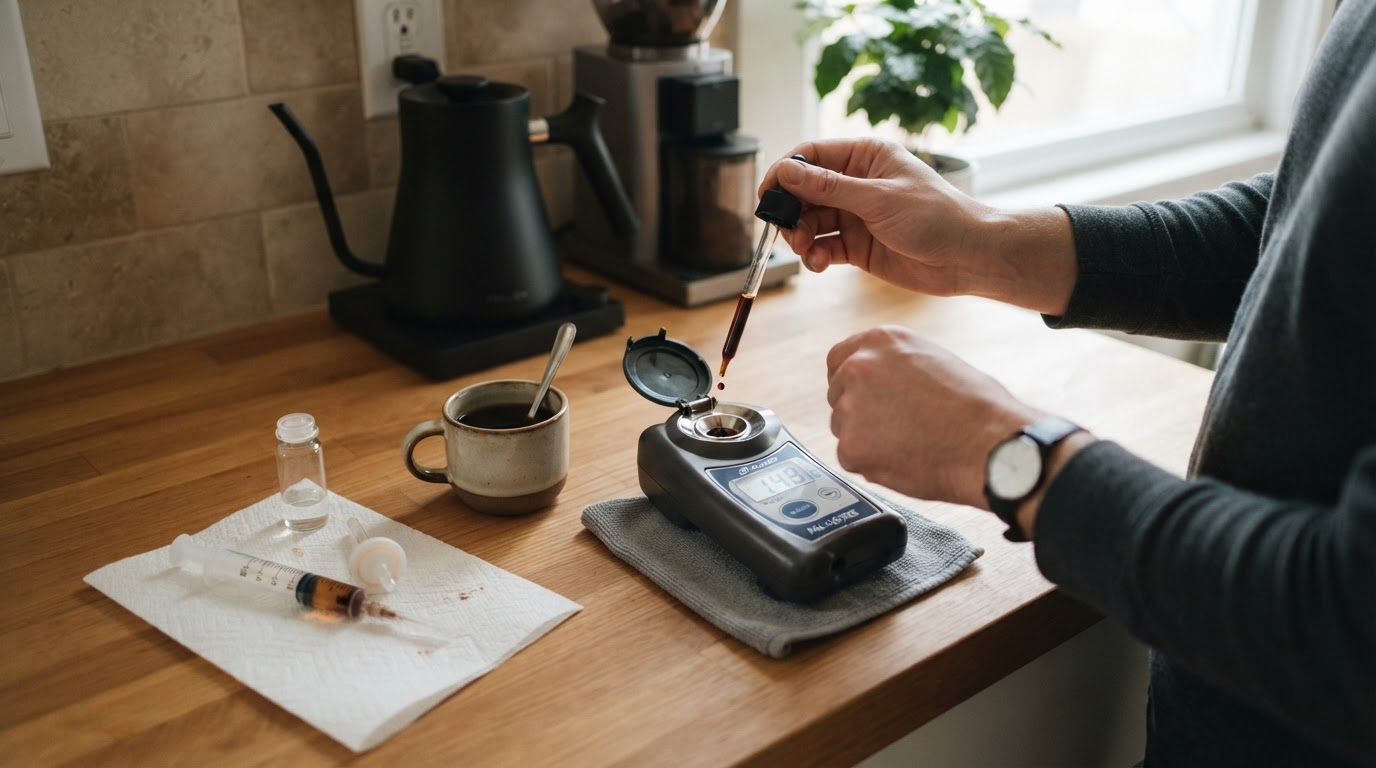
A refractometer measures how light bends as it enters the sample, then converts that refractive index into a concentration. Both ionic and nonionic particles change the refractive index, which is why the instrument suits finished coffee.
Check the output scale as well as the product name. ATAGO's PAL-COFFEE line is sold in Brix, %TDS and combined BX/TDS versions, so the version you buy fixes what the screen displays. If the number you want to record is coffee %TDS, the TDS-scale version reports it without a conversion step. For a Brix-only instrument, use a conversion supported by that instrument's manufacturer rather than treating its number as coffee %TDS.
Choose by the Job, Not the Label
What you are checking | Instrument | What the number is | Where it stops |
|---|---|---|---|
Brewing water before you brew | Conductivity-based TDS pen | ppm (mg/L) estimated from electrical conductivity, mostly mineral salts | An estimate, not a complete measure of coffee solids; the reading does not identify which minerals are present |
Finished coffee concentration | Coffee-calibrated refractometer | %TDS from refractive index, including ionic and nonionic dissolved material | Concentration only; extraction yield also needs beverage mass and dose |
Batch-to-batch change in one coffee | Either instrument, used the same way each time | Relative movement between samples | A pen and a refractometer are not interchangeable |
If your filtered tap water is stable, the pen is a check you run when the supply or the filter changes. If you are adjusting grind, ratio or dose and want to know whether the cup actually got stronger, the refractometer answers that question. The unit on the display is not what separates the instruments; both report a TDS figure. The sensing principle and the calibration behind the number are what make a reading from one instrument unfit for the other job.
Read Range, Resolution and Accuracy Separately
Three numbers on a spec sheet get treated as one, and they answer different questions.
Range is the span the instrument covers. Coffee refractometers can share %TDS units and still have different ranges: ATAGO lists PAL-COFFEE (TDS), Cat.No.4532, at 0.00–22.00% TDS, and VST posts 0.00–20.00% for its coffee refractometer (ATAGO DIRECT; VST coffee refractometer specifications). Check that your usual reading sits inside the listed range rather than at its endpoint.
Resolution is the smallest step the display shows. Both of those posted specifications list 0.01%, so the screen can report 1.38% rather than 1.4%. Resolution describes the display, not the reliability of the number behind it.
Accuracy is the separate claim about how close the reading sits to the true value, and manufacturers state it in their own terms. ATAGO lists ±0.15% for Cat.No.4532. VST's posted specification lists ±0.03% from 0.00% to 4.99% and ±0.05% from 5.00% to 20.00%. These are manufacturer figures, not independent measurements of a particular unit, and they show that a 0.01% display step does not translate into the same stated margin on both instruments.
Take the Sample the Instrument Expects
Fellow's guide to coffee TDS describes the sequence its own workflow uses (Fellow, "The Beginner's Guide To Total Dissolved Solids And Coffee"). Zeroing, sample temperature and volume, filtration, a lid, waiting time and cleaning method vary by model, so the manual that ships with your refractometer decides those details:
- Zero the instrument with distilled water, then wipe the prism.
- Stir the brewed coffee so the sample is uniform before you draw any.
- Bring the sample to the temperature your instrument requires; hot coffee may need to cool first.
- Filter the sample where your instrument's instructions call for it. Fellow's workflow does this for metal-filtered coffee and espresso, to remove suspended solids.
- Apply the sample volume, cover it if the instrument has a lid, and take the reading.
- Take the reading again to confirm the sample was prepared consistently, then clean the prism as directed.
What %TDS Does Not Tell You
%TDS describes concentration — the dissolved coffee material as a share of the beverage. Extraction yield describes something else: how much of the dry dose ended up in the cup, which needs the beverage mass and the dose as well as the reading. As an arithmetic illustration rather than a measured result, if 300 g of brewed coffee reads 1.40% TDS it holds about 4.2 g of dissolved solids; divide that by a 20 g dose and the apparent extraction is roughly 21%.
A %TDS figure does not identify caffeine content, it does not say which minerals came from the water, and it does not predict flavor.