What Hardness and Alkalinity Each Describe
Hardness is the amount of dissolved calcium and magnesium in the water, and those are the minerals that can form scale when water is heated. Alkalinity is not a mineral count. It is the water's buffering capacity: its ability to neutralize acids and keep pH fairly stable.
Barista Hustle's guide to remineralising water keeps the same separation, treating calcium and magnesium hardness as one variable and bicarbonate and carbonate buffering as another. pH is a third property. It describes where the water sits on the acid/base scale at the moment you measure it, not how much acid it can absorb.
Why Both Numbers Are Reported as CaCO3
A report might list hardness as 80 mg/L as CaCO3 and alkalinity as 40 mg/L as CaCO3. The shared unit does not make them the same measurement. Both are expressed as calcium carbonate equivalents because that convention gives one comparable number for two different tests. One counts divalent cations; the other counts acid-neutralizing capacity.
The two often rise together in limestone-influenced supplies, because dissolving carbonate minerals adds both. They can still move apart in treated water or in supplies shaped by different minerals.
The conversion is fixed: one German degree, written 1 °dGH or 1 °dKH, equals about 17.8 mg/L as CaCO3. A kit reading of 5 °dKH therefore represents roughly 89 mg/L as CaCO3, not 5 mg/L of bicarbonate. Do that conversion before comparing a kit result with a water report or a machine specification.
How to Read a GH/KH Test Kit
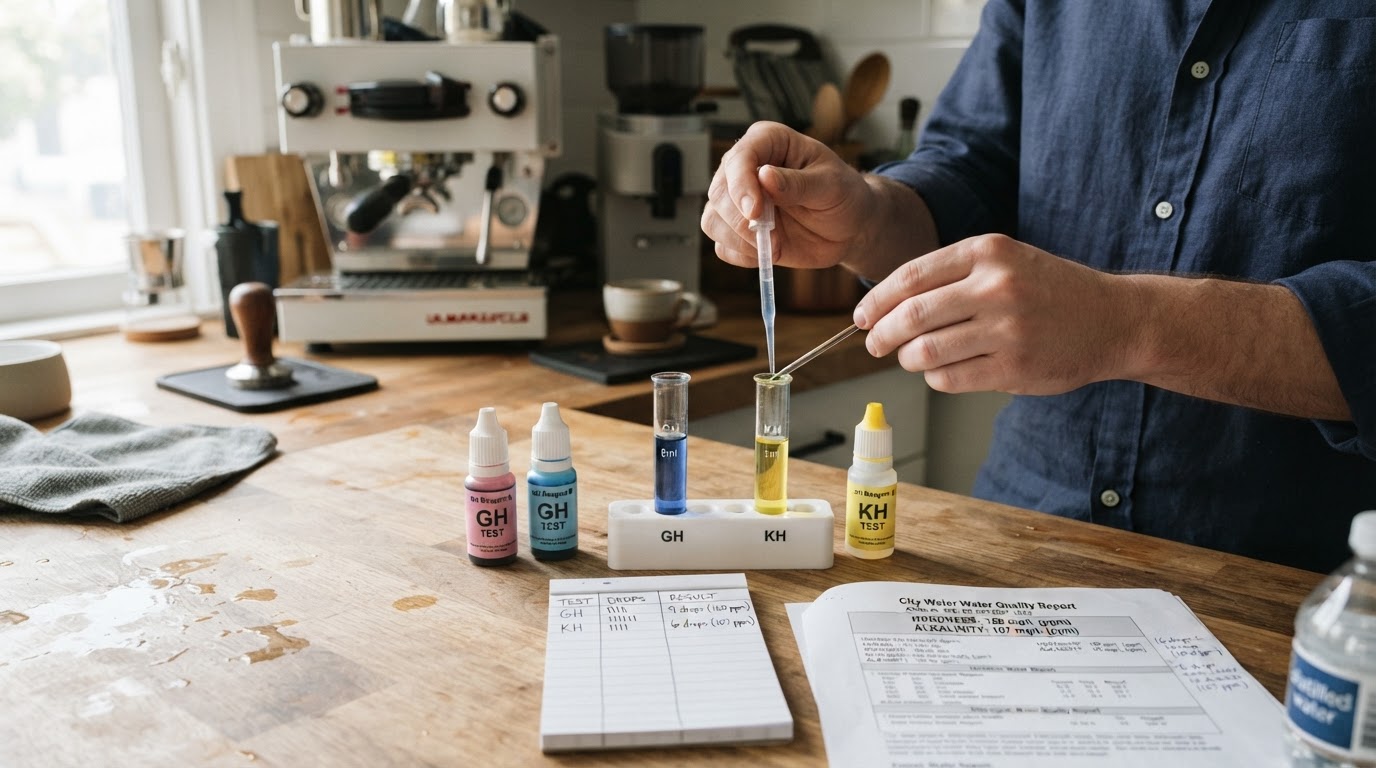
Aquarium-style GH/KH drop kits are common in coffee because they are inexpensive and readable at home. The labels are the first trap. GH means general hardness, the calcium and magnesium reading. KH means carbonate hardness, and it is the alkalinity measurement; the same kit may call it total alkalinity. Neither bottle measures pH.
Kits differ in sample volume, drop size, conversion per drop and endpoint color. Read the instructions that came with your kit and use its own units rather than carrying over a procedure from another brand. A kit that reports degrees and a kit that reports ppm as CaCO3 can describe the same water with very different-looking numbers, so write down the unit before you compare the result with anything.
Reading | What it counts | Unit you may see | What it does not tell you |
|---|---|---|---|
Hardness (GH) | Dissolved calcium and magnesium | °dGH, or ppm/mg/L as CaCO3 | Buffering capacity or pH |
Alkalinity (KH) | Acid-neutralizing bicarbonate and carbonate | °dKH, or ppm/mg/L as CaCO3 | Calcium or magnesium concentration |
pH | Current acid/base state | pH units | How much acid the water can absorb |
TDS | Total dissolved solids, estimated | ppm or mg/L | Which dissolved solids are present |
What a Handheld TDS Reading and a pH Reading Cannot Replace
A handheld TDS meter gives a quick estimate of total dissolved solids, usually derived from the water's electrical conductivity. It does not evaporate a sample and weigh the residue, and it cannot identify which minerals or salts are present. A reading can be built from sodium, chloride or sulfate as easily as from calcium and bicarbonate, so two waters with the same TDS number can have different hardness and different alkalinity. Two samples could both read 150 ppm while one carries most of that total as sodium chloride and the other as calcium bicarbonate.
A pH reading is even less of a substitute. pH tells you the current balance of acids and bases. Alkalinity tells you how much acid the water can absorb before pH moves. A sample can sit at a comfortable pH and still have very little buffering, which is why a pH reading cannot predict how the water will behave when coffee acids enter it. Keep TDS and pH as supplementary readings; they do not replace the two tests.
A Three-Question Check for Any Water Report
Use the same order every time, whether the numbers come from a municipal report or a kit.
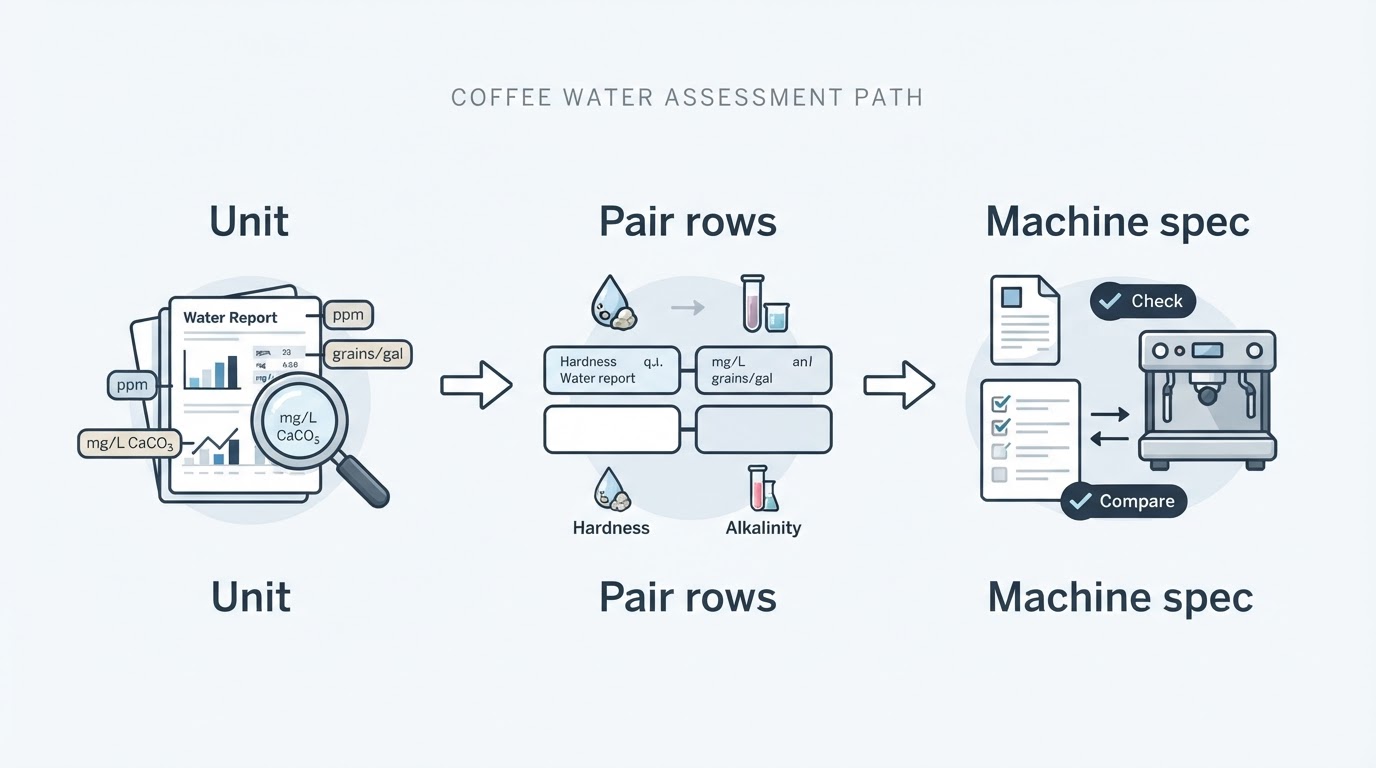
- Identify the unit. Is the value in mg/L or ppm as CaCO3, in German degrees, or in the ion's own concentration? Convert degrees to CaCO3 equivalents before comparing anything.
- Pair the rows. Find hardness and alkalinity separately. If the report gives only one hardness row, look for a separate alkalinity, bicarbonate or carbonate row rather than assuming the two match.
- Compare with the machine's specification. Use the water limit the manufacturer states, in the unit the manufacturer uses. Hardness alone does not decide scale risk: temperature, alkalinity, pH, how often the machine runs and the equipment's own design all matter.
An illustrative example: a report lists total hardness of 120 mg/L as CaCO3 and alkalinity of 60 mg/L as CaCO3. The two rows differ, so a single hardness figure would hide half the picture. That arithmetic does not tell you whether the water suits a particular espresso machine; only the machine's own specification can answer that.
How Water Hardness Affects Coffee, and What to Do Next
How water hardness affects coffee depends on the rest of the cup. Hardness supplies the calcium and magnesium that can scale a machine when the water is heated, while alkalinity is the number most often tied to how much of the coffee's acidity reaches the drink. High buffering can mute coffee acids and make a cup taste flat; very low buffering can leave it sharp. Roast level, grind, dose, water temperature and the coffee itself also move the result, so treat any taste prediction as a hypothesis to test with one small change.
Filter care is the practical next step. Follow the machine maker's water specification and the stated replacement interval for your filter; a model-specific schedule such as the Breville water filter replacement interval is a better guide than a general rule of thumb. A filter is not a universal mineral fix: its job is defined by its maker, and that definition is worth reading before you assume it targets the number you are worried about. If a report or kit shows a value outside the machine's range, use water that meets the specification rather than adding acids or alkalis by guesswork.
That caution matters most with espresso machines. Barista Hustle's guide warns against casually putting self-remineralised water into an espresso machine, because the machine's materials and sensors are not a test bench. Reading the two numbers correctly is the safe first step. Changing the water is a separate decision that should follow the equipment's specification.