The Short Answer: 1:15 by Weight
Brew ratios are written coffee-to-water, and the numbers only mean something when both sides are measured by weight. A 1:15 ratio means 1 gram of coffee for every 15 grams of water. Because 1 ml of water weighs essentially 1 g, you can read milliliters off a measuring jug and treat them as grams: 240 ml of water with 16 g of coffee is a 1:15 brew.
Most French press recipes sit slightly stronger than the Specialty Coffee Association's golden ratio of 1:16 to 1:18, a baseline written for filter brewing. Immersion is forgiving, and a 1:15 start keeps the cup from tasting thin. From there the ratio is a dial you can turn:
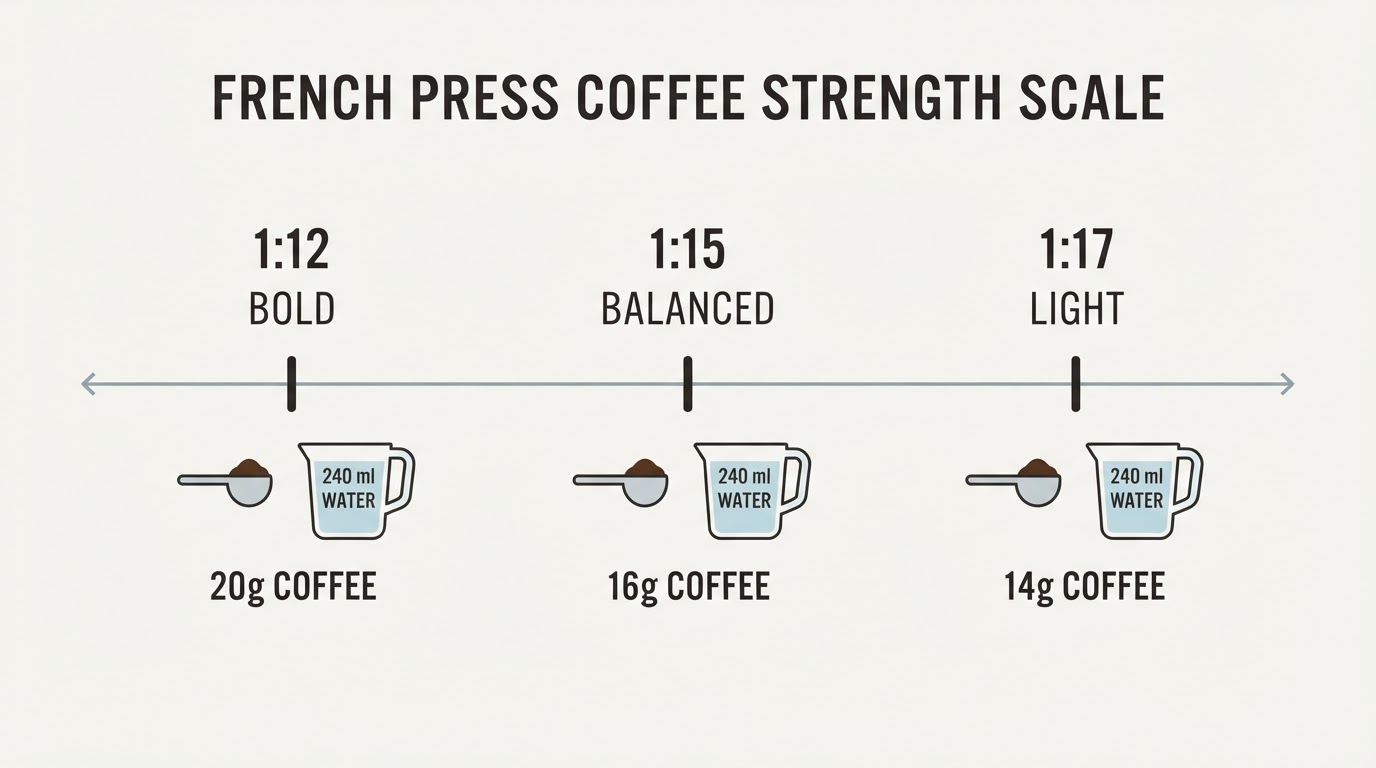
Ratio | What it tastes like | Coffee per 240 ml (8 oz) water |
|---|---|---|
1:12 | Bold, syrupy, heavy body | 20 g |
1:15 | Balanced starting point | 16 g |
1:16–1:18 | Lighter, tea-like, filter style | 13–15 g |
Two caveats before you commit. The ratio sets strength, not quality, so a 1:12 cup can still taste sour if the grind is wrong. And "cup" here means 8 fluid ounces, not the 12 oz mug in your cabinet.
Ratio Reference for 1, 2, 4 and More Cups
Scaling is simple once the ratio is fixed: multiply the coffee and the water by the same number, never just the coffee. The table below works at 1:15 and assumes a level tablespoon of coarse grounds weighs about 5 g.
Water | Coffee at 1:15 | Level tablespoons (about 5 g each) | Typical press |
|---|---|---|---|
240 ml (1 cup) | 16 g | 3 tbsp | 3-cup press |
480 ml (2 cups) | 32 g | 6 tbsp | 4-cup press |
720 ml (3 cups) | 48 g | 9–10 tbsp | 6-cup press |
950 ml (4 cups) | 63 g | 12–13 tbsp | 8-cup press |
1.4 L (6 cups) | 95 g | 19 tbsp | 12-cup press |
Tablespoons are a shortcut, not a standard. A level tablespoon of coarse grounds is roughly 5 g, but it can swing a gram either way depending on the grind and how you scoop, so weigh the first few brews, note what your own scoop holds, and then tablespoons are close enough for weekday mornings.
As a cross-check, CoffeeBrewsHub's Coffee to Water Ratio Chart lists French press doses of 22–23 g for a 3-cup press, 60–65 g for an 8-cup press and 90–100 g for a 12-cup press. Those numbers land in the same 1:15 to 1:17 band the arithmetic above produces for those press sizes. The chart covers seven brew methods at once and states the 1:16–1:18 golden range as its baseline.
Water the Grounds Keep
Wet grounds retain water, roughly 2 ml for every gram of coffee. That retention is why a full press never pours its full volume, and it is the detail most scaling advice leaves out.
Take the 950 ml batch: 63 g of coffee holds on to about 126 ml, so roughly 820 ml reaches the carafe. That is three generous mugs or four modest ones, not four full 240 ml cups. To pour four full cups, brew about 1.1 L of water with 73 g of coffee (73 × 15 = 1,095 ml) in a press that can hold it, and expect around 950 ml to come out.
How Grind and Steep Time Change the Result
The ratio decides how strong the cup is. Grind and time decide how much of the coffee actually dissolves into it, and the two are not interchangeable. French press wants a coarse grind, roughly the texture of coarse sea salt or breadcrumbs. The metal mesh cannot hold fine particles back, and those fines keep extracting while they sit in the carafe.
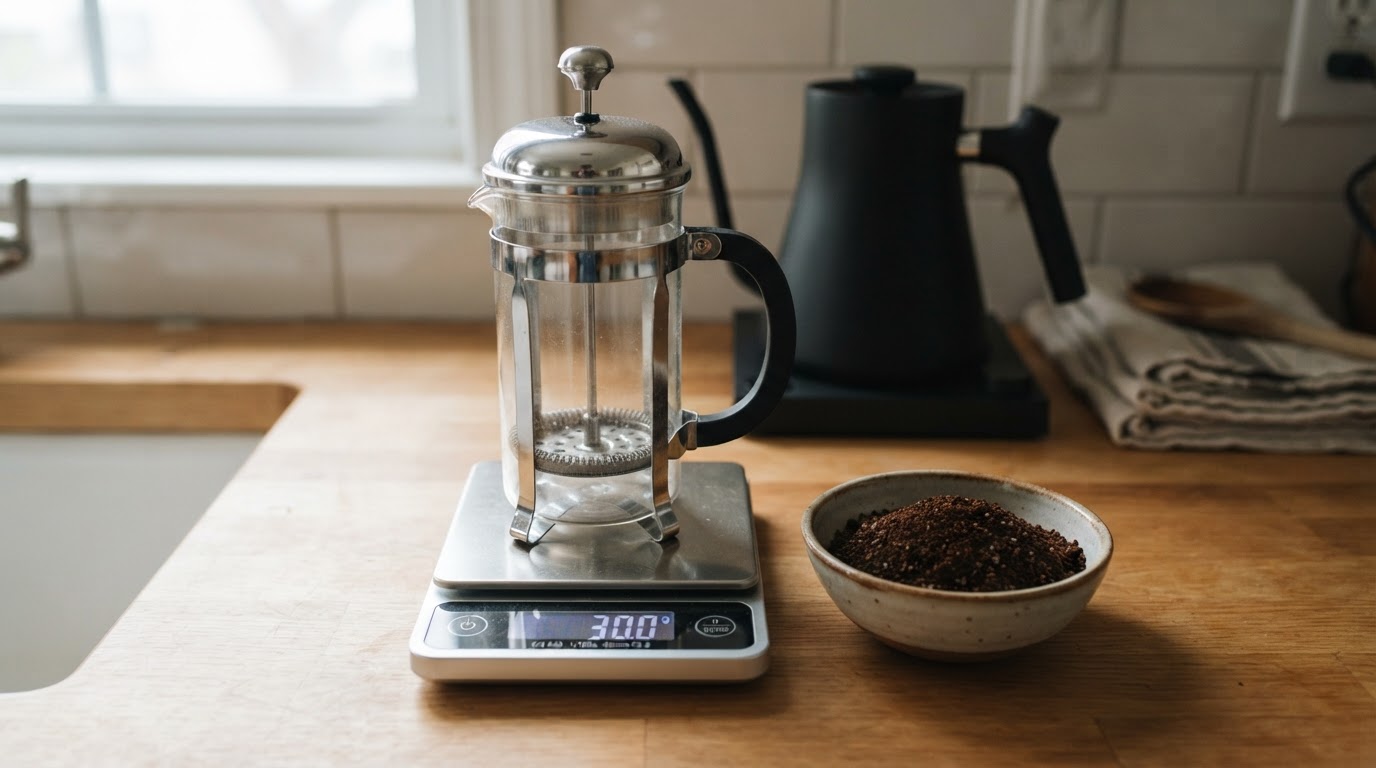
A finer grind extracts faster: more body, quicker results, but a shorter path to bitterness and silt. A coarser grind extracts more slowly and can leave a clean cup tasting sour or thin. Steep time works the same way. About four minutes is the familiar starting point for immersion brewing, and extending the steep keeps pulling compounds out, bitter ones included. A fine grind plus a long steep is the most common route to a harsh cup.
That is the trade-off this brewer asks you to manage: the press is simple, but it keeps working on your coffee until you pour it out. If you plan to linger over a second cup, decant the brew into a carafe.
Worked Examples
One mug (240 ml). 16 g of coarse coffee, 240 ml of water just off the boil. Add the grounds, pour all the water, stir once, steep four minutes, press slowly, then pour. Expect around 215 ml in the cup once the grounds have held their share.
A 1 L press (three to four cups). 63 g of coffee, 950 ml of water, same method. Pour roughly 820–830 ml, which is three generous mugs or four modest ones.
A 12-cup press (six cups). The chart's reference dose for a 12-cup press is 90–100 g, and 1.4 L of water at 1:15 calls for about 93 g, so aim inside that window and adjust to taste.
The scaling rule. Multiply the coffee and the water by the same factor, then add the retention water, about 2 ml per gram of coffee, to the water figure. Never scale only the coffee.
Common Mistakes That Throw the Ratio Off
- Brewing by tablespoons alone. Volume shifts with grind, moisture and scooping style. A scale removes the guesswork.
- Ignoring retention. At 63 g of coffee, more than 120 ml of water never leaves the press. Plan the batch size around it.
- Grinding too fine for immersion. The mesh lets fines through, and they keep bittering the cup while it sits.
- Steeping longer to fix a weak cup. Strength comes from the ratio. Time and grind change extraction, not concentration.
- Trusting the label on the press. A 3-cup, 8-cup or 12-cup rating is nominal and rarely matches 8 oz cups.
- Leaving the coffee in the press. Once you have pressed, the grounds keep contributing. Decant what you are not drinking yet.
Adjusting to Taste: A Checklist
Work through this before you change the ratio, because two different problems can look like one weak cup:
- Weak or watery → move toward 1:13, and check that the grind is not too coarse.
- Bitter or drying → grind a step coarser, or cut the steep by 30 seconds.
- Sour, sharp or thin → grind finer, or extend the steep by 30–60 seconds.
- Flat and dull → check that the coffee is fresh, then confirm you are weighing it.
- Complete when the cup tastes balanced at your target strength and the press plunges without resistance.
CoffeeBrewsHub's ratio chart separates those first four symptoms, weak, bitter, sour and flat, from extraction percentage, and uses an 18–22% extraction target as the band to aim for. The practical takeaway: keep the ratio as your strength control, use grind and time as your extraction controls, and change one variable at a time.
FAQ
What is the best French press coffee ratio? 1:15 by weight for most people, with 1:12 at the bold end and 1:17 at the light end.
How many tablespoons of coffee is that? About 3 level tablespoons per 240 ml at 1:15, assuming 5 g per spoon. Weigh one scoop to confirm what yours holds.
Does the ratio change if I want a stronger cup? Yes, and the fix is more coffee rather than more time. Moving from 1:15 to 1:12 adds about 4 g per 240 ml.
How long should I steep French press coffee? Four minutes is the usual starting point. Longer steeps extract more, and bitterness arrives before extra flavor does.
Should the water be boiling? Take the kettle off the boil and let it settle for a few moments before pouring. Water at a full rolling boil tends to flatten the cup.
Why is my French press coffee bitter? Most often a fine grind, a long steep, or both together. Fix the grind first, then shorten the time if the cup still bites.
Can I use this ratio for cold brew? Cold brew is usually brewed as a concentrate and diluted later, so a ready-to-drink 1:15 ratio is not the right starting point for it.