The short answer: insert or filter after brewing?
Use a built-in paper insert only when the manufacturer publishes one for your exact press. For an ESPRO Press in 18 oz or 32 oz, ESPRO sells paper filters designed for that assembly, and its FAQ notes that the same filters fit the Travel Press and Ultralight Press.
For any other press, check your own maker's documentation for your model. If your maker does not list a paper filter for that exact model, do not improvise a paper stack under the mesh screen. Brew and press as usual, then filter the decanted coffee through paper in a separate dripper.
The two routes are not equally supported. A fitted insert is a configuration the manufacturer documents for specific models. Gravity filtration after decanting is a proposed workaround: it uses ordinary brewing equipment in the way that equipment is designed to be used, but no press maker has specified it for your brewer.
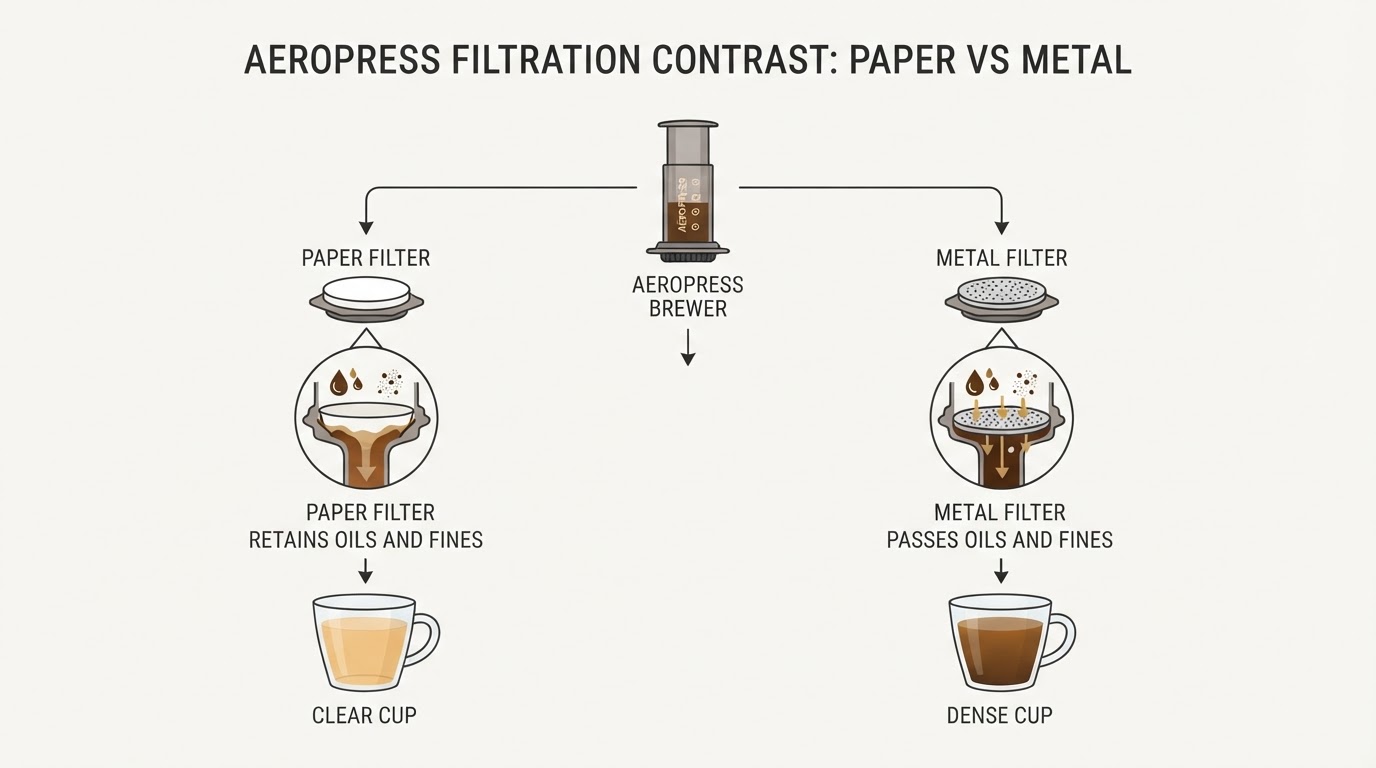
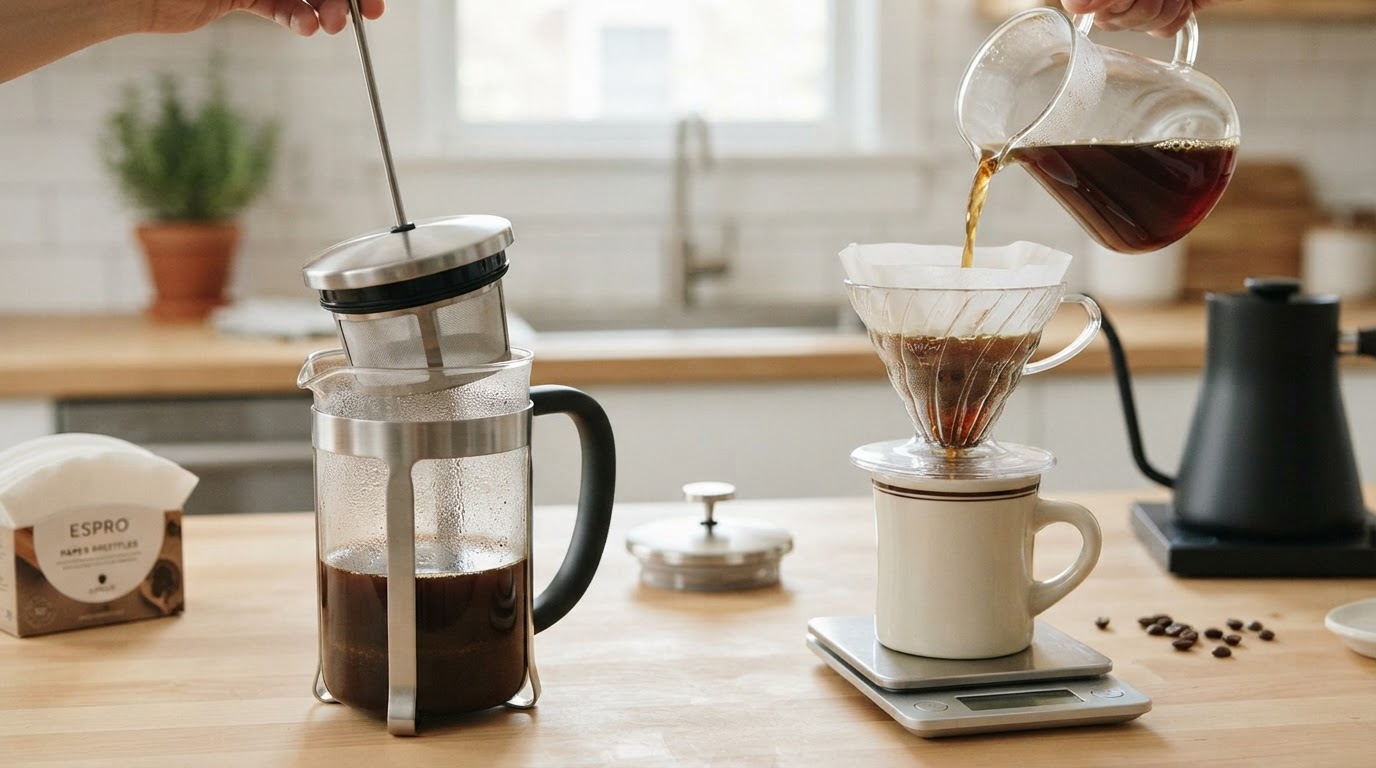
An insert filters inside the press; a post-brew filter removes fines and some oils after the coffee has left the grounds.
What a fitted paper insert changes
ESPRO's FAQ says you can add a paper filter to any ESPRO press to make "an ultra-clean, oil-free pour over-style coffee." It also explains why the cup changes: paper absorbs the aromatic oils many people like in French press coffee, so flavor varies with and without a filter.
"Oil-free" is the manufacturer's phrase for a direction of change, not a laboratory result and not a health guarantee. Paper catches finer particles and some oils, so the cup reads cleaner and lighter. It does not mean every oil molecule disappears, and it says nothing about health outcomes.
Compatibility is model-specific. ESPRO's paper filter page lists 18 oz and 32 oz ESPRO Press sizes, and the FAQ adds that the Travel Press and Ultralight Press use the same size paper filters. None of that transfers to a Bodum or to an unnamed press, whose filter assemblies differ. Check your own maker's accessory list for your exact model before buying; a filter that fits one assembly is not evidence about another.
How to use a paper filter with a French press
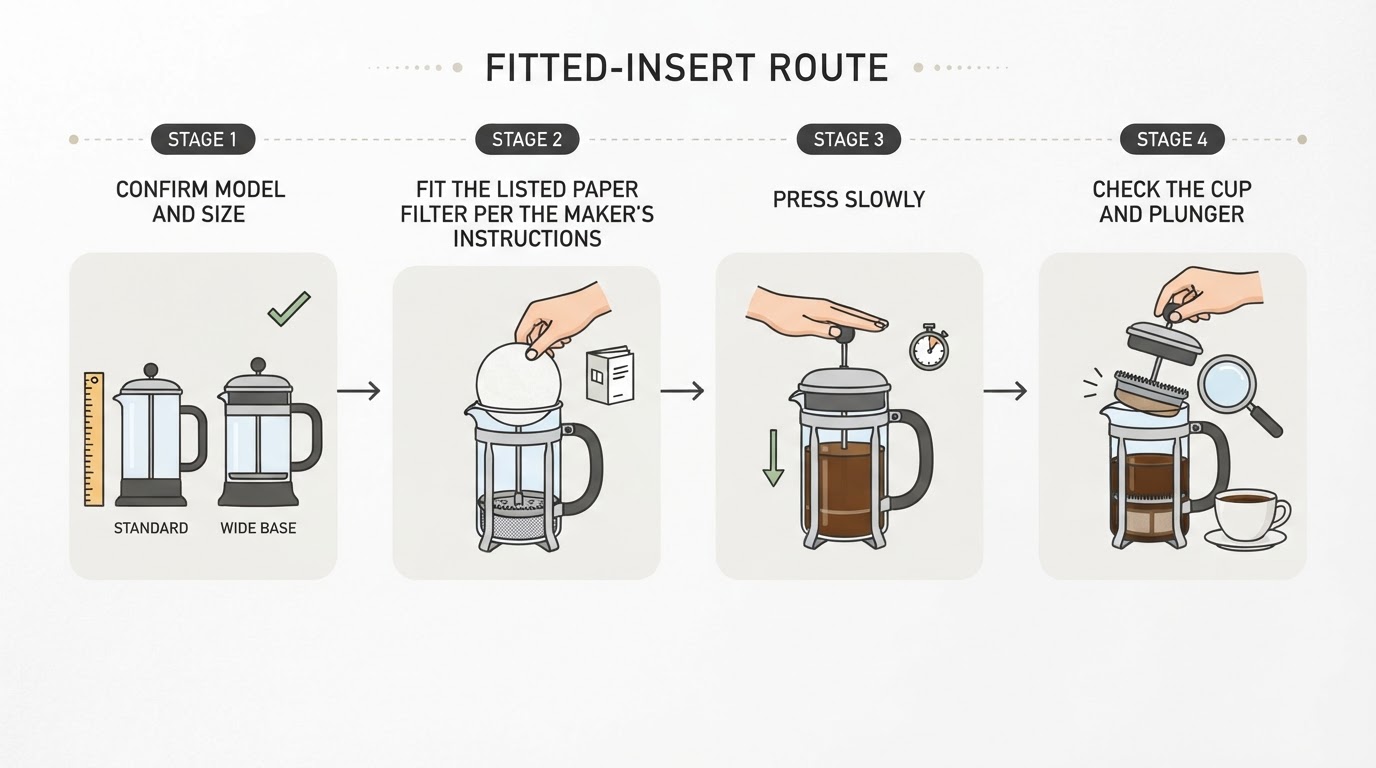
Route 1: a manufacturer-supported fitted insert
- Confirm the exact model and size of your press, then buy the paper filters the manufacturer lists for that model.
- Assemble the filter stack exactly as the manufacturer instructs; do not add paper to a stack it was not designed for.
- Brew with your normal dose, grind, water and steep time, then press slowly.
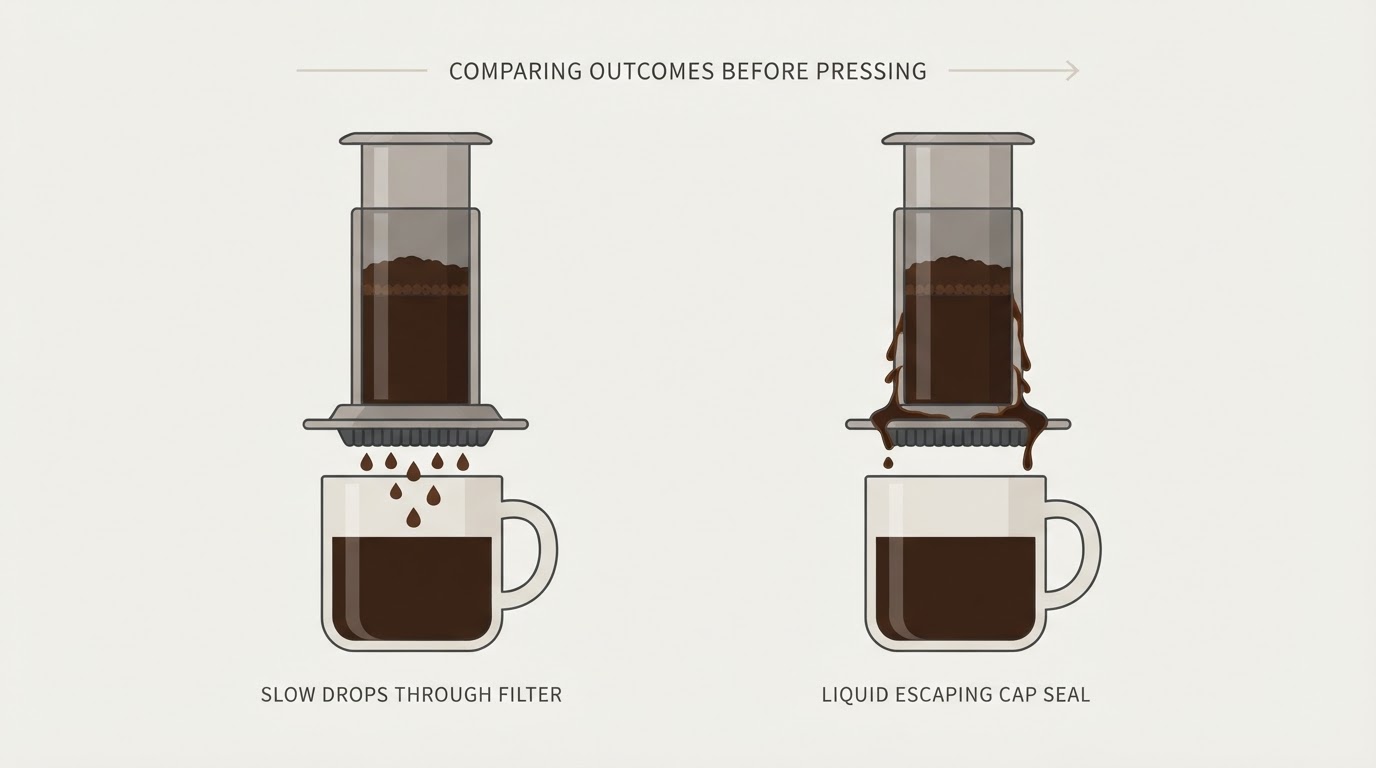
- If the plunger becomes unusually hard to move, stop pressing rather than forcing it. Resistance alone does not tell you why it is stiff; the next section covers what to do.
Completion check: the press operated safely, the plunger moved with steady, low resistance, the paper stayed intact, and no paper ended up in the cup. Judge the cup as cleaner than your usual unfiltered brew — an observation about this batch, not proof that nothing remains in suspension.
If the plunger gets stiff
A stiff plunger is a symptom, not a diagnosis. A clogged filter, too fine a grind, an unevenly seated paper stack or overfilled grounds can all produce the same feel, and you cannot identify the cause from the handle alone.
Stop pressing without forcing the plunger. Do not press harder to clear the resistance, and do not lever the rod or tap the carafe. Let the press cool, then handle it according to your manufacturer's guidance before any disassembly — never open a hot press. If your maker publishes a troubleshooting or service procedure for your model, follow that instead of improvising.
Route 2: gravity filtration after decanting (a proposed workaround)
This route is not a manufacturer-specified setup for any particular press. It uses a paper filter and a dripper as those tools are ordinarily designed to be used.
- Brew and press normally, then pour the coffee into a heat-safe carafe or mug. Decanting separates the bulk of the grounds from the liquid and limits continued contact with them; it does not instantly halt every extraction reaction still underway in the cup.
- Set a paper filter that matches your dripper — a cone or basket filter sized for that dripper — in the dripper, over a second stable, heat-safe vessel. Both should sit on a dry, level surface, and both should be vessels you would put hot coffee in.
- Pour the decanted coffee through the paper in a slow, steady stream. Let gravity do the work: no pressure, no stirring the bed, and no pressing the slurry through the paper.
- Discard the paper and rinse the dripper before the next brew.
Completion check: the dripper and receiving vessel stayed stable, the filter did not tear or overflow, and the decanted cup looks clearer with less sediment than your usual press coffee. Treat that as an observation about your batch, not a guarantee of zero visible sediment or oil.

Which route fits your setup?
Your situation | Better route | Why |
|---|---|---|
ESPRO Press, 18 oz or 32 oz | Fitted ESPRO paper insert | The maker lists a paper filter for this assembly |
ESPRO Travel Press or Ultralight Press | Fitted ESPRO paper insert | The maker says the same paper filters fit |
Another press, and the maker lists a paper filter for your exact model | That maker's fitted insert | Follow the maker's assembly instructions |
Another press, and the maker lists no paper filter for your model | Filter after decanting (proposed workaround) | Do not improvise a paper stack for an undocumented assembly |
You want the heaviest body | Skip paper, or filter part of the brew | Paper absorbs aromatic oils |
You want a cleaner, lighter cup | Either route | Both remove fines and some oils |
Serving several people | Filter after decanting | One batch passes through one dripper |
What changes in the cup, and what does not
A fair comparison holds the recipe constant: same coffee weight, water, grind and steep. If you change the dose too, you cannot tell whether paper or strength caused the difference. Our guide to the French press coffee ratio covers dose and scaling; filtration is a separate variable layered on top.
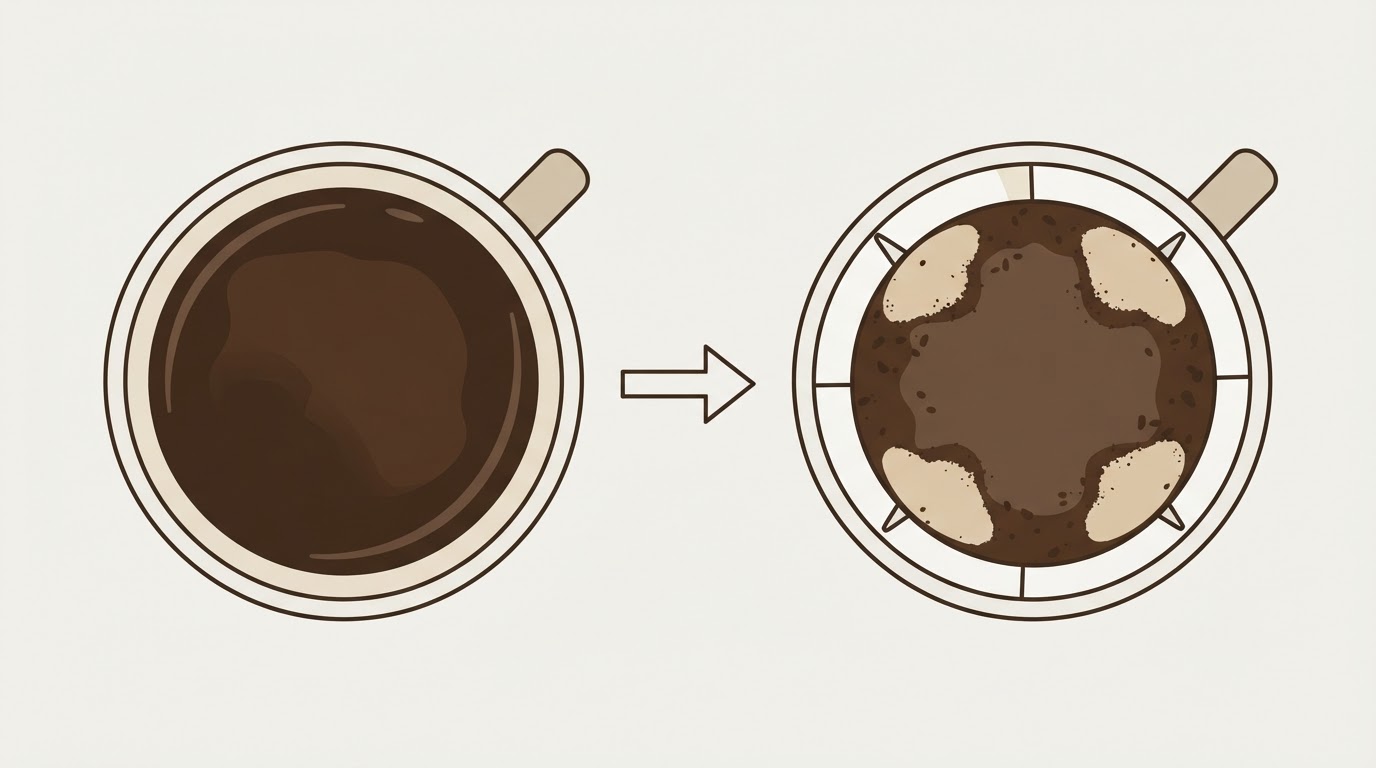
With paper, expect less sediment, a lighter body and a clearer flavor, because paper traps fines and absorbs some aromatic oils, as ESPRO describes. Without paper, expect more body and oil. Neither version is better in the abstract, and paper filtration is not a health claim or a promise of zero oils.
Mistakes to avoid
- Putting paper under an arbitrary mesh screen. If the maker did not design the stack for paper, the paper can bunch, tear or block the press.
- Forcing a stiff plunger. Stop, let the press cool, and follow the maker's handling guidance before disassembling anything.
- Opening or wrenching a hot press when the plunger sticks. Wait for it to cool and use the maker's documented procedure.
- Assuming an ESPRO filter fits a Bodum or a generic press. Sizes and assemblies differ.
- Expecting the same cup. Paper changes texture and aroma by design.
The practical rule: use a fitted insert only where the maker documents one for your model, and filter after decanting when it does not — as a workaround, not as a maker-specified configuration.