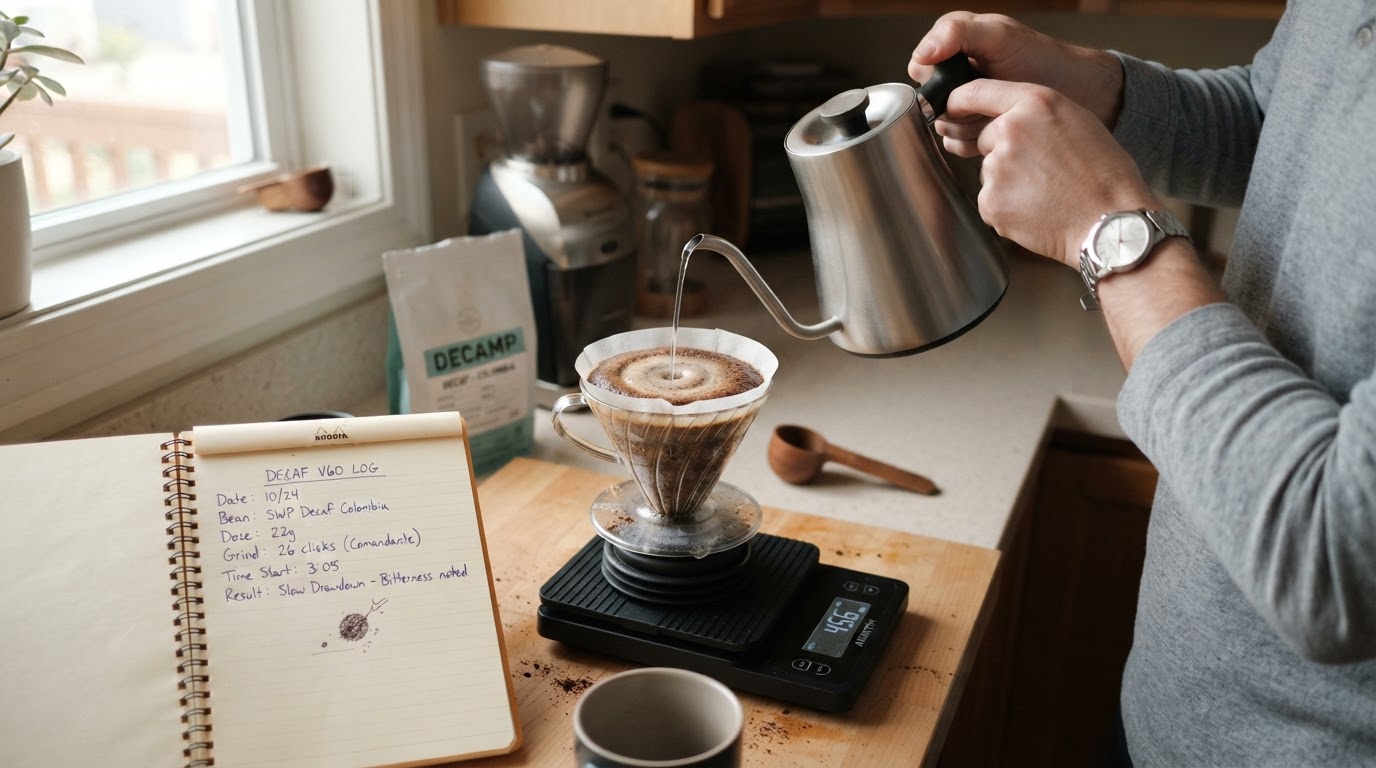
Start With What the Bloom Is For
Counter Culture Coffee's pour-over guide describes the bloom as a small first pour that lets coffee release gases trapped during roasting, and it stresses saturating the entire coffee bed. It gives a rough rule of thumb of about twice the coffee's weight in water: a 30 g dose gets about 60 g of bloom water. That figure is a recipe starting point, not a freshness test.
Wetting is the part you can see and act on. A bubble count does not measure gas mass or volume, and the appearance of the bed cannot quantify gas or establish freshness.
The Direct Answer: No Bubbles Is Not a Verdict
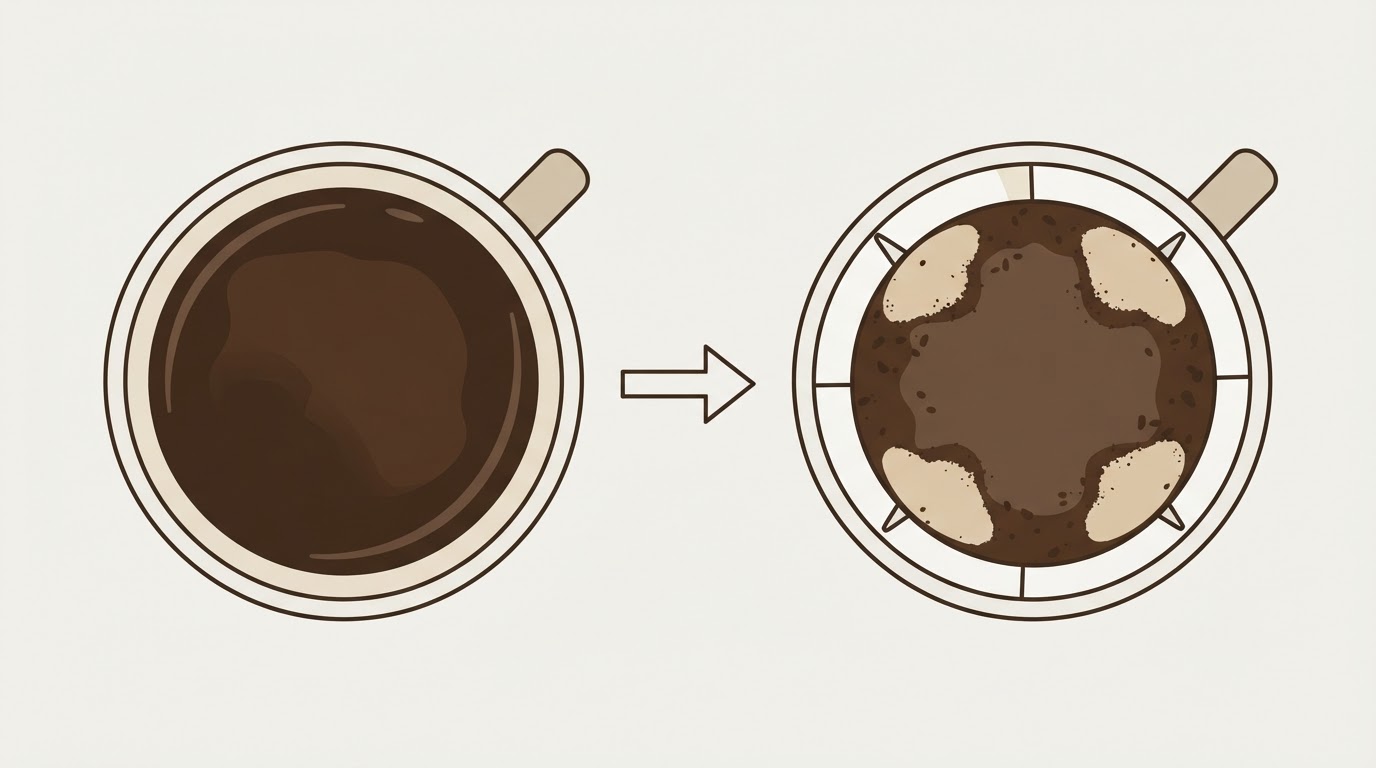
If the bloom looks flat and quiet, the absence of a mound or bubbles alone cannot identify bean age, quality, or extraction. A quiet bed can be fully wetted. A dramatic dome can sit over a dry ring at the edge of the filter.
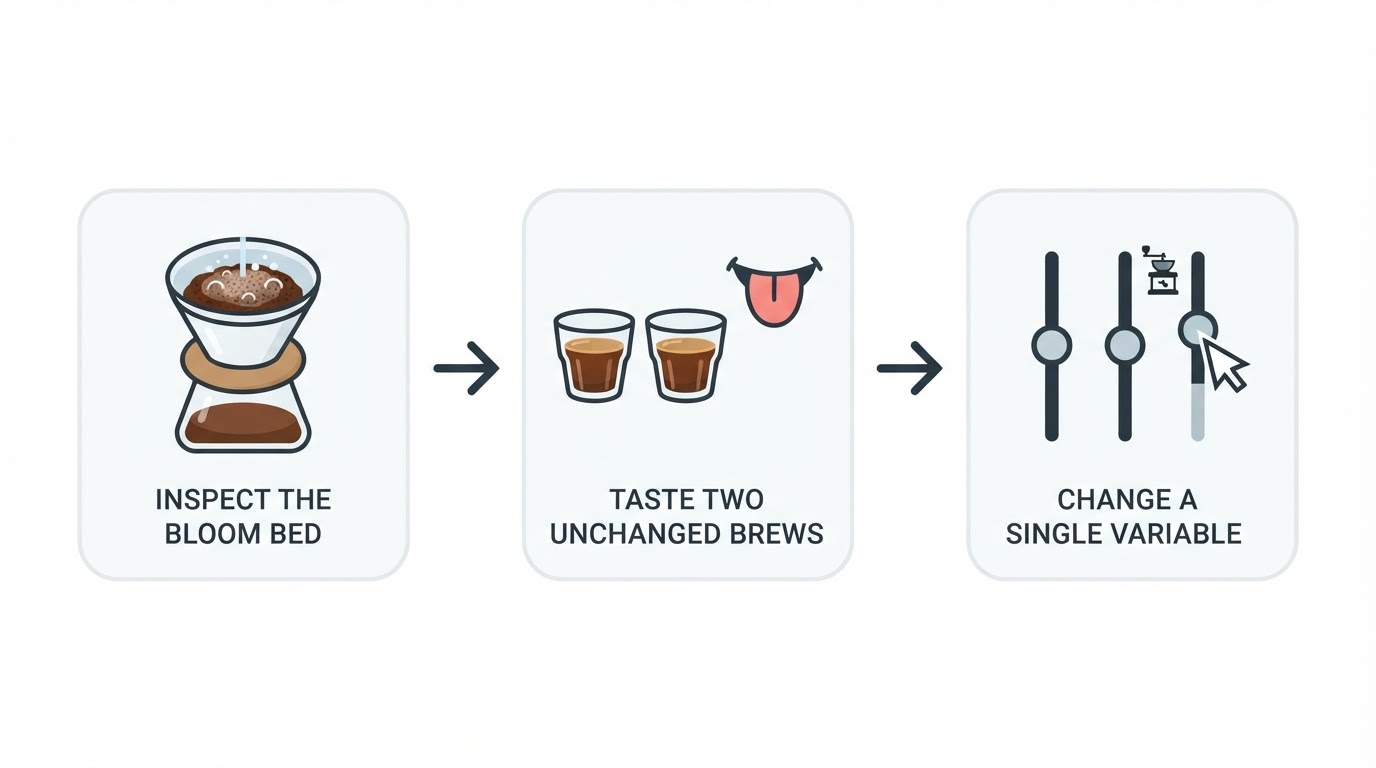
That distinction changes the next move. A flat bloom does not by itself justify a finer grind, hotter water, or a new bag of coffee. Inspect the bed first, then taste the cup before you rewrite the recipe.
Step 1: Inspect the Bed, Not the Foam
Keep this check short and tied to the recipe you already use.
- Level the grounds before the first pour so the bed has no crater or slope.
- Add the bloom water your recipe specifies, working around the full visible bed.
- Look for dry islands. Dark, glossy grounds are a visible wetting clue, not proof that every particle is saturated.
- If dry islands remain, address them gently: a slower pour aimed at those spots, or a gentle swirl if that suits your setup. There is no blanket swirl-over-spoon rule, and no promise that a swirl avoids disturbance.
What you see after the bloom pour | What it can suggest | What to try |
|---|---|---|
Dark, glossy bed with few or no bubbles | A visible wetting clue, not proof every particle is saturated, and not a freshness reading | Keep the recipe and taste the cup |
Dry patches or pale spots | The water did not reach every particle | Rewet those spots gently, then continue the recipe |
Water pooling on the surface | Flow, filter, fines, or wetting can all contribute; sight alone cannot pin it to a bloom that was too small | Note the pooling, stay with your recipe, and watch the main pour |
A wet center with a dry ring at the filter wall | The pour aimed at the middle and missed the edge | Aim the stream toward the dry ring and keep it off the paper |
The bed collapsing as liquid drains | A shape change during drawdown, not a failure by itself | Note it and judge the cup |
Step 2: Read the Bag Without Declaring the Beans Stale
The roast date, the day you opened the bag, and how it has been stored are useful context. They are not a verdict. Bags are labeled differently and coffees rest differently, so no single date turns a quiet bloom into proof of stale beans.
Record what the bag actually says and when you opened it. If you want to compare how published guidance treats resting, our guide to how long to rest coffee after roasting walks through roaster windows and a simple rotation plan. Treat that as context for this bag, not a pass-or-fail threshold.
Step 3: Follow the Wetting Step You Already Use
Recipes differ in bloom volume and timing, so follow the one you are already brewing with instead of stacking a new bloom volume, a new wait, and a new pour pattern on top of each other. If the surface is still dry at the end of the wetting step, extend the wetting gently and leave grind, dose, and temperature alone for that brew.
The size of your dripper changes how deep the bed sits, which affects how the same pour lands. If you are wondering whether the brewer itself is part of the picture, our comparison of V60 01 vs 02 covers batch room and filter fit.
You do not need all bubbling to stop, and you do not need a particular visual dome before the next pour. The bloom is a wetting step, not a bubble test.
Step 4: Taste Repeated Unchanged Brews
Repeat the same recipe for two or three brews without changing anything. That is a starting check, not a validated completion threshold: it gives you a comparison, and it keeps a single flat bloom from becoming a diagnosis.
For each brew, note whether the bed looked evenly wet, whether the drawdown behaved roughly as your recipe leads you to expect, and whether the cup was pleasant, thin, sour, or harsh. These are your own observations from your own brews, not laboratory measurements.
Repeated pleasant cups mean there is no obvious problem to fix; they do not prove that a flat bloom is purely cosmetic. Repeated poor cups are a fair reason to keep looking, but they still do not prove the beans are stale.
Step 5: Keep It a Decision Guide
- Dry islands in the bed: adjust the pour before changing anything else.
- Evenly wet bed, pleasant cups across repeated brews: nothing obvious needs fixing, so keep the recipe.
- Evenly wet bed, repeatedly disappointing cups: change one variable at a time, with bloom volume or grind as reasonable places to look, and taste again before concluding anything.
- Bag details worth recording but not proof of staleness: the roast date if printed, the opening date, and how the coffee has been stored. There is no fixed expiry date, and no guaranteed bubble response.
- Water temperature: use whatever your own recipe specifies rather than a universal target.
Because a single changed trial is one observation, give each change repeated brews before drawing a conclusion.
What the Sources Can and Cannot Tell You
Counter Culture Coffee is a roaster publishing its own brew guidance. Its description of the bloom and its roughly 2x starting point are useful for wetting, but they are recipe guidance, not a measurement of your bag, grinder, or water. Nothing in that guidance makes a visible dome a required outcome.
That is why the bloom is best read as a wetting check. Look at the bed, follow the recipe you have, taste the coffee more than once, and only then decide whether anything needs changing.