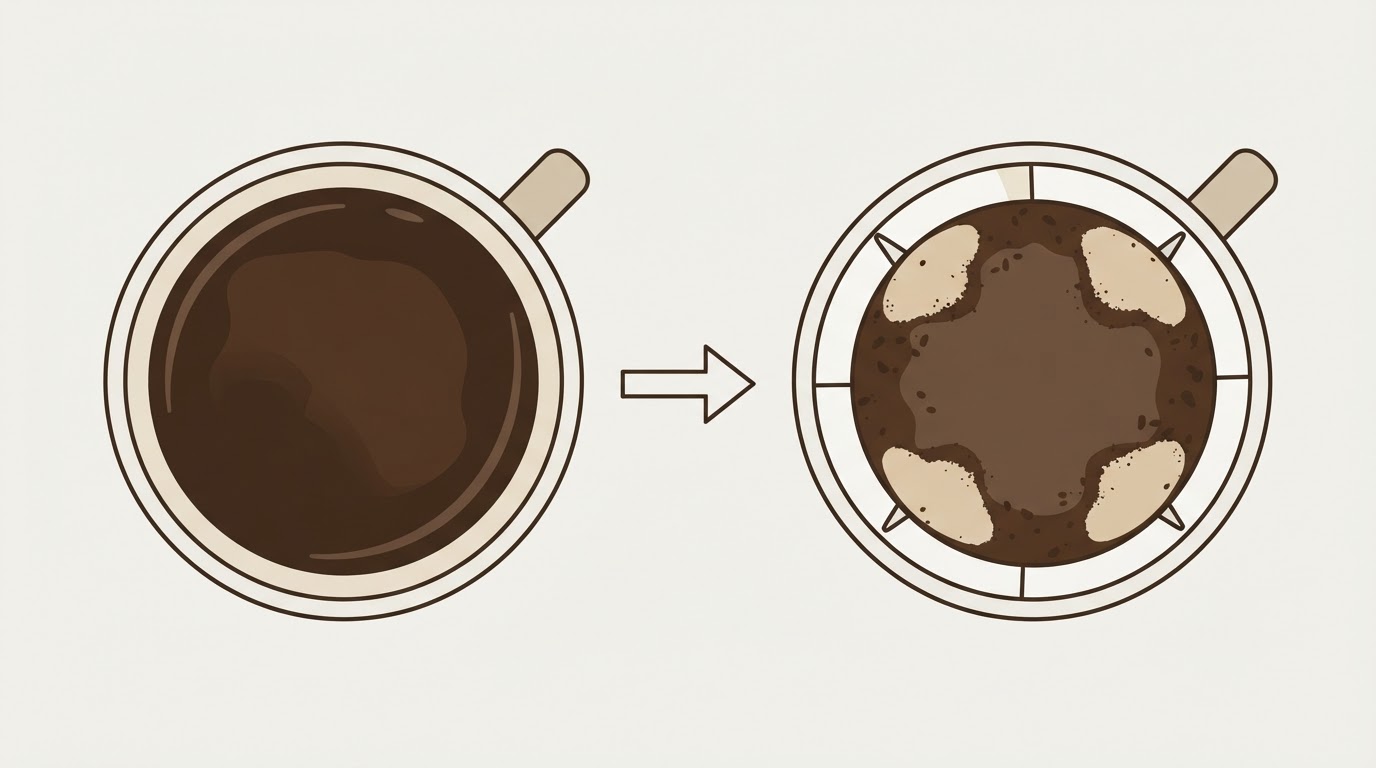
Start With Your Grinder's Filter Range, Not a Click Count
There is no universal decaf setting. A click number from someone else's grinder tells you very little about your burrs, your paper or your dose. Begin at the setting you already use for filter coffee, usually the medium-fine band your grinder manual, roaster or grinder maker points to for pour-over, and call that your baseline. Then hold dose, paper and pour plan steady while you read three things: the drawdown, the way the bed wets and finishes, and the taste in the cup.
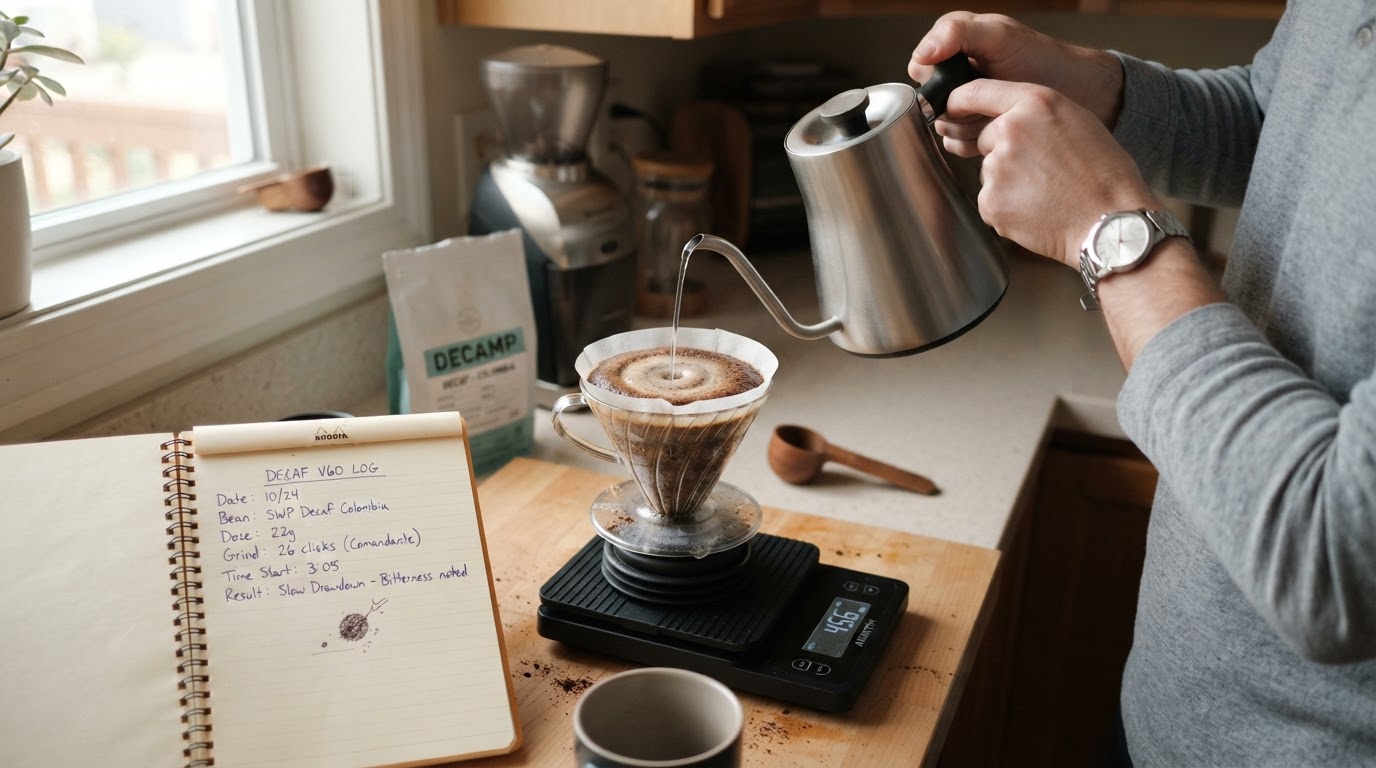
That is the practical answer to the decaf pour over grind size question. Your starting point comes from your equipment, and your adjustment comes from repeated evidence. Decaffeinated coffee is a broad category, so a setting that stalls one bag may drain normally on the next.
What you observe, with dose, paper and pour held steady | First trial | What would support the read |
|---|---|---|
Repeated stalls: water pools on the bed and the last drops take much longer than your baseline | One small step coarser | Two or three brews at the new setting drain evenly, with no dry patches and no muddy center |
Fast drain and a thin, watery cup | One small step finer | Repeated brews slow to a steadier flow and the cup carries more body |
Flow changes from brew to brew with no setting change | Change nothing yet | A filter seating, paper or pour problem is found and fixed |
The bed wets unevenly from the first pour | Fix the bloom and pour first | Water covers the bed evenly before you judge the grind |
The table is a decision aid, not a guarantee. It works because you compare your own brews, not because one row predicts a perfect cup.
Why Decaf Can Slow a Paper Filter
Filter paper clogs when fine particles pack into its pores. In his analysis of percolation, Jonathan Gagné of Coffee ad Astra describes what follows: the drip rate can fall sharply, and the water that still passes does so along fewer, unchanging paths, leaving some parts of the bed under-extracted while others take most of the flow and add astringency. He specifically notes that some decaffeinated coffees can still generate enough fines to potentially clog most paper filters unless you are careful. The full argument is worth reading at the Coffee ad Astra article on optimal percolation.
That is a mechanism, not a verdict on every bag. It does not mean all decaf is brittle, low-density or guaranteed to stall, and it is not a measured result from our own brewing. It means fine-particle load is one plausible explanation when your usual setting suddenly behaves badly with a decaffeinated coffee.
Gagné's analysis also points to two design factors that raise a filter's tolerance: a larger paper surface and thicker paper both give fines more places to lodge before flow chokes. The same source warns that heavy agitation can drive fines into the paper, which is why a gentler pour can be a separate thing to test when a bed keeps stalling.
Freshness deserves the same care. If the bag is only a few days off roast, the same setting may behave differently while the coffee is still releasing gas. Our guide to how long to rest coffee after roasting collects roasters' own resting windows and explains how to match a bag to a brew method, so check the roast date before you decide the grinder is at fault.
Build a Baseline You Can Repeat
Weigh both the coffee and the water. Wimp Decaf's brewing guide recommends weighing coffee and water and offers 1:16, one part coffee to sixteen parts water by weight, as its starting ratio. Treat that as roaster guidance for that roaster's coffee, not as an SCA certificate for decaf and not as a universal decaf target.
The same guide suggests slightly cooler water for decaf, around 195°F to 200°F, and describes decaf beans as often less dense after caffeine is removed. Those are the roaster's statements about its own coffee. They are not evidence that every decaf over-extracts at a normal pour-over temperature, so change temperature only as a separate trial if you have another reason to.
Hold the rest of the setup constant across your first three brews: one dripper, one paper type, the same dose, the same water weight, the same pour stages and the same kettle temperature. Write down what happened while it is fresh, because the comparison is the whole method.
A blank brew log you can copy
Grind setting | Dose (g) | Water (g) | Temp | Drawdown | Bed after brewing | Taste in your own words |
|---|---|---|---|---|---|---|
|
|
|
|
|
|
|
|
|
|
|
|
|
|
|
|
|
|
|
|
|
Measure drawdown from the start of the bloom to the last drops, and describe the bed in plain terms: level, muddy in the middle, dry at the edges, or holding a puddle. Those notes tell you more than a single time on its own.
Check the Setup Before You Turn the Dial
A filter that is not seated flat, a paper that sags into the dripper's holes, or a dose that is too large for the cone can imitate a grind problem. So can pouring faster than the bed can drain, because flooding the bed agitates it and moves fines toward the paper. Dripper size and batch room also change how deep the bed sits, and our comparison of the V60 01 and 02 explains the size, filter and headroom differences, which matters if you are troubleshooting a small dose in a larger cone.
If the setup checks out and two or more brews at the same setting stall with the same paper and pour plan, then the grind is a reasonable next trial.
If the Bed Keeps Stalling: Go Coarser First
When two or more brews at the same setting stall with the same paper and pour plan, move one small step coarser and change nothing else. Brew twice at the new setting before you decide anything. A single cup cannot establish cause, and a change that helps once may simply have coincided with a different pour or a slightly different dose.
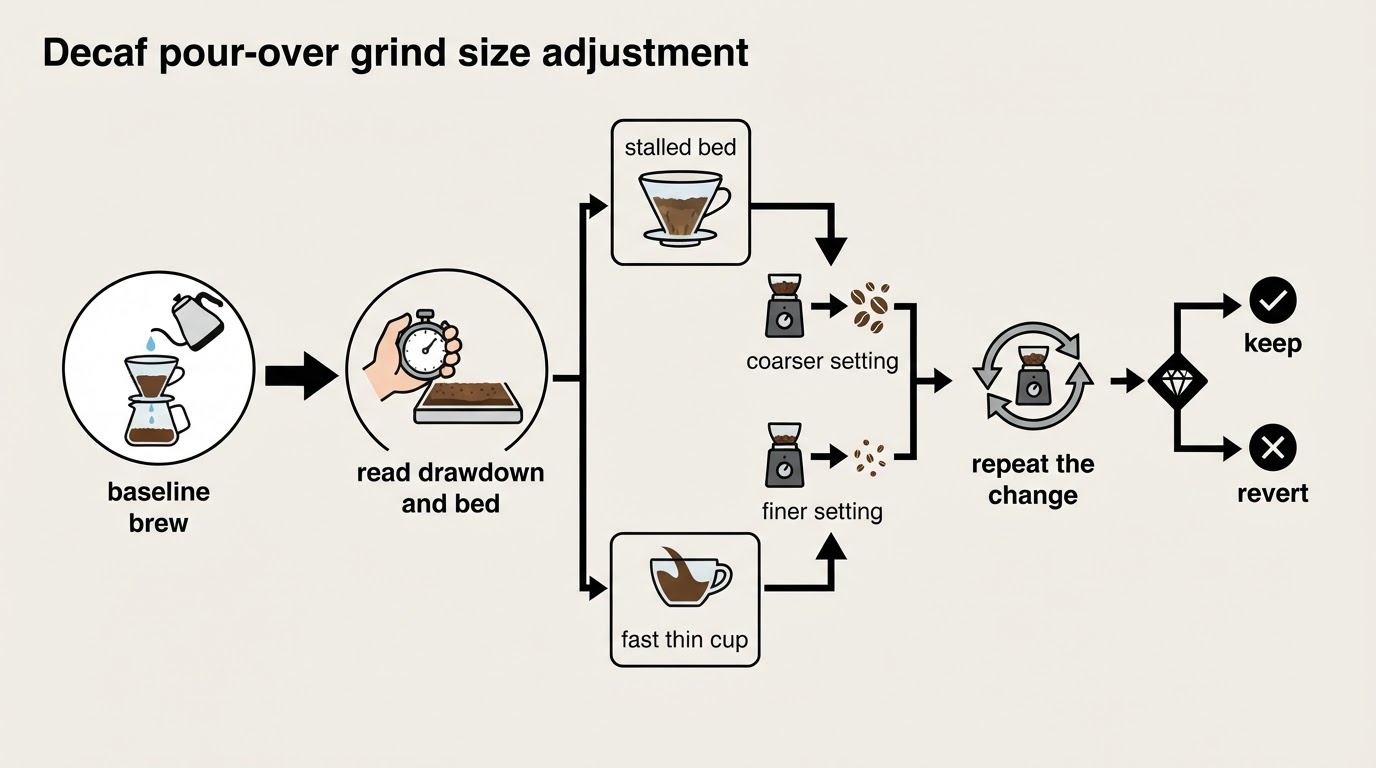
Keep agitation out of the same trial. If you also want to test a gentler pour, do that as a separate round after you have a coarser result, because reduced agitation and a coarser grind both alter flow. Testing both together leaves you unable to tell which one mattered.
Stop moving coarser when the bed drains evenly and the cup stops tasting harsh or drying. If it still stalls after two small steps, return to the setup checks: a partly blocked dripper outlet, a mismatched paper or a dose that is too large will not be fixed by grinding coarser forever.
If the Bed Drains Fast and the Cup Tastes Thin
Fast flow and a thin cup can justify one small step finer, followed by two repeat brews at that setting. Watch for the opposite problem: if the drawdown lengthens sharply or the bed starts holding a puddle, you have gone past the useful range for that paper and dose.
Do not diagnose from taste alone. Bitterness and sourness are not reliable single indicators of over-extraction or under-extraction. Gagné's analysis describes how clogging and uneven flow can leave parts of the same bed under-extracted and other parts over-extracted, so a muddled cup can come from uneven flow rather than from the grind being simply too coarse or too fine. Read taste together with drawdown and bed appearance.
If the cup is weak but the flow is already slow, grinding finer is likely to make the stall worse. Keep the grind fixed and test ratio, water or dose as a separate change instead.
Change One Variable, Then Repeat It
A repeatable loop is more useful than a long list of settings.
- Brew twice at your baseline setting and record both results.
- Identify the dominant signal: stalling, fast flow, uneven wetting or a taste problem with otherwise normal flow.
- Fix any setup issue before touching the grind.
- Change one thing by one small step: grind coarser for repeated stalls, finer for fast and thin brews, or adjust a single pour or agitation variable in its own round.
- Brew twice at the changed setting, not once.
- Compare drawdown, bed evenness and taste against the baseline, then keep the change or revert it.
You have a workable setting when two consecutive brews at the same dose, paper and pour plan wet evenly, finish in a similar drawdown band, and taste better to you than the baseline. That is a practical stopping point, not proof that the grind caused the improvement. If two settings tie on repeatability, keep the one whose drawdown varies less from cup to cup.
What Not to Conclude From One Bag
- Decaf is not automatically brittle, low-density or in need of a coarser grind. Some decaffeinated coffees appear to produce more fines, and many do not; your own bag is the evidence.
- Bitter does not automatically mean over-extracted, and sour does not automatically mean under-extracted. Use flow and bed evidence as well.
- There is no universal click-to-micron conversion. Grinder scales differ, so another person's click count is not a measurement you can transfer.
- One improved cup is not proof of causation. Repeat the setting before you credit the change.
- A roaster's ratio or temperature advice describes that roaster's coffee and process. Do not turn it into a rule for every decaf.
Start inside the filter range your equipment already defines, hold the other variables steady, and repeat each change twice. The setting you keep should be the one your own brews can reproduce, not the one someone else's click count promised.