Last updated: October 27, 2026
Start with the decision, not the model list
A drip brewer is a repeatable process: water heats, rises, spreads across the coffee bed in a basket, and drains through a filter into a carafe. Nearly every difference that matters to a buyer sits inside that sentence — how steady the water temperature is, whether the water reaches all of the coffee evenly, how the brewed coffee is held afterward, and how much of the process you have to supervise.
That is why a machine that wins a group test can still be the wrong machine for your counter. A household pouring two mugs before work and a household filling a thermal carafe for a meeting have opposite needs from the same criteria. So this guide is organised criteria first and categories second. Each verdict line names the kind of brewer that fits a specific reader and the one thing to verify on the manufacturer's own specification page before paying, because prices and test data change faster than any buyer guide can.
The nine criteria that decide the best drip coffee maker for you
Brew temperature stability
Ask whether the machine holds its target brewing temperature through the whole cycle, not only at the start. A brewer that heats quickly but cools as the tank drains can look identical on a specification sheet and still produce a thinner cup. When comparing two machines, look for a stated brew temperature range, whether the heating element cycles during the brew, and whether pre-heating is part of the cycle. If a listing only says "optimal temperature" with no number and no control, treat that as marketing until the manual confirms it.
Even saturation and basket shape
Extraction depends on water reaching every part of the coffee bed at roughly the same rate. Flat-bottom baskets fed by a wide spray pattern usually saturate more evenly than narrow cone baskets fed by a single thin stream, though cone baskets can work well when the showerhead spreads water properly. Check the sprayhead design, the basket shape, and whether the brewer offers a bloom pause or pre-wet stage. If you grind your own coffee, an adjustable flow or pulse option matters more than a long feature list.
Carafe type and hot-holding
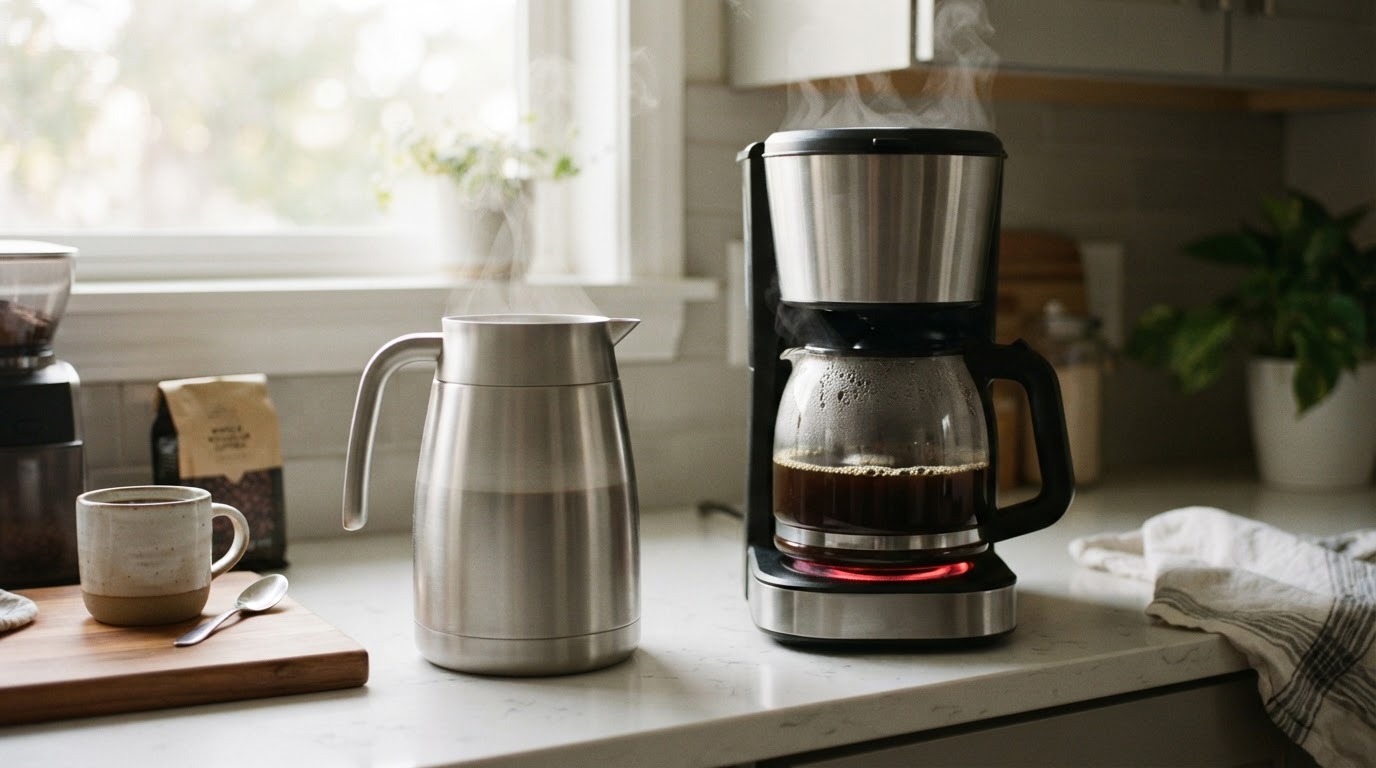
Glass carafes on a hot plate keep coffee hot by continuing to heat it, which flattens flavour within the hour. Vacuum or thermal carafes hold heat without adding heat, so the coffee stops developing the moment brewing ends. The trade-off is that you cannot see the level through the wall, and you need to pre-heat the carafe for the first cup to stay hot. Decide which failure mode bothers you more: coffee that keeps changing on a hot plate, or coffee that starts hot and then cools with no way to warm it.
Batch size flexibility
A large carafe is convenient until you want two cups. Look for a machine whose minimum batch is realistic for your smallest morning, not only whose maximum is impressive. Some brewers offer a small-batch mode that changes the water path or the flow rate; others brew a short pot with the same cycle and produce weak results. Match the minimum batch to your usual weekday volume and the maximum to your weekend volume, and check how the carafe markings map to real mugs rather than nominal cups.
Programmability and scheduling
A timer only helps if you prep the machine the night before: water in the tank, filter and grounds in the basket, carafe in place. If that is a routine you will keep, a programmable brewer earns its place. If you would rather grind fresh every time, you are paying for a clock and a display you will not use. Also check whether the machine remembers your settings after being unplugged, and whether a scheduled brew runs safely into a thermal carafe without a hot plate.
Grinder dependency
A drip brewer does not grind coffee unless it is an all-in-one grind-and-brew machine. Budget for a grinder, or accept pre-ground coffee and the staleness that comes with an opened bag. If one appliance has to do both jobs, expect to trade counter space, extra cleaning steps, and repairability, because a combined unit has more parts that can fail. If you already own a grinder, spend the difference on temperature control and build quality instead.
Cleaning and descaling effort
Daily cleaning is a rinse of the basket and carafe. The burden that decides long-term satisfaction is descaling and the internal parts you cannot see. Check whether the machine has a descaling reminder, whether descaling is a documented cycle or a manual flush, and whether the water tank and lid are removable and wide enough to wash by hand. Brewers with narrow fill openings and fixed tanks are the ones owners skip, and a skipped descale shortens the machine's life.
Build quality and repairability
Look for replaceable consumables: carafes, baskets, filter holders, and showerhead seals. A brewer with a stocked parts page is the better long-term purchase than a sealed unit with a short service life, even when the purchase price is higher. Check the warranty terms, whether service runs through the retailer or the manufacturer, and whether spare parts are published at all. A machine that cannot be repaired is a subscription, not a purchase.
Footprint
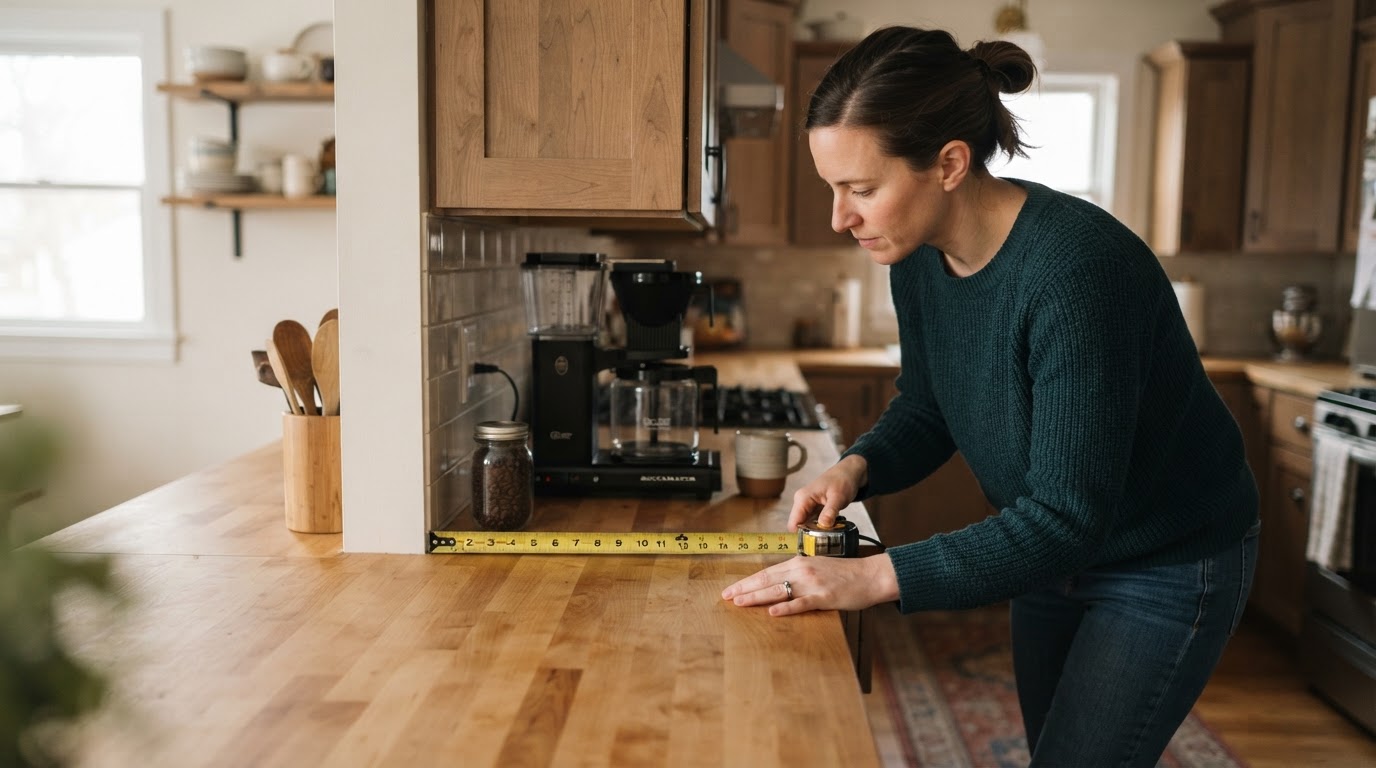
Measure the counter depth before you measure anything else. Depth is usually the binding constraint in a small kitchen, and clearance above the machine matters if the lid opens upward under a cabinet. Confirm too that the carafe can be lifted out and refilled without pulling the machine forward every morning.
Best for X → the brewer category that fits
These verdict lines map a reader to a category. They deliberately stop short of naming a single winner, because the best unit inside a category shifts with availability, price, and part support.
- Best for a household that brews one predictable pot every morning → a fixed-cycle batch brewer with a thermal carafe. You give up scheduling and gain temperature consistency without a hot plate.
- Best for someone who wants coffee ready before the alarm → a programmable glass-carafe brewer with a hot plate, run on a schedule you will actually prep the night before.
- Best for one or two drinkers who rarely finish a pot → a small-batch brewer with an honest minimum batch, or a single-serve machine with a carafe option for guests.
- Best for a carafe that has to survive a meeting → a high-capacity batch brewer with a vacuum carafe and a showerhead that spreads water across a wide bed.
- Best for filter-forward flavour experiments → a brewer with an adjustable bloom or pulse cycle and a flat-bottom basket, paired with a grinder you choose yourself.
- Best for someone who wants one appliance on the counter → an all-in-one grind-and-brew machine, accepted together with the extra cleaning steps and lower repairability.
- Best for a small kitchen → a compact brewer with a removable tank and a front-loading basket, chosen against your actual counter depth rather than the product photo.
Category comparison at a glance
Category | Best for | Strengths | Trade-offs | Verify before buying |
|---|---|---|---|---|
Fixed-cycle thermal-carafe brewer | Predictable daily pot | Stable temperature, coffee stops cooking | No clock, opaque carafe | Stated brew temperature and hold time |
Programmable glass-carafe brewer | Scheduled mornings | Timer, visible level, low entry price | Hot plate keeps cooking coffee | Whether scheduled brew is safe unattended |
Small-batch brewer | One or two drinkers | Honest minimum batch, less waste | Limited capacity for guests | What the minimum batch actually is |
High-capacity batch brewer | Offices and meetings | Fills a crowd, wide spray pattern | Takes counter space, slower to heat | Depth and clearance under cabinets |
Adjustable-flow drip brewer | Flavour experiments | Bloom and pulse control, flat bed | Needs a grinder and attention | Whether settings are repeatable |
Single-serve plus carafe | Mixed households | Choice per cup, small footprint | Pod cost, weaker batch mode | Cost per cup and carafe mode quality |
How to shortlist in about twenty minutes
- Count cups, not people. Write down the most cups you brew on a weekday and on a weekend. The weekday number sets the minimum batch; the weekend number sets capacity.
- Pick the carafe before the model. If coffee sits for more than half an hour before it is finished, choose vacuum insulation. If you drink it within twenty minutes, a glass carafe and hot plate are cheaper and easier to see.
- Split the budget honestly. If you grind your own coffee, a grinder plus a simpler brewer usually beats a single expensive machine. If you never will, buy within the pre-ground category and spend on temperature control.
- Check the parts page. Confirm that the carafe, basket, and filter holder are sold separately. If none of them are, assume the machine is disposable.
- Read the manual, not the badge. The specification sheet and manual answer most criteria above; a marketing badge answers none of them.
What to check when prices and test data are not supplied
This guide does not quote prices, review scores, or measured brew results, because those move and because a number copied from another publication is not verification. Check these instead:
- Brew temperature: ask for a stated range and whether it is held during the brew, not just reached at the start.
- Tested standard: ask whether the model was tested against a published brewing standard and by which organisation. A certification claim without a body named is decoration.
- Hot-holding: ask for the manufacturer's stated hold time and whether it was measured with a full carafe.
- Filter cost and availability: cone and flat filters are not interchangeable, and reusable filters change the flow. Confirm which the machine needs and what replacements cost.
- Descaling interval: ask how often the manufacturer recommends descaling and whether the machine tracks it for you.
- Warranty and returns: check who services the machine, how long the coverage lasts, and who pays shipping on a return.
- Current street price: compare the price you can buy at today with the price a few weeks earlier rather than trusting a list price or a struck-through figure.
Treat an aggregate star rating as a signal about buyer satisfaction, not as evidence about brewing. A machine can please most buyers and still fail your temperature or batch-size requirement.
Common ways people overpay for the wrong brewer
- Buying capacity you never use. A large carafe that brews weak two-cup batches solves a problem you do not have.
- Paying for a grinder twice. An all-in-one machine plus a separate grinder is one appliance too many unless you genuinely want both.
- Assuming a hot plate means hot coffee. It means hot coffee that keeps changing while it waits.
- Ignoring water. Descaled machines brew closer to their rated behaviour, and the descaling routine you will actually follow matters more than a feature on the box.
- Confusing a certified model with a certified brand. Certifications attach to specific models, not to every brewer a company sells.
What this guide does and does not claim
This is a decision framework built from how drip brewing works and what manufacturers publish about their machines. It is not a lab report, and it does not rank specific units, because a purchase recommendation needs current pricing and current model availability that a static page cannot keep accurate. Use the verdict lines to narrow the category, use the criteria to compare two or three candidates, and confirm the final details — temperature, carafe hold, minimum batch, filter type, parts support — on the manufacturer's own pages before you order.