The Short Answer
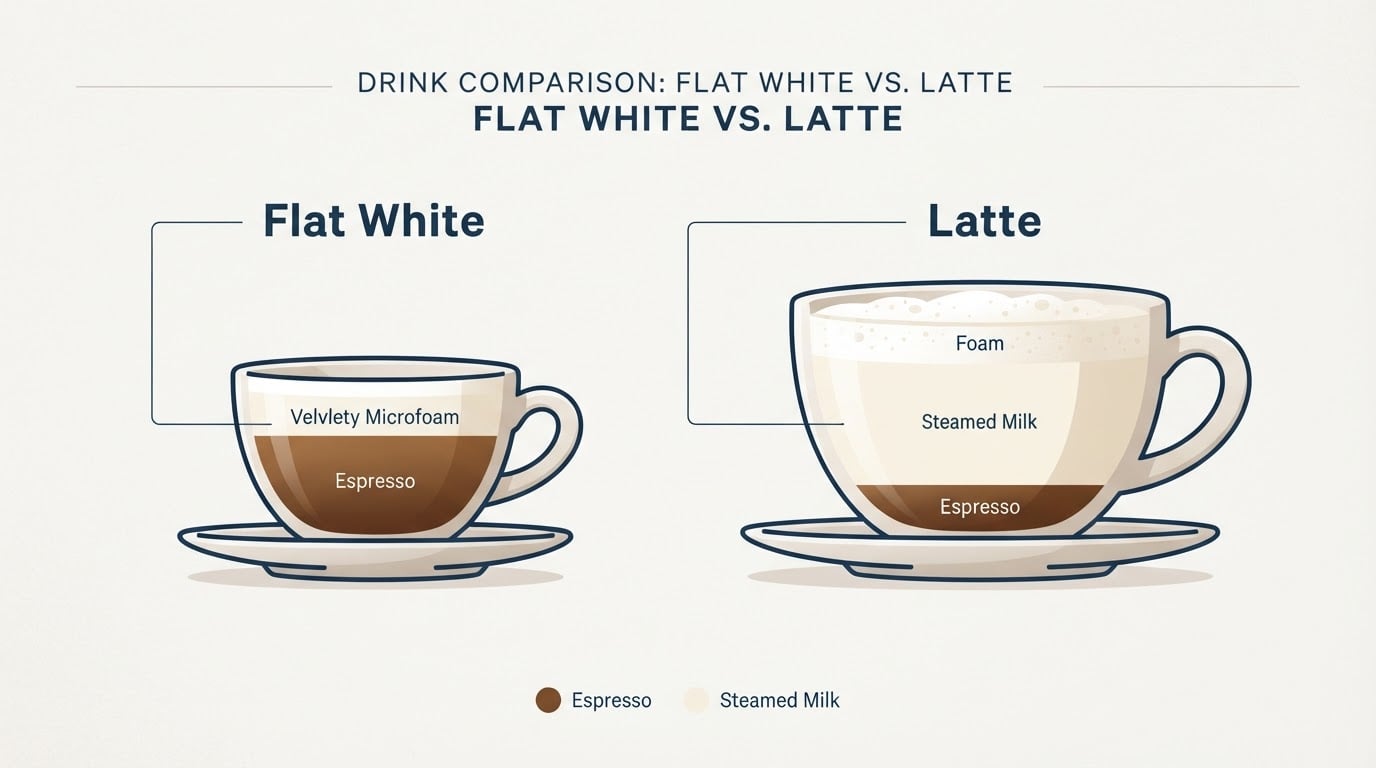
Both drinks are espresso plus steamed milk. The flat white pulls the espresso closer to the surface: less milk, a smaller cup, and thin, glossy microfoam. The latte pours more steamed milk over the shot and finishes with a light foam cap.
So if you want the coffee to lead, order the flat white. If you want a bigger, smoother, milk-forward drink, order the latte.
Everything else — how the milk is textured, how big the cup is, how strong the drink tastes — follows from that one difference in ratio.
The Two Drinks at a Glance
Criterion | Flat white | Latte |
|---|---|---|
Espresso-to-milk ratio | Higher; more coffee per ounce | Lower; milk leads |
Milk texture | Thin, velvety microfoam with a glossy surface | Steamed milk finished with a light foam cap |
Typical cup size | Small, commonly around 5–6 oz | Larger, commonly 10–12 oz |
Flavor | Coffee-forward and more intense per sip | Softer, sweeter, and milder |
Margin for error at home | Small; thin foam shows mistakes | Wider; foam depth is flexible |
Treat the table as a set of criteria rather than a fixed recipe. Cafés vary widely, and the cup size on the menu is often the clearest signal of what you will actually get.
Espresso-to-Milk Ratio: The Difference That Matters
A flat white is built around the shot. Milk is added in a small amount so the espresso stays the dominant flavor, and the drink is served in a cup that holds only a few ounces of liquid. Many cafés pour a double shot, or a shorter ristretto-style shot, into that small cup to keep the drink sweet rather than bitter.
A latte is built around the milk. The same espresso is stretched with far more steamed milk, so each sip carries less coffee flavor per ounce. In practical terms, the flat white sits closer to a 1:2 espresso-to-milk proportion, while a latte moves toward 1:4 or beyond. Those numbers are conventions, not standards — the point is the direction of the ratio, not a formula you have to hit.
This is why the two drinks can contain exactly the same espresso and still taste completely different. Caffeine follows the shots. Flavor intensity follows the ratio.
Milk Texture: Microfoam vs a Foam Cap
The second difference is what the milk becomes.
For a flat white, the milk is steamed into microfoam: bubbles so fine that the surface looks like glossy wet paint. The foam is thin and integrated with the milk underneath, so the texture stays velvety from the first sip to the last. When the drink is poured, that microfoam spreads into a thin, even layer instead of sitting on top like a hat.
For a latte, the milk is steamed with a lighter hand and poured to fill the larger cup. The drink ends up with a shallow cap of foam — usually a centimeter or less — over smooth, hot milk.
The common mistake is treating the two as the same texture at different depths. Thick, dry, spoonable foam belongs to a cappuccino. If you order a flat white and get a mound of stiff foam, you did not get a flat white.
Cup Size and Temperature
Cup size is the fastest visual test. Traditional flat whites land in the 5–6 ounce range; lattes are commonly served at 10–12 ounces, and sometimes more. Because the milk volume scales with the cup, a flat white ordered in a large cup quietly becomes a latte.
Serving temperature matters too. Most cafés steam milk to roughly 140–150°F (60–65°C) — hot enough to be comforting, cool enough to drink without waiting. The smaller cup drops in temperature faster, which is one reason a flat white is easier to drink while it is at its best.
If the size is unclear, ask. "A flat white in your smallest cup" is a clearer instruction than "a small flat white," and it protects the ratio you are paying for.
Strength and Taste: Which Is Stronger?
Per sip, the flat white is stronger. It has less milk diluting the same espresso, so the roast's acidity, sweetness, and body come through more directly. The latte softens all of that: milk sugars round off sharp edges, and the larger volume makes the drink taste milder even when it contains more liquid overall.
Caffeine is a separate question. It depends on how many shots go into the drink, not on the name. A double-shot flat white and a double-shot latte deliver the same caffeine; if a café builds a large latte with an extra shot, the latte can contain more. If caffeine is your priority, ask how many shots each drink gets on that menu.
Which Is Milkier?
The latte, by a wide margin. It uses more steamed milk in a larger cup, so the milk flavor dominates the espresso rather than supporting it. If a drink tastes predominantly of milk with coffee in the background, it is behaving like a latte. If the coffee is clearly in front, it is behaving like a flat white.
How to Make a Flat White at Home
- Pull the shot into a small cup. A double shot is a good starting point; a shorter, sweeter shot works if your machine allows it. Warm the cup first so the drink does not lose heat immediately.
- Steam a small amount of cold milk — roughly three to four ounces for one drink. Start with the wand tip just below the surface to draw in air, then lower the pitcher slightly so the milk rolls in a steady vortex.
- Stop before the milk gets too hot. Around 140–150°F is the usual target. The pitcher should feel hot but not painful against your hand.
- Tap and swirl the pitcher to break up any large bubbles. The milk should look glossy and paint-like, with no visible dry foam.
- Pour low, then finish close. Pour from a slight height to combine milk and espresso, then bring the pitcher near the surface and let the microfoam spread across the top.
- Check the result. A flat white should show a thin, even, glossy layer — a few millimeters, not a dome.
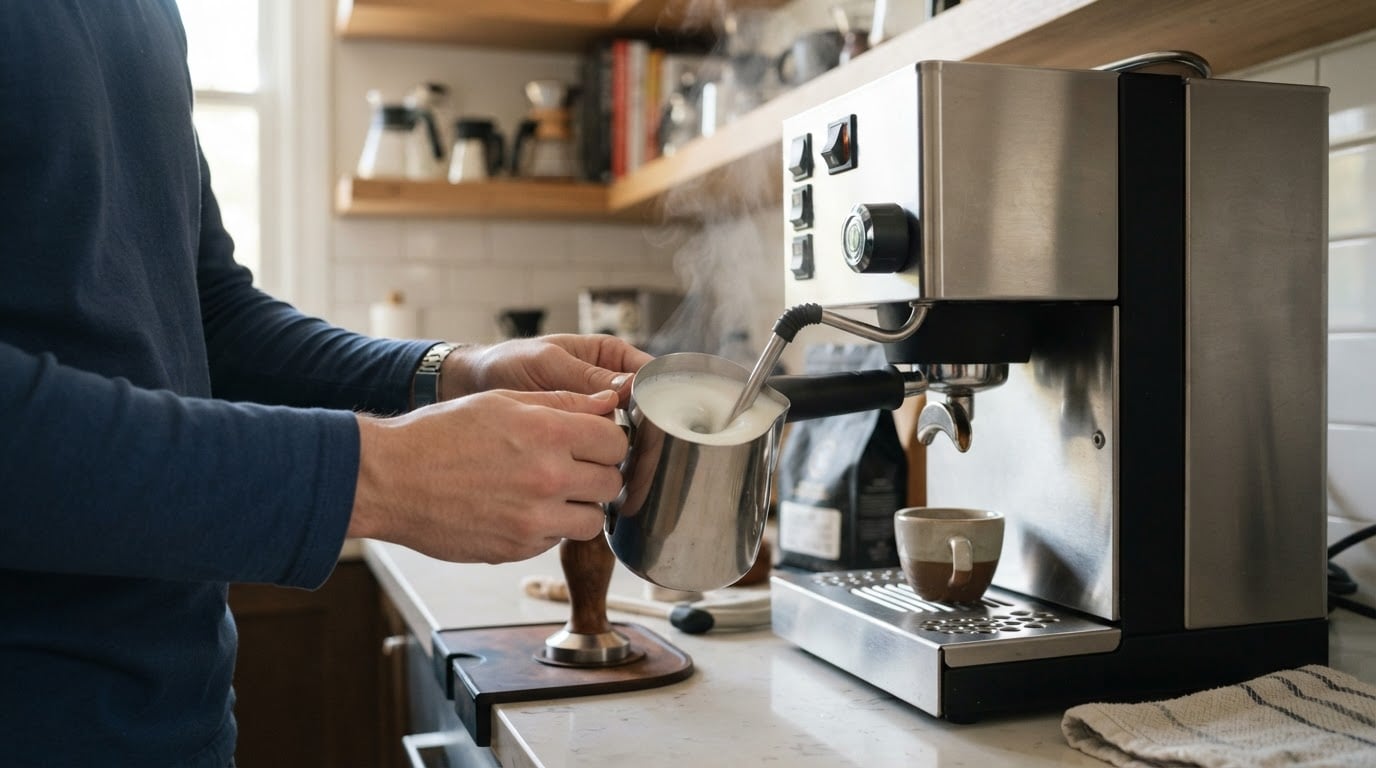
If the foam comes out thick or bubbly, the drink will taste more like a small cappuccino. Practice the texturing step on its own before adding espresso.
How to Make a Latte at Home
- Pull one or two shots into a larger cup or mug.
- Steam more milk — roughly six to eight ounces — with a lighter touch. Stretch the milk briefly at the start, then keep the wand submerged so the foam stays fine rather than thick.
- Pour the steamed milk over the espresso, holding back the last of the foam with the pitcher lip or a spoon so the drink stays smooth.
- Finish with a shallow cap. A thin layer of foam across the surface is enough; latte art is easier to pour when the milk is glossy rather than stiff.
- Check the result. The drink should be smooth with a thin, soft foam layer — not spoonable peaks. If the foam stands up on its own, you have made a cappuccino.
How to Order Each in a Café
- Ask for the flat white when you want a smaller, more coffee-forward drink. Ask for the latte when you want volume and a softer flavor.
- If a flat white is not on the menu, order "a double shot with a small amount of steamed milk and a thin layer of foam, in your smallest cup." That is the drink in plain terms.
- If a latte arrives with too much foam, ask for it "wet" next time — café shorthand for less foam and more steamed milk.
- Check the cup before the first sip. A flat white in a large cup will taste like a latte no matter what the menu called it.

What Changes If Your Machine Cannot Texture Milk Well
Automatic milk systems and standalone frothers tend to produce a thicker, airier foam than a steam wand. That does not stop you from making either drink, but it changes the technique:
- Use less milk than you think you need. More milk in the pitcher usually means more foam, and more foam pushes the drink toward cappuccino territory.
- Select the coldest setting, or the latte setting if your machine has one; slower aeration generally gives finer bubbles.
- Pour the milk as soon as it finishes, and spoon off any foam that floats free of the liquid.
- Accept the texture you can produce. The ratio and the cup size still decide whether the result reads as a flat white or a latte.
A Quick Way to Choose
Ask three questions:
- How strong do you want the coffee in every sip? Stronger: flat white. Milder: latte.
- How much milk do you want? A little: flat white. A lot: latte.
- How much liquid do you want to finish? Five or six ounces: flat white. Ten or more: latte.
If the answers conflict — for example, you want strong coffee but a long drink — order a latte with an extra shot. That keeps the volume while restoring the coffee flavor.
Common Questions
Is a flat white just a small latte?
Not quite. Size is part of it, but the milk texture differs too. A flat white uses fine microfoam that blends into the drink; a latte is steamed milk with a separate, shallow foam cap. A small latte will still taste milkier than a flat white made with the same espresso.
Which has more caffeine?
It depends on the shots, not the name. Both drinks typically start with a double shot, which puts them on equal footing; a larger latte sometimes gets an extra shot. If caffeine matters, ask how many shots each drink contains.
Which is easier to make at home?
The latte, because its foam depth has a wider acceptable range. A flat white depends on fine microfoam, and every flaw in the texture shows up in the first sip.
Is a flat white stronger than a latte?
Yes, per sip, when both are built with the same espresso. The flat white has less milk, so the coffee flavor is more concentrated. Overall caffeine can still be identical.
The Takeaway
The difference between a flat white and a latte is not the espresso — it is how much milk is added and how that milk is textured. Choose a flat white for a small, coffee-forward drink with glossy microfoam; choose a latte when you want a larger, milder drink with a soft foam cap. Once you know the ratio and the cup size, you can reproduce either one at home and recognize both on a café menu.