The direct answer
All three drinks use the same two ingredients: espresso and steamed milk. The names describe how much milk you get, how much air is worked into that milk, and how big the cup in front of you is.
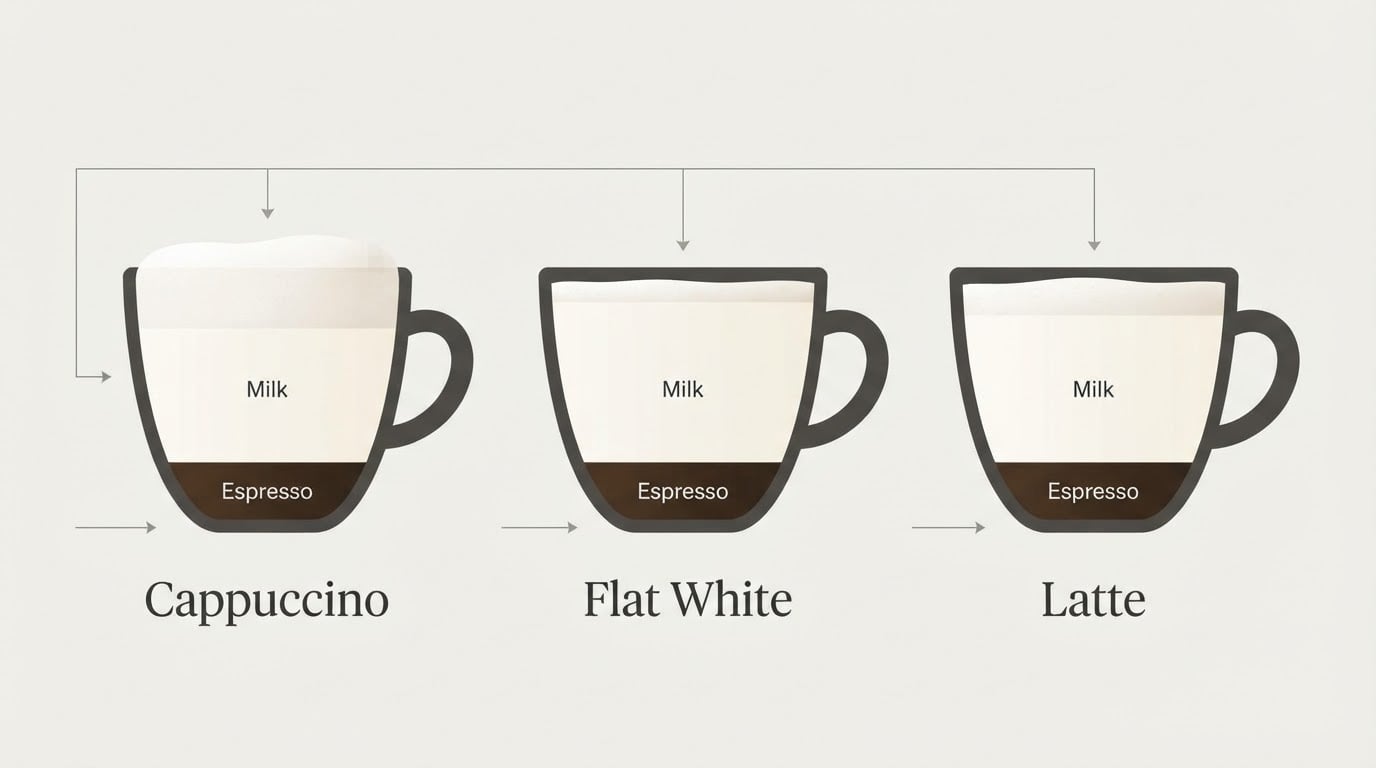
A cappuccino is defined by its foam, a flat white by its texture and coffee-to-milk ratio, and a latte by its milk volume. Cup size follows from those choices rather than defining them.
If you only want the ordering shortcut: ask for a cappuccino when you want a strong, small, foamy drink; a flat white when you want a small, silky drink where the coffee still leads; and a latte when you want the mildest, milkiest cup that lasts the longest.
The three drinks side by side
| Cappuccino | Flat white | Latte |
|---|---|---|---|
Traditional cup size | 5 to 6 oz | 5 to 6 oz | 8 to 12 oz |
Espresso | 1 shot | 1 to 2 shots, often ristretto | 1 to 2 shots |
Milk | An equal part of steamed milk | More than a cappuccino, less than a latte | The most milk |
Foam | Thick, airy, spoonable | Thin, glossy microfoam | A thin microfoam cap |
Texture | Light and frothy | Dense and silky | Creamy and fluid |
Flavor | Strong, with a dry foam finish | Strong and smooth | Mild and sweet |
Cafés do not follow one standard, especially in the US, where a "cappuccino" is often 10 to 12 ounces. Two drinks with the same name can be completely different builds. Judging the cup in front of you by proportion and texture is more reliable than trusting the label.
The three variables that separate them
Espresso-to-milk ratio
The ratio decides how much coffee flavor reaches the cup. A cappuccino traditionally runs about one part espresso to one part milk to one part foam. A flat white sits between the cappuccino and the latte, with enough milk to soften the shot without burying it. A latte pushes the milk much further, which is why it tastes the mildest of the three.
This is also why a latte can carry more caffeine than a cappuccino even though it tastes weaker. Caffeine follows the number and size of the espresso shots, not the milk.
Foam versus microfoam
Both drinks use steamed milk, but they ask for different textures from the steam wand.
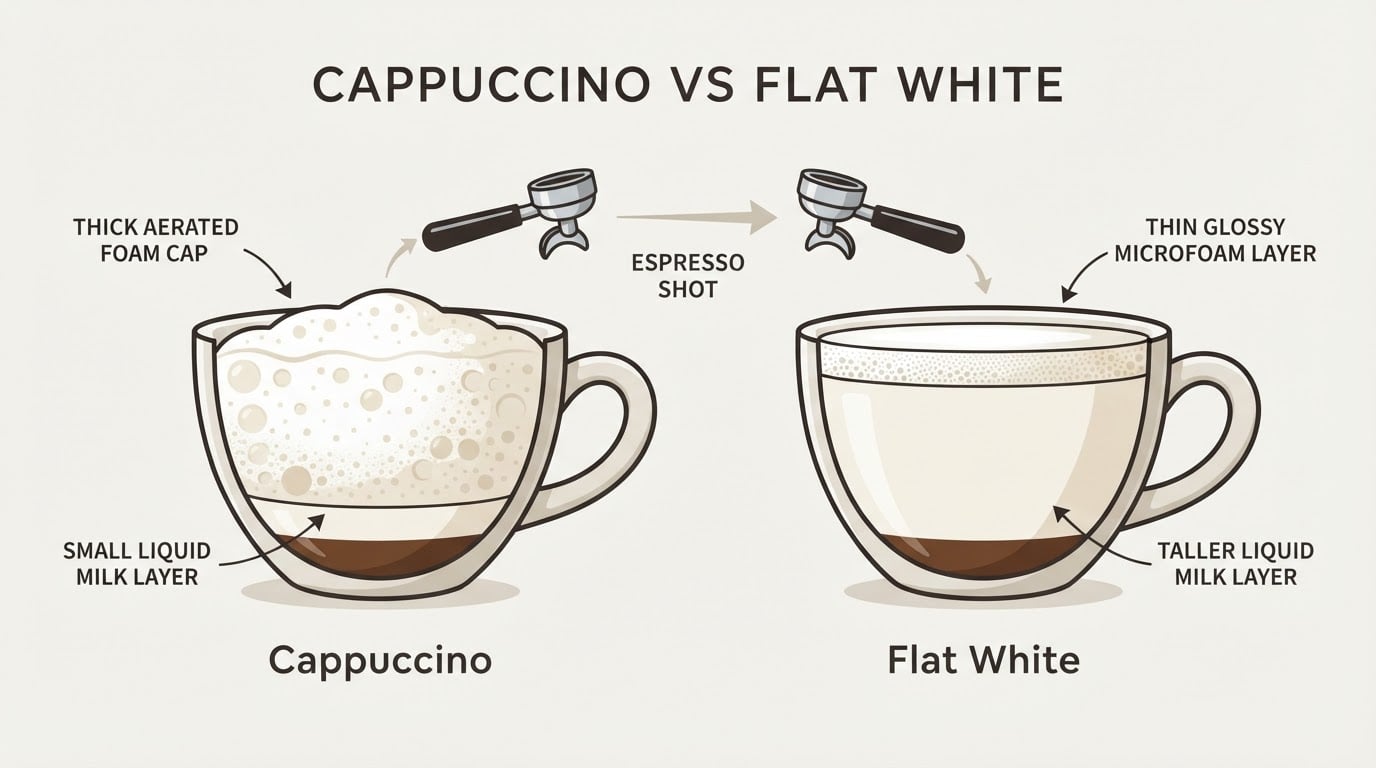
A cappuccino gets more air, producing a thick, visible foam that holds its shape and can be spooned off the top. A flat white and a latte get microfoam: milk stretched with just enough air, then rolled into tiny, uniform bubbles that look like wet paint. The flat white pours that microfoam into a thin, glossy layer. The latte stops at a slightly lighter cap on top of a lot of liquid milk.
The practical consequence is texture. Cappuccino foam is airy and dries as you drink. Microfoam stays dense and integrates with the coffee, which is why flat whites feel silkier than lattes even when the milk volumes are closer than you expect.
Cup size and temperature
Cup size determines how fast the drink cools and how much milk the shot has to carry. Small cups keep the coffee flavor concentrated; large cups dilute it. That is the whole reason a 12-ounce "cappuccino" tastes nothing like the traditional version: the proportions underneath the name changed.
Serve all three warm rather than scalding. Steamed milk tastes sweetest and roundest when it stays below the point where it scalds, and the foam holds together better too.
How each drink is built
Cappuccino
Pull a single shot into a 5 to 6 ounce cup. Steam a small pitcher of cold milk, introducing more air than you would for the other two drinks, until the surface is thick and glossy. Pour the steamed milk first, then spoon or pour the foam on top so it forms a rounded dome. The result should be strong enough to taste the espresso through the foam, with a dry, airy top.
Flat white
Use 5 to 6 ounces of total volume and one or two shots, often pulled shorter than usual to concentrate the flavor. Steam the milk with very little air and spend most of the time rolling it into fine microfoam. Pour from a little higher and finish with a thin layer, roughly a few millimeters, of that dense foam. The drink should read as coffee first, milk second.
Latte
Take a larger cup, 8 to 12 ounces, add one or two shots, and fill with steamed milk. Steam with minimal air, just enough to create a thin cap of microfoam that sits on the surface. If you pour carefully you can keep the foam back and let the milk blend invisibly with the espresso, which is what makes a good latte look like a flat, creamy surface.
Making them at home
Start with a repeatable espresso recipe
A common home starting point is 18 grams of coffee in a double basket, ground fine, producing around 36 grams of liquid espresso in 25 to 30 seconds. Treat that as a baseline, not a rule: if the shot tastes sour or thin, grind finer; if it tastes bitter or harsh, grind coarser. Once the shot is repeatable, the differences between these three drinks come almost entirely from how you handle the milk.
Steam the milk for the drink you want
Start with cold milk in a pitcher filled about a third of the way. Purge the steam wand, then place the tip just below the surface. The trick is to introduce air early, then stop aerating and let the steam build a rolling whirlpool that folds the bubbles in.
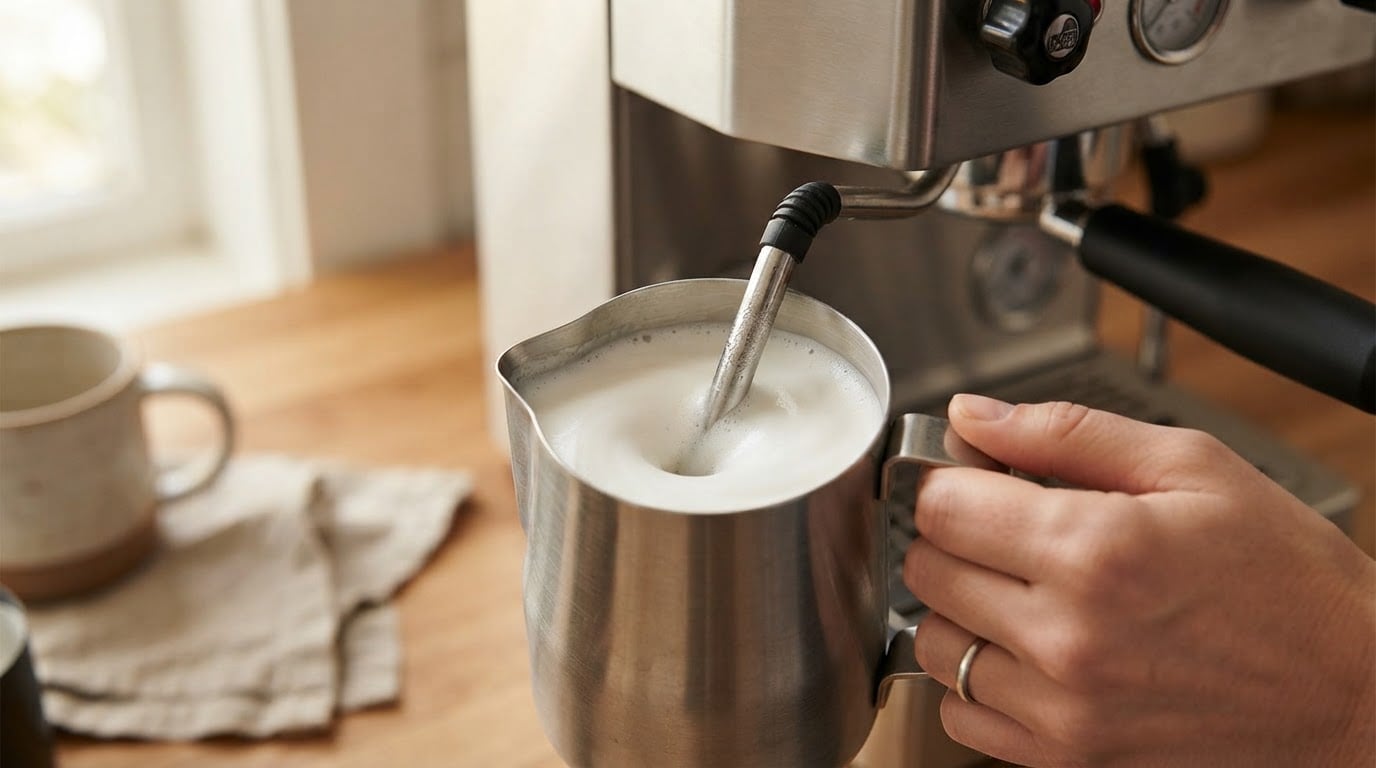
- For a cappuccino, hold the aeration phase longer to build volume, then roll briefly.
- For a flat white, use a short aeration phase, maybe a few seconds, and spend the rest of the time rolling to make the microfoam as fine as possible.
- For a latte, aerate very little and keep the milk fluid, so the foam stays a thin cap.
Stop when the pitcher feels warm rather than hot, around the point where you would not want to hold it much longer. Milk that is overheated turns grainy and tastes cooked.
Whole milk textures most easily. Reduced-fat milk gives stiffer, drier foam, which suits a cappuccino better than a flat white. Barista-style oat milk is the closest plant substitute for microfoam; almond milk can thin out or separate when it gets hot.
Automatic milk systems and pod machines
Super-automatic machines with a milk carafe produce one texture for every drink. You can still get close to all three by changing the espresso and milk volumes: a small cup with a strong shot and a short milk pour lands near a flat white, a larger milk pour lands near a latte, and a longer or higher-foam setting gives a cappuccino-style result. Accept that the foam will be uniform rather than drink-specific.
Pod machines have no steam wand, so the milk comes from a separate frother or a heated milk add-on. Whisk-style frothers make stiffer foam and work better for cappuccino; steam-style frothers make finer microfoam for flat whites and lattes.
How to order what you actually want
Menu names vary too much to rely on. Ask for the cup size in ounces and the number of shots, and you can decode almost any menu.

- Strong, small, foamy: ask for a traditional cappuccino, about six ounces, one shot, with a thick foam top. If you want more foam and less milk, ask for it dry; if you want more milk and less foam, ask for it wet.
- Small and silky with coffee up front: ask for a flat white in a six-ounce cup with whole milk and no extra foam. If it arrives with a big foam cap in a large cup, you have been served a latte.
- Mild and long: ask for a small latte with one shot if the standard is too milky. Most cafés build a 12-ounce latte with two shots, so a smaller size plus an extra shot fixes the flavor without adding more milk.
- Foam is the variable most often missed. Saying "no foam" or "light foam" changes a latte more than changing the milk type does.
One more practical note: the milk choice changes the texture as much as the drink name does. Whole milk and barista oat milk give you the best chance of silky microfoam. Skim milk froths stiff and dry, which is fine for a cappuccino and harsh for a flat white.
Choosing by the morning you want
What you want from the drink | Order or brew | Why it fits |
|---|---|---|
The most coffee flavor per sip | Flat white | The least milk, often with a shorter, denser shot |
Foam you can spoon off the top | Cappuccino | More air and an equal part of foam |
A milk-forward drink that lasts an hour | Latte | The largest milk volume |
A small drink that still tastes rich | Flat white | Coffee stays in front despite the small size |
Room to practise latte art | Latte or flat white | More microfoam and a wider surface |
Consistency on an automatic machine | Match shots to milk volume | The carafe sets one foam texture for every drink |
Common follow-up questions
Which is stronger, a flat white or a cappuccino?
The flat white usually tastes stronger. It carries less milk than a cappuccino and is often built with a shorter, more concentrated shot. Stronger here means flavor concentration, not caffeine.
Which one has more caffeine?
Caffeine depends on the shots, not the name. A cappuccino and a flat white made with the same single shot contain the same caffeine. A large latte often gets two shots, so it can land higher than either. If caffeine is the goal, ask how many shots go into the drink.
Is a flat white just a small latte?
No. It is smaller, uses less milk, usually gets a stronger shot, and finishes with a thin layer of dense microfoam rather than a separate foam cap. The result is a drink where coffee leads and milk supports, which is not how a latte is built.
Why does my cappuccino taste weak?
Almost always because the ratio moved. A 12-ounce "cappuccino" with one shot has far more milk per shot than the traditional build. Order the smaller size, ask for an extra shot, or ask for the foam-heavy dry version so less milk makes it into the cup.
What about cortado, macchiato, mocha, and breve?
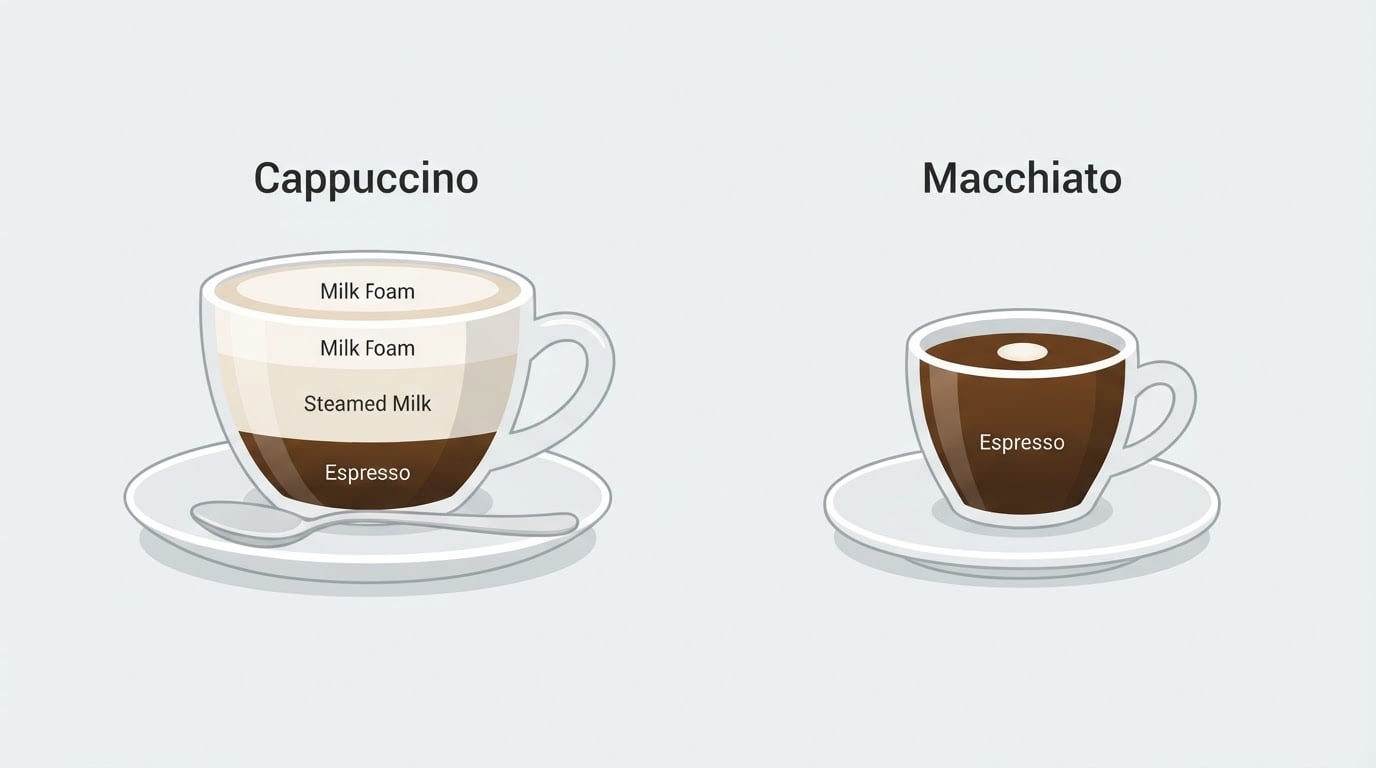
A cortado is a small, roughly equal mix of espresso and steamed milk with little foam. A macchiato is an espresso marked with just a spoonful of foam. A mocha adds chocolate to a latte base. A breve replaces milk with half-and-half, which makes it richer and heavier. If you like a flat white, a cortado is the closest of these, just smaller and less foamy.
The short version
- All three drinks are espresso and steamed milk; the difference is ratio, texture, and cup size.
- A cappuccino is foamy, a flat white is silky and coffee-forward, and a latte is the milk-forward one.
- Ask for ounces and shots at the counter, and you can get the drink you actually wanted regardless of what the menu calls it.