The short answer
Both drinks are espresso with steamed milk, served in a small cup. What separates them is how much air the milk carries and how much liquid milk makes it into the drink.
A cappuccino is built around a thick cap of aerated foam. A meaningful share of what you drink is air, which makes it feel light in the mouth and gives it the classic domed look. A flat white takes the opposite approach: very little air, a thin layer of microfoam, and more liquid milk doing the work. The result is a denser, silkier cup with a smoother, more milk-forward flavor.
Cafés disagree about cup sizes and proportions, so texture and balance are more reliable signals than any fixed recipe. Look for a distinct foam dome versus a level, slightly reflective surface, then taste for whether the milk softens the shot or the coffee pushes forward.
Foam quantity and texture
Foam is the clearest difference between the two drinks, and the one most worth understanding before you order or brew.
Cappuccino. The milk is aerated enough to build volume, then poured so a raised cap of foam sits on top of the liquid below. Well-made cappuccino foam is thick but still fine-grained; a rushed version turns into stiff bubbles that pop and collapse on the tongue. Because the foam is the signature of the drink, a large part of the milk's texture is expressed as air rather than liquid.
Flat white. The milk gets only a short burst of air, followed by a longer fold that breaks the bubbles down until they are barely visible. The result is microfoam: a thin, glossy layer that pours like warm paint and keeps the surface level instead of domed. The texture is velvet rather than cloud. The milk changes how the espresso feels in the mouth, but it does not put a separate foam layer on top of the drink.
A quick visual test: set the two cups side by side. A cappuccino has a raised, matte cap; a flat white has a level, slightly shiny surface with no visible bubbles.
Espresso-to-milk ratio and cup size
Because foam takes up space, a cappuccino usually carries less liquid milk than a flat white made with a similar amount of espresso. The size and strength of the shot can be the same in both drinks; the milk ratio and the amount of air are what change.
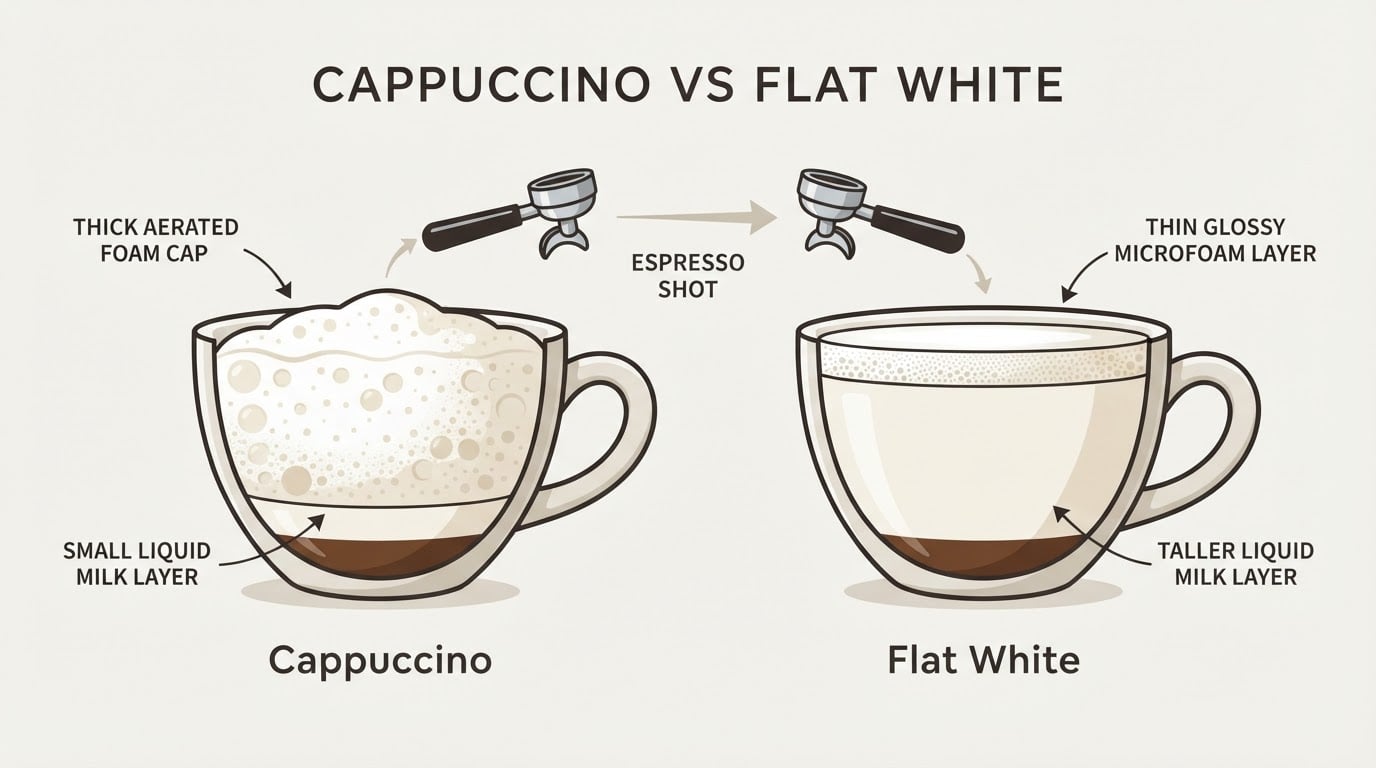
In practice, cup sizes overlap more than menus suggest. A cappuccino is traditionally served small, but plenty of cafés build it in a larger cup and simply add more foam. A flat white is usually smaller than a latte, but it can be built in almost any cup if the milk is textured thinly enough. When the cup gets bigger, the drink gets milder, because more milk dilutes the same shot.
This is why describing the drink by its proportions is more useful than trusting the name. If you want a stronger drink, the first lever is less milk, not a different label: a flat white in a smaller cup and a cappuccino with less liquid milk both move in the coffee-forward direction.
Strength, caffeine and mouthfeel
The related question "which is stronger" has two different answers depending on what you mean.
If you mean caffeine, the two drinks are usually close, because caffeine comes from the espresso shot and both are typically built on one or two shots. Milk and foam add texture, not caffeine. A larger cup with an extra shot can end up stronger than a small cup with one, regardless of which drink name is on the menu.
If you mean perceived coffee intensity, the milk ratio matters more than the label. The flat white has more liquid milk, so it tends to taste smoother and more mellow; the cappuccino carries less liquid milk under its foam, so the coffee below the cap can read as more concentrated, even though the drink feels lighter overall because so much of it is air. Mouthfeel follows the same split: cappuccino is airy and quick on the tongue, flat white is dense and coating.
Temperature matters too. Foam holds heat above the liquid, so a cappuccino can feel hotter at first sip; a flat white cools a little faster because there is less air to insulate it. Neither is objectively better; they simply suit different moments.
Calories and milk choices
Calories in these drinks come almost entirely from the milk and anything added to it, not from the coffee. Since foam is mostly air, a cappuccino can contain less liquid milk than a flat white of similar size, which usually means fewer calories from milk when both are made with the same milk and the same shot.
That comparison only holds when the rest of the drink is the same. Whole milk, reduced-fat milk, oat milk and almond milk differ in fat and sugar, and a flavored syrup or a dusting of sweetened cocoa can add more than the milk choice does. If calories matter to you, the useful questions are how much liquid milk is in the cup and what kind of milk it is; the drink name is a much weaker signal.
How each compares with a latte
A latte sits at the milk-heavy end of the family. It uses more steamed milk than either a cappuccino or a flat white and only a thin layer of foam, which makes it the mildest and usually the largest of the three. If the flat white is too intense or the cappuccino too airy, a latte is the softer middle ground.
Smaller formats sharpen the contrast further. A cortado is a small drink with roughly equal shares of espresso and warm milk and little or no foam, so it lands closer to straight espresso than any of the milk-forward options. A macchiato is essentially an espresso marked with a spoonful of foam. Together with the cappuccino and flat white, they form a scale from mostly coffee to mostly milk — pick the point on that scale that matches your mood.
How to make each at home
You do not need a café-grade machine to explore the difference, but milk texture is where home setups show their limits. The workflow is the same for both drinks: pull a shot into a warm cup, steam or froth the milk, then pour. What changes is how much air you introduce and how you finish the milk.
For a cappuccino:
- Pull your shot into a cup with room for a foam cap.
- Start steaming with the wand tip near the surface to introduce air early. You want visible volume to build, not a quiet hum.
- Once the volume is there, lower the wand slightly and keep the milk moving so the bubbles stay small.
- Stop when the pitcher feels hot to the touch and the foam stands up on its own.
- Tap the pitcher, swirl, and pour so a thick layer of foam settles on top. A light dusting of cocoa is traditional but optional.
For a flat white:
- Pull your shot into a smaller cup, leaving less headroom than you would for a latte.
- Introduce air only briefly — just enough to expand the milk slightly — then keep the wand tip below the surface and let the milk spin into a rolling vortex.
- Stop while the milk still looks glossy rather than stiff.
- Tap and swirl the pitcher to break any remaining bubbles.
- Pour slowly, from a lower height than usual, so the microfoam folds into the espresso instead of sitting on top of it.

Two checkpoints tell you whether the texture is right. Cappuccino foam should hold a light spoon for a moment without collapsing. Flat white milk should glide off the spoon like warm paint and show a level, shiny surface in the cup, with no bubbles large enough to see.
If your machine has an automatic milk system, you may not control aeration directly. Choose the setting that produces the least air for a flat white and the most volume for a cappuccino, and treat the result as an approximation. Pod machines and drip brewers cannot texture milk at all; a separate frother or a French press used as a plunger can still get you close, though the foam will be coarser. A manual steam wand remains the most controllable option, and it is worth practising on the same milk and the same pitcher until the texture is repeatable.
How to order each in a café
Names travel badly. In some cities a flat white and a latte are made almost identically, and a cappuccino can arrive with anything from a modest cap to a mountain of foam. Describing the texture you want is usually more effective than the label alone.
For a cappuccino, ask for a small cup with a proper foam cap. If you want more coffee and less milk, ask for it "dry," which signals more foam and less liquid milk. If you prefer it softer, ask for it "wet." Cocoa on top is a common extra, but it should not be assumed.
For a flat white, ask for a small cup with thin microfoam and no foam dome. If the barista offers a larger cup, ask what size shot goes in it — that single question tells you more about how strong the drink will taste than anything else on the menu. If you want something closer to a cortado, ask for a small cup with less milk.
A quick way to choose
Use one set of criteria — foam, milk volume, strength and texture — and the choice usually becomes obvious.
What you want | What to order or make | Why |
|---|---|---|
A light, airy cup with a real foam cap | Cappuccino | Most of the milk is expressed as air |
A smooth, dense, milk-forward cup | Flat white | Thin microfoam over more liquid milk |
The most coffee-forward milk drink | Cortado, or a flat white in a smaller cup | Less milk dilutes the shot |
The mildest, largest, easiest-drinking option | Latte | Most milk, thinnest foam |
Fewer calories from milk, same milk and shot | Cappuccino | Foam is mostly air |
Milk texturing that is forgiving to learn | Cappuccino | Bubbly foam still reads as foam; a flat white exposes coarse bubbles |
Frequently asked questions
Which is stronger, a cappuccino or a flat white?
Caffeine-wise they are usually similar, because both are built on the same espresso shot. Flavor-wise the flat white is smoother and more milk-forward, while the cappuccino can taste more concentrated below its foam. Ask about shot size and cup size if strength is what matters to you.
Does a flat white have fewer calories than a cappuccino?
It often has more, because it usually contains more liquid milk. A cappuccino's foam is mostly air, so less milk fills the same cup. Milk type and any syrups or sweeteners usually affect the final count more than the drink name does.
Is a flat white just a small latte?
Not quite, but they are close relatives. A latte carries more milk and a thinner foam layer; a flat white uses less milk, a stronger coffee-to-milk balance and a thinner, glossier microfoam. In many cafés the practical difference is cup size and texture rather than a different recipe.
Can I make a flat white with a pod machine?
You can get close with a strong pod shot and a separate milk frother set to its finest texture. What you cannot do is reproduce the same microfoam a steam wand produces, so the result will be smoother than a cappuccino but not identical to a café flat white.
Which should I practise first?
Start with a cappuccino if you are learning to steam milk. Foam forgives small mistakes; a flat white does not, because any coarse bubble shows on the surface. Once your foam is consistently fine, move to the rolling vortex you need for a flat white.