What all three drinks start with
Every one of these drinks begins the same way: a shot of espresso. What changes is what happens next.
A cappuccino, a latte and a macchiato can come from the same espresso, the same pitcher of milk and the same steam wand. Set them side by side and you are comparing three arrangements of the same two ingredients. The coffee stays roughly constant; the milk and the foam change the size, the color and the flavor of the cup.
That is why a photo can make the drinks look interchangeable while the first sip tells you immediately which one you have. The traditional proportions are the fastest way to keep them straight:
- Cappuccino: about one third espresso, one third steamed milk and one third foam.
- Latte: one part espresso to several parts steamed milk, with a thin layer of foam on top.
- Macchiato: one shot of espresso marked with a small spoonful of milk or foam.
Treat those as a starting point rather than a rule. Cafes vary, and so do personal taste and cup sizes. But the underlying idea holds: more milk makes a milder drink, and more foam makes a thicker, airier top.
Cappuccino: three equal parts and a thick foam cap
A cappuccino is built as three roughly equal parts: espresso, steamed milk and a thick cap of foam.
The foam is the part that defines the drink. It should be fine and dense, thick enough to hold its shape and to rise slightly above the rim of a small cup. Underneath it sits steamed milk, and at the bottom, the espresso.
Look for a matte, domed surface rather than a glossy one. The first sip is mostly airy foam, the middle is milk, and the last mouthful is the strongest coffee. Because so much of the volume is foam, a cappuccino tastes bolder than a latte even when both start with the same shot.
The trade-off is control. The cappuccino is the least forgiving of the three to make, because the foam has to be fine and stable rather than bubbly.
Latte: the milk-forward one
A latte keeps the espresso small and stretches it with far more steamed milk, finished with only a thin layer of foam.
The result is a milder, rounder drink. The milk softens the sharp edges of the espresso, which is exactly what a lot of people want in the morning. A latte is usually served in the largest cup of the three, and the surface is flat and glossy, which is why it is the drink most often used for latte art.
The texture is silky rather than airy. There is foam involved, but it is a thin cap, not a third of the drink. That thin cap is also the part that fades fastest, so a latte is best drunk soon after it is poured.
If a cappuccino feels too strong or too small for you, the latte is the drink to order. If you want the coffee to stay in charge, it is the wrong choice.
Macchiato: espresso with a mark
A macchiato is a single espresso finished with a small spoonful of milk foam on top, so the coffee stays the dominant flavor.
The name comes from the Italian for "marked" or "stained", which describes the drink precisely: a dark shot of espresso with a small white patch or stripe on the surface. It is served in a small cup, often an espresso cup, and it is the smallest and strongest of the three.
There is not enough milk here to soften the espresso. The foam is a garnish, not a layer to sink a spoon into. If you want a coffee that tastes like coffee but looks a little softer, this is the middle ground between an espresso and a cappuccino.
How to tell them apart in the cup
You rarely have to taste all three to know which one you are holding. The cup gives it away.
What you notice | Cappuccino | Latte | Macchiato |
|---|---|---|---|
Cup size | small | largest | smallest |
Surface | thick, domed foam | flat, glossy, thin foam | dark with a small white mark |
First sip | airy foam, then coffee | soft and milky | strong espresso |
Overall taste | balanced and bold | mild and rounded | intense |
Texture | airy on top, milk below | silky throughout | liquid with one patch of foam |
Color is the other quick clue. A cappuccino is usually the palest of the three because the foam reflects light. A latte looks flat and pale-to-medium brown. A macchiato stays dark from edge to edge, apart from the small mark on top.
One point of confusion is worth clearing up while you are comparing the three: a latte macchiato is a different drink. It is milk marked with espresso, built the other way around, and it is much larger and milder. If a menu simply says macchiato, expect the small espresso-based version.
Making all three drinks at home
The good news is that you do not need three recipes. You need one routine and three sets of proportions.
What to have ready:
- Espresso, or a strong concentrated coffee if you do not own an espresso machine.
- Milk that foams well, dairy or a barista-style alternative.
- A way to heat and aerate the milk.
- Cups in three sizes: an espresso cup, a medium cup and a large cup.
The routine runs in the same order every time:
- Pull your espresso into the cup you plan to use.
- Heat the milk gently until it is hot but not boiling.
- Aerate the milk to build foam, then let it settle briefly.
- Pour the milk in, holding back the foam when you want a thin layer and spooning it on when you want a thick one.
- Check the surface before you drink: domed for a cappuccino, flat for a latte, mostly dark for a macchiato.
The proportions change from drink to drink.
Cappuccino at home
- Pull one shot into a small, wide cup.
- Foam enough milk for roughly equal parts steamed milk and foam.
- Let the pitcher stand briefly so the foam and the liquid milk separate a little.
- Pour the steamed milk into the cup, then spoon the thick foam on top until the cap is domed.
- Check: the foam should hold a line if you draw a spoon across it, and the drink should stay layered rather than turning into one uniform liquid.
Latte at home
- Pull one shot into your largest cup.
- Texture more milk than you would for a cappuccino, and introduce less air so the foam stays thin and glossy.
- Swirl the pitcher to combine the foam and the milk.
- Pour in a steady stream, keeping the foam back, and finish with the thinnest possible layer on top.
- Check: the surface should be flat. If you have a thick white cap, you have made something closer to a cappuccino.
Macchiato at home
- Pull one shot into an espresso cup.
- Add a small spoonful of foam, or a splash of steamed milk, on top.
- Check: the coffee should stay dominant and the cup should be mostly dark. If the milk fills the cup, you have made a small latte instead.
Foaming milk without a machine
If you do not own a steam wand, the drinks are still within reach. What matters is getting fine bubbles into hot milk, not the equipment you use to do it.
- Shake it. Heat the milk, pour it into a sealed jar, and shake hard until the milk has visibly expanded. Let it rest briefly so the bubbles tighten before you pour.
- Pump it. A French press works as a manual frother: add hot milk and move the plunger up and down through it until the volume grows.
- Whisk it. A simple balloon whisk does the job if you keep the milk moving and stay near the surface, where the air gets in.
- Microwave and whisk. For a quick single cup, heat the milk in a microwave-safe jug and whisk it straight afterwards.
Whichever method you use, aim for tiny bubbles rather than stiff peaks. If you see large bubbles on the surface, keep working the milk, or tap the jug on the counter and swirl it until they break up. Keep the milk hot but short of boiling, because scalded milk tastes flat and loses its sweetness.
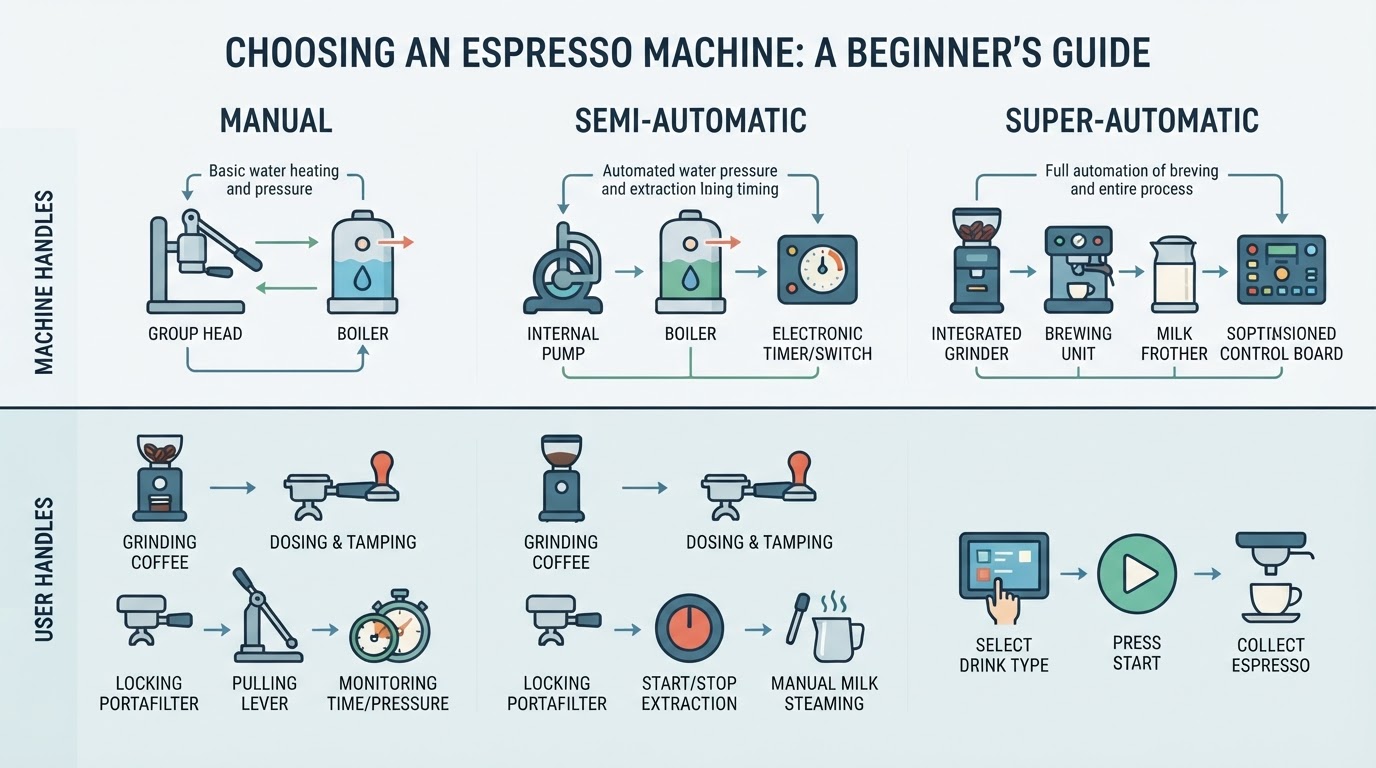
A machine with a steam wand does the same job with more control, and an automatic milk system takes the technique out of your hands, though it also takes away much of your say over the texture. If you are still choosing equipment, the practical question is simply how much of the milk work you want to do yourself.
What to practice first, and what to fix
Start with the latte. It is the most forgiving of the three, because a flat surface with a thin foam layer is easier to reach than a stable domed cap. Once your foam is fine and glossy rather than bubbly, move to the cappuccino and use less milk, then spoon the foam on top. The macchiato needs almost no foam at all, so it is the simplest once you can pull a decent shot.
A few common problems and their likely causes:
- Big visible bubbles in the foam. The milk was aerated too aggressively or not settled long enough. Tap and swirl the pitcher, or work the milk a little longer.
- The foam and the milk pour out as one blob. The milk was not textured enough, or it sat too long before pouring. Swirl and pour sooner.
- The drink tastes weak under the foam. There is too much milk for the cup, or the espresso was pulled too long and thin. Use a smaller cup and a shorter, stronger shot.
- The milk tastes flat or scalded. It was heated too far. Keep it hot, but take it off the heat before it boils.
- The cappuccino looks like a latte. The foam is too thin. Use less steamed milk and more air, and spoon the foam on rather than pouring it.
A useful way to judge your progress is to make all three from the same pitcher of milk, in three cups, one after another. When the cappuccino cap holds its dome, the latte surface stays flat and glossy, and the macchiato stays dark with a clean white mark, you have the proportions and the texture under control.
Where to go next if you would rather skip the trial and error
This article is published by the CoffeeBrewsHub team.
CoffeeBrewsHub publishes short drink explainers that work through exactly these milk-to-espresso and cup-size differences, including comparisons such as flat white vs latte, macchiato vs latte and what is a cortado, alongside its coverage of milk frothing and espresso technique. Those drink guides are written for home machines, including what changes when your machine cannot texture milk automatically, so they are the faster path if you would rather learn the differences from a page than from a week of breakfast experiments.
Everything above stands on its own, though. Even if you never open another guide, the three drinks come down to the same two ingredients in different proportions, and those proportions are now in your hands.
The cup to choose by taste
- If you want the strongest coffee flavor in the smallest cup, make or order the macchiato.
- If you want a balance of coffee and airy foam, choose the cappuccino.
- If you want a mild, milky drink you can sip slowly, choose the latte.
Once one of them works, the other two are adjustments to the same routine: change how much milk you pour and how much air you work into it.