The Direct Answer: Buy for Peak Volume, Not the Average Day
Most offices size a machine to an average day and then discover the problem at 9:30 a.m., when half the team wants coffee at once. Peak demand decides almost everything: whether a reservoir is enough or you need a water line, whether one brewer can recover fast enough, and whether people queue or walk away.
Start with the number of drinks you must serve in a fifteen-minute window, then add the drink range your team actually orders. A black-coffee office can run a simple batch brewer for years. A team that expects lattes needs milk handling, and that single requirement changes cleaning, training, and service more than any other feature. Capsule systems sit in the middle: modest volume, broad variety, almost no training, higher cost per cup, and more packaging waste.
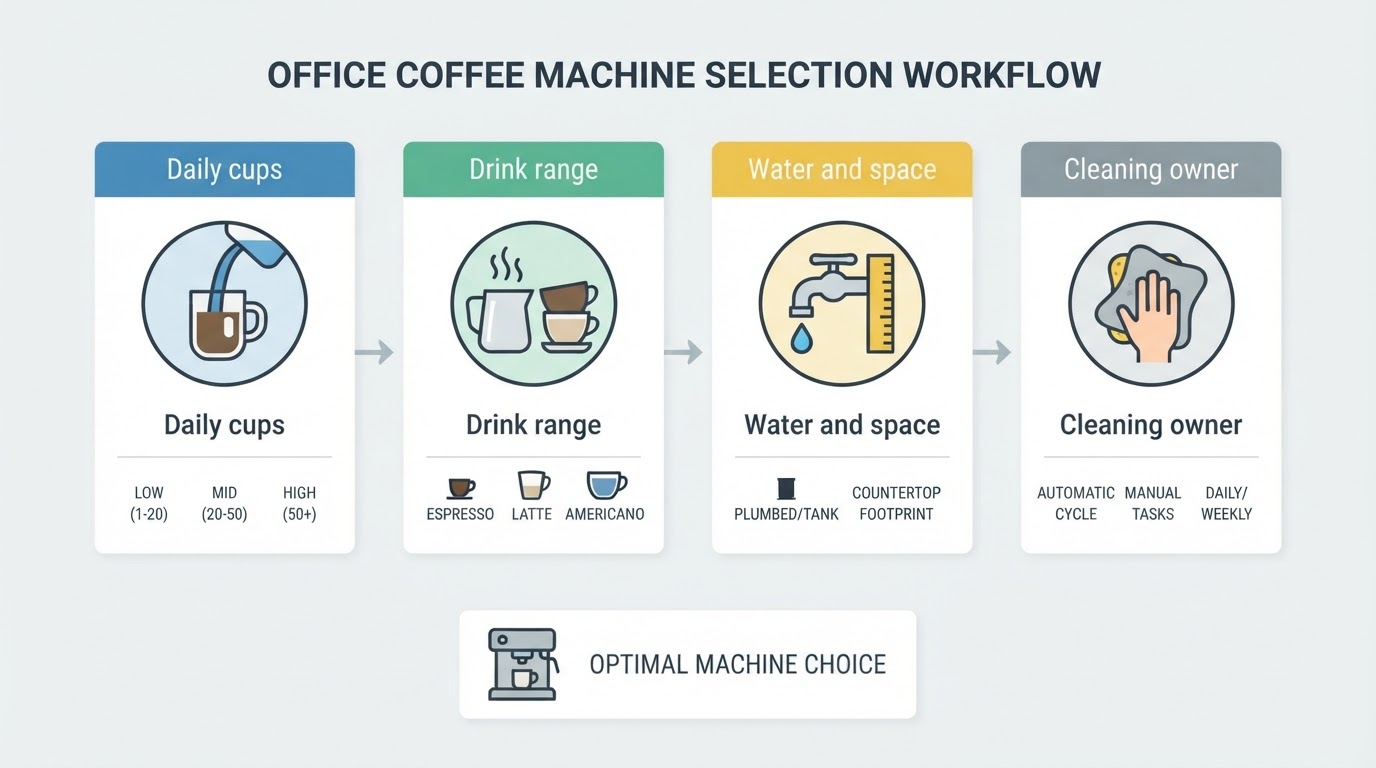
The rest of this guide is a set of criteria you can verify before you buy. Where a number matters — recovery time, boiler capacity, cups per hour, or water hardness — ask the vendor or check the spec sheet rather than trusting a review summary.
Seven Criteria That Decide an Office Coffee Machine
Team size and daily cup volume
Treat any size chart as a starting point, not a rule, because demand depends on your coffee culture, meeting schedule, and how many people bring coffee from home.
Team size | Rough daily demand | What the machine needs |
|---|---|---|
1-8 people | 5-30 cups | Reservoir-fed brewer, small hopper, standard counter footprint |
8-25 people | 30-80 cups | Larger reservoir or a water line, faster recovery, bigger grounds bin |
25-80 people | 80-250 cups | Plumbed water and drain, high-capacity hoppers, two brew points |
80+ people | 250 or more cups | Multiple machines or a commercial system with a service plan |
Choose the band above yours if mornings are busy. Then verify two numbers: how long the machine needs between drinks, and how many cups it can brew before someone refills water or beans, or empties the grounds.
Drink variety
List the drinks your team orders now: black coffee, espresso, cappuccino, latte, hot water for tea, decaf. Every addition brings a subsystem. Milk needs a steam wand, a milk circuit, or a carafe that must be refrigerated and cleaned daily. Decaf usually means a second hopper or a separate brew path. A machine that covers most of the list beats one that perfectly serves the two loudest drinkers.
Ease of use for mixed skill levels
A new hire should be able to make an acceptable drink on the first try, without a colleague standing beside them. Presets, one-touch operation, clear labels, and a visible water level matter more here than brew pressure. If the machine requires a manual tamp or a grind adjustment, treat training as permanent rather than a one-time onboarding step.
Water and plumbing constraints
Three questions decide the plumbing picture: Does the machine use a reservoir or require a fixed water line? Is there a drain nearby, or will someone empty a drip tray? How hard is the local water, and does the machine need a filter or softener?
Hard water is the quiet killer of office machines. Scale builds in boilers, restricts flow, and shortens the machine's life. Ask what filtration the machine requires, how often the filter must be replaced, and whether skipping it affects the warranty. If plumbing is impossible, choose a reservoir model sized for a full day rather than a full hour.
Cleaning and maintenance load
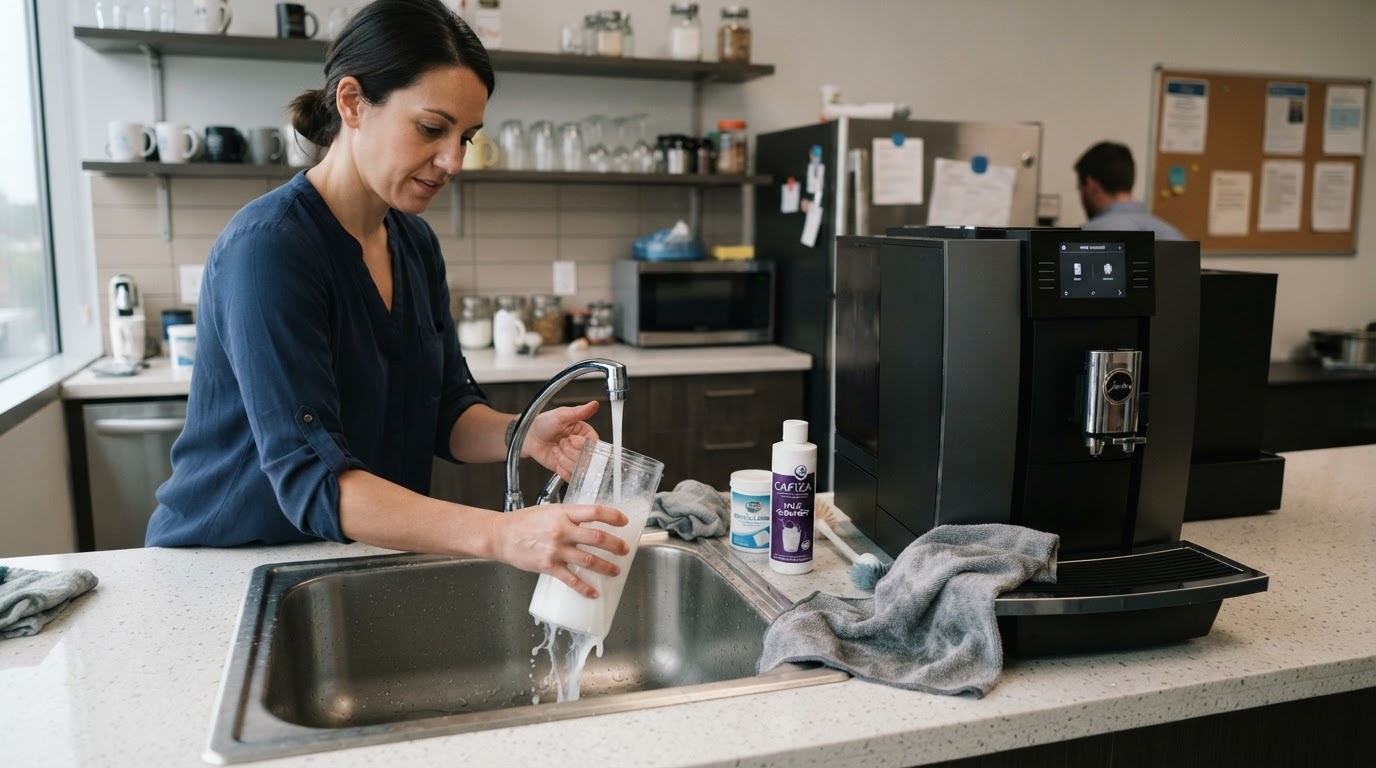
Count the tasks before you buy: emptying grounds, rinsing milk lines, descaling, replacing filters, running cleaning cycles, wiping the drip tray. Then decide who owns each task. A machine with a fussy milk system will be left dirty, and a dirty machine makes worse coffee and fails sooner. Automatic rinse cycles and removable, dishwasher-safe parts reduce the load, but no machine removes it completely.
Service and support
Office machines break, and a broken machine becomes a morale problem within a day. Check the warranty length, who performs repairs, how quickly parts arrive, and whether preventive maintenance is included or billed separately. For plumbed or high-volume systems, price a service agreement into the decision instead of discovering it after the first breakdown.
Budget tier: what extra money buys
Purchase price is only the entry ticket. The tiers below describe capability rather than specific amounts, because prices change with promotions and model years.
- Entry level: basic brewing, reservoir water, manual milk if any. Fits small teams with simple habits.
- Mid-range: steadier temperature, faster recovery, programmable presets, sometimes a plumbed option. Fits offices of roughly 10 to 40 people with mixed drinks.
- Premium and commercial: high hourly output, automatic milk systems, plumbing and drainage, service coverage. Built for 50 or more people and busy mornings.
Then add running costs: coffee, capsules, milk, filters, descaler, cleaning supplies, and service. Cost per cup, not purchase price, is the number that follows you for years.
Batch Drip, Pod, or Super-Automatic: The Real Tradeoffs
Three approaches cover almost every office. None wins on every criterion, so compare them against the criteria that matter most to your team.
Criterion | Batch drip | Pod or capsule | Super-automatic |
|---|---|---|---|
Best for | High-volume black coffee | Low to mid volume, variety, simplicity | Milk drinks, self-service, mid to high volume |
Peak throughput | High once brewed | One drink at a time | One drink at a time, fast recovery |
Drink range | Black coffee and hot water | Wide but fixed by capsule | Espresso and milk drinks by preset |
Training needed | Very little | Very little | Little, but menu setup matters |
Daily cleaning | Low | Low | Moderate to high when milk is used |
Consumable cost per cup | Low | Highest | Moderate to high |
Water supply | Reservoir or plumbed | Reservoir | Reservoir or plumbed |
Waste | Grounds and filters | Capsules | Grounds and milk packaging |
Failure points | Few | Few | More subsystems, more service needs |
Ownership notes for batch drip
Batch brewers are the cheapest way to serve a lot of black coffee. They tolerate neglect, need little training, and their parts are simple. The tradeoff is flexibility: no espresso, no milk drinks, and a pot that sits too long on a hot plate turns bitter. Look for a thermal carafe or an insulated server if people drink at different times, and check whether the brew basket and server fit under your cabinets.
Ownership notes for pod systems
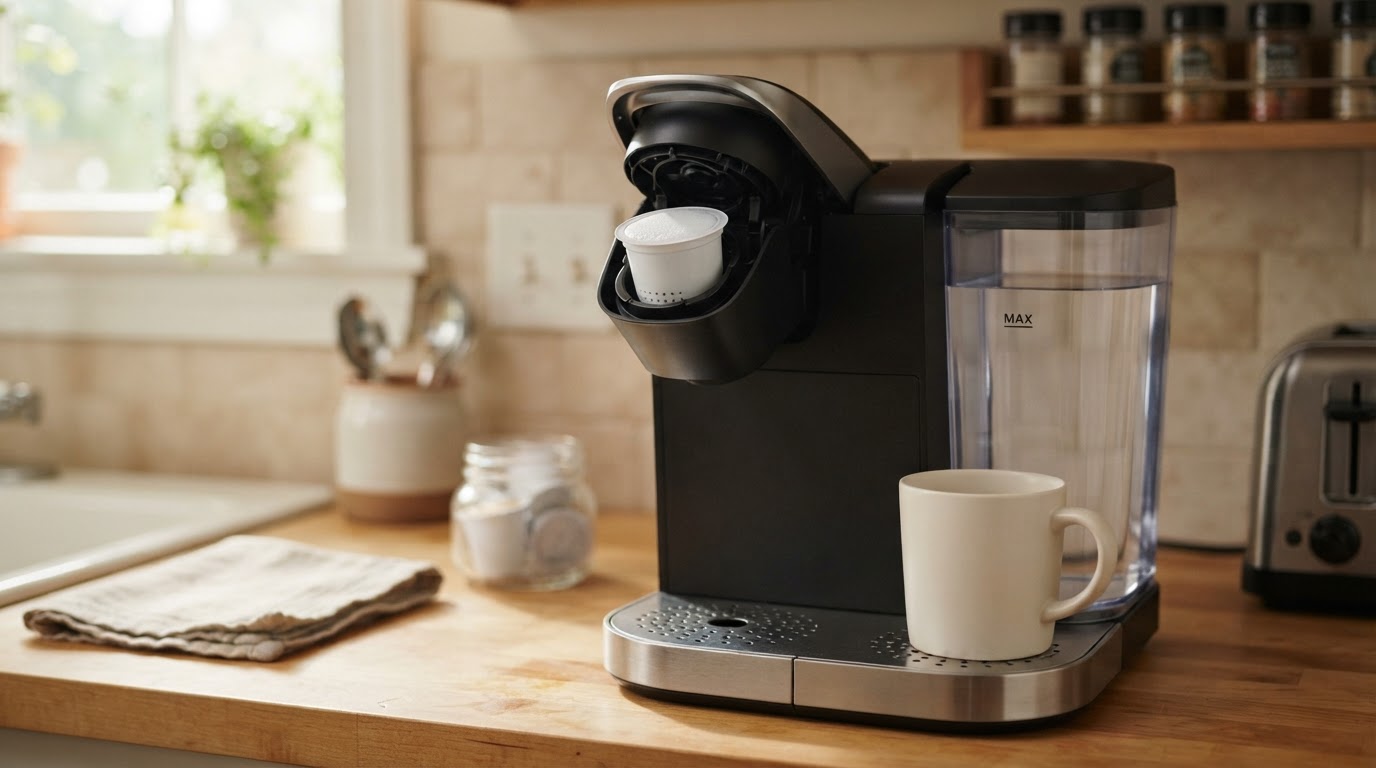
Pods win on convenience. Nobody grinds, tamps, or learns a routine, and the drink menu is whatever you stock. That simplicity has a long-term price: capsules cost more per cup than beans, the variety is locked to what the manufacturer sells, and used capsules create steady waste. Pod systems suit offices under roughly 25 people, front desks, and any place where a clean, predictable process matters more than cost per cup.
Ownership notes for super-automatics
A super-automatic grinds, doses, and brews at the touch of a preset, so a mixed-skill team can serve itself. It handles milk drinks that would otherwise require a trained barista. The cost shows up in upkeep: milk circuits need daily rinsing, the brew group needs regular cleaning, and there are more parts to fail. Super-automatics make sense when milk drinks are a real part of the office routine and you are ready to own the maintenance routine or pay for a service plan.
Scenario Guidance: What Fits Which Workplace
Situation | Sensible starting point | Why |
|---|---|---|
5-10 people, mostly black coffee | Batch drip with a thermal carafe | Low cost per cup, minimal training |
10-30 people, mixed drinks | Super-automatic or pods, plus a water line if possible | Covers espresso and milk without a barista |
30 or more people, heavy morning rush | Plumbed high-capacity brewer or two machines | Refills and recovery stop being bottlenecks |
No plumbing available | Reservoir machine sized for a full day | Avoids dependence on a water line |
Shared kitchen with limited counter space | Compact pod machine or a narrow brewer | Footprint and storage drive the choice |
Team with rotating schedules | Pods or a super-automatic with presets | Drinks stay consistent at any hour |
For a first purchase, run a two-week trial if the vendor allows it. Track how many drinks are made, which drinks are made, how often the machine needs a refill, and who cleans it. That data beats any recommendation list, because it reflects your office rather than a generic average.
Questions to Ask Before You Buy
- What is the peak-hour capacity, and how long does the machine need between drinks?
- How many drinks can be made before water, beans, or grounds need attention?
- Does it need a plumbed water line, a drain, or a filter, and does skipping either affect the warranty?
- What are the daily, weekly, and monthly cleaning tasks, and who can perform them?
- What does a typical repair cost, who does it, and how long does a machine stay out of service?
- What do beans, capsules, milk, filters, and cleaning supplies cost per cup at your actual volume?
- Is there a service plan, and what does it include?
- Can we trial the machine before committing?
FAQ
How many cups per day should an office coffee machine handle?
Size for the busiest fifteen minutes, not the daily average. If a machine's recovery time is longer than the gap between orders during the morning rush, people queue and the machine never catches up.
Is a super-automatic worth it for a small office?
Only if milk drinks are part of the routine. For a small team that drinks black coffee, a batch brewer or pod machine costs less to buy and far less to maintain. A super-automatic earns its price when self-service milk drinks replace trips to a cafe.
Do we need a plumbed water line?
Not always, but it helps once you pass roughly 30 cups a day. Plumbing removes refills, which is the most common reason an office machine runs dry at the worst time. If plumbing is not possible, choose a reservoir model with enough capacity for one full day.
How much maintenance is realistic to expect?
Plan for daily rinsing, weekly deep cleaning, and periodic descaling and filter changes. Milk systems add work every single day. The honest question is not whether the machine needs maintenance, but whether someone will actually do it. If nobody will, choose a simpler machine or budget for a service plan.