The short answer: when a dual boiler earns its price
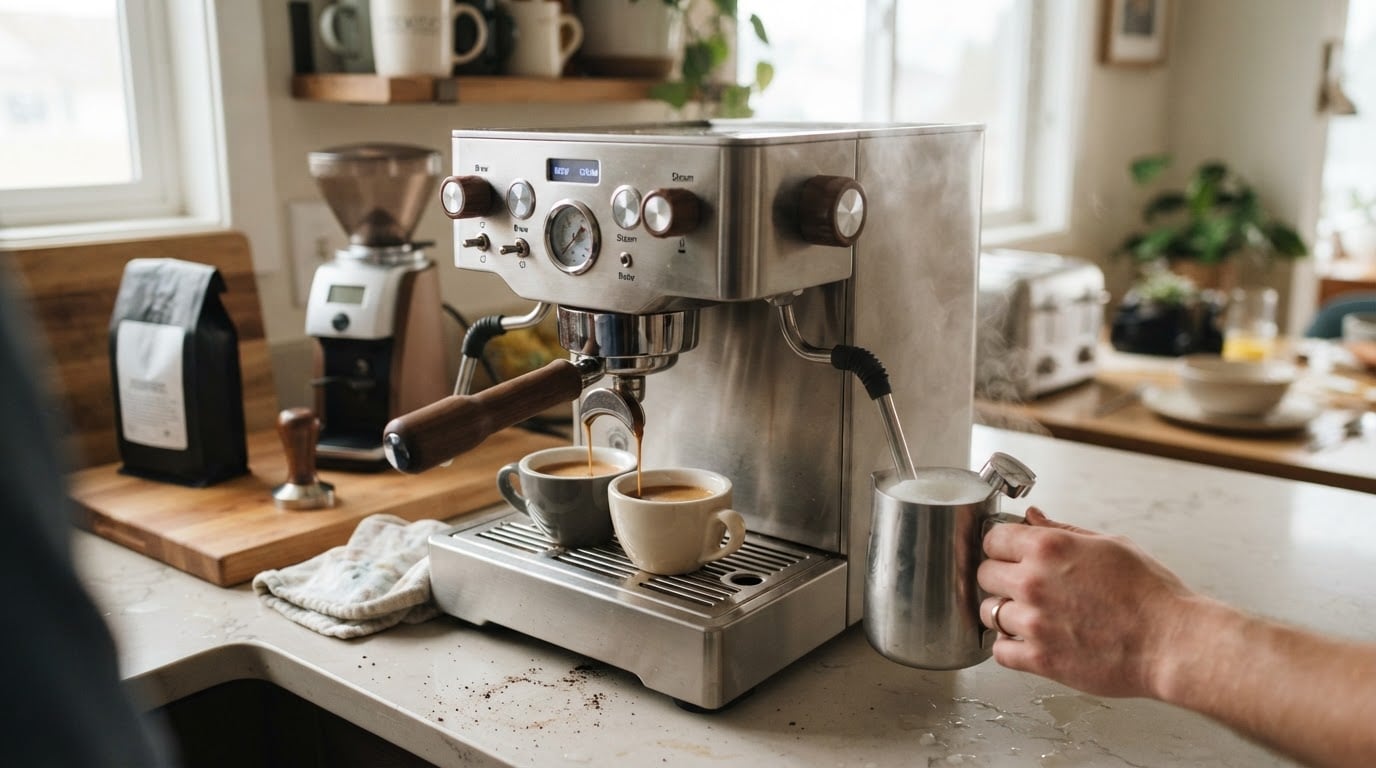
Buy a dual boiler when you routinely brew and steam at the same time — the weekday morning where one person wants a flat white and the next wants a cortado, or the evening where you make four milk drinks in a row. A dual boiler keeps brew and steam on separate circuits, so pulling a shot no longer interrupts the steam you were about to use, and steaming no longer drags brew temperature around.
Skip it when your routine is mostly straight espresso, or when you make one milk drink at a time without time pressure. A well-built single-boiler or heat-exchanger machine can produce an equivalent cup. What a second boiler buys is throughput and repeatability under load, not a better-tasting shot in isolation.
A dual boiler solves a scheduling problem. If your kitchen does not have that scheduling problem, the extra boiler, footprint, and maintenance are the wrong trade-off.
What "dual boiler" actually means at the machine
Espresso machines that can both brew and steam come in three broad architectures, and the differences show up in your routine rather than in the cup alone.
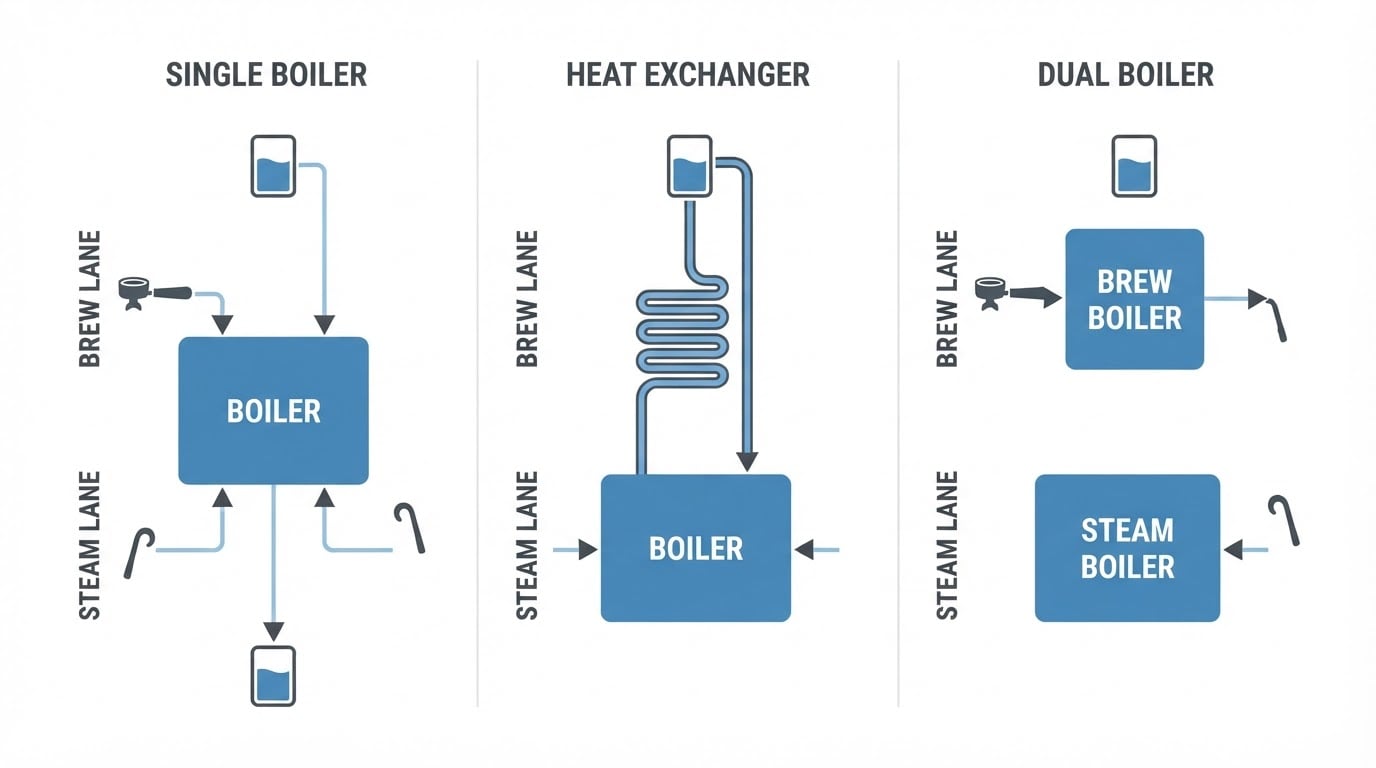
- Single boiler, dual use. One boiler heats water for brewing, then climbs to a higher temperature for steaming. You switch modes, wait, and steam after the shot. Compact and inexpensive, and fine for occasional milk.
- Heat exchanger. A single boiler holds steam-pressure water, and a tube running through it flash-heats brew water. You can brew and steam at once, but brew temperature depends on how the machine is managed, so the first shot after a long idle can run hot and needs a cooling flush or a disciplined routine.
- Dual boiler. Separate brew and steam boilers, each with its own heating element and usually its own temperature control. Brew temperature and steam pressure are set independently, and neither job steals capacity from the other.
Architecture | Brew and steam at once | Brew temperature control | Main trade-off |
|---|---|---|---|
Single boiler, dual use | No | Reaches each mode's temperature, then waits | Cheapest and smallest, slowest when milk is involved |
Heat exchanger | Yes | Depends on flushing and timing routine | Simultaneous work with less predictable brew temperature |
Dual boiler | Yes | Independent brew boiler and control | More cost, more counter space, more parts to maintain |
The practical consequence: only the dual boiler fully decouples the two jobs. That decoupling is what you are buying. Everything else — build quality, control precision, water handling, repairability — varies between individual dual boiler machines, and that is where most of the decision actually lives.
The six factors that separate one dual boiler from another
Two dual boilers can look almost identical on a product page and behave very differently on a weekday morning. Evaluate them on these six dimensions.
Warm-up time and brew temperature stability
The brew boiler's job is to hold a stable temperature at the group, not only inside the boiler. Look at how temperature is controlled — a PID controller rather than a pressurestat or a simple thermostat — where that temperature is measured, and how much metal sits between the boiler and the coffee.
Machines with a saturated or integrated group head carry more thermal mass, which usually means a longer warm-up but a more stable temperature across consecutive shots. Machines with a thermosiphon loop and a heavy group head behave differently again: they need to reach equilibrium before the first shot is representative.
Warm-up is a real constraint on weekday mornings, so usable warm-up time matters more than a headline specification. Treat any single warm-up figure as a starting point and ask how it was measured — from a cold start, or after a timer brought the machine most of the way there.
Steam capacity and recovery between pitchers
Steam capacity decides how fast you texture milk and whether steam pressure holds while you finish. The variables that matter are steam boiler volume, heating element power, the steam valve and tip, and how much milk you ask the machine to handle in one pitcher.
For a household making one or two milk drinks, most dual boilers are comfortable. For entertaining or a small office, recovery is the limiting factor: how quickly steam pressure returns between pitchers, and whether the machine refills its steam boiler mid-session in a way that drops pressure at the wand.
One question separates designs more than any specification: can the machine refill its steam boiler without interrupting an extraction? On some designs the pump is shared, and a refill can show up as a change at the group.
Recovery and duty cycle
Recovery is the honest measure of throughput. Think in terms of a session: how many milk drinks in a stretch of time, and at what quality does the fifth one arrive?
Two machines with the same steam boiler volume can recover very differently because of element power, the control loop, and how refills are handled. A plumbed water line removes the reservoir constraint entirely, which changes recovery behavior as well. If you make drinks in sequence, duty cycle belongs above almost every cosmetic difference.
Footprint and kitchen fit
Dual boilers are usually wider and deeper than single-boiler machines, and they carry two boilers plus a pump, so the weight is real. Measure in three dimensions before deciding: counter depth, height with cups on top, and clearance under a cabinet. A machine that must be pulled out from under an overhang to fill its reservoir will be annoying every week.
Check where the steam wand sits as well. Left, right, or front-facing matters more than it sounds, especially if the machine lives against a wall or next to a grinder.
Water handling
Water is the most neglected part of a machine's long-term behaviour. The decision points are a reservoir or a plumbed supply, whether a filter fits, how easy the tank is to empty and refill, and whether the machine offers a drain.
Hard water deposits scale in both the brew boiler and the steam boiler, and descaling a dual boiler is a bigger job than descaling a single-boiler machine because there are two boilers and more paths to reach. Soft or filtered water is not an upgrade — it is part of the maintenance plan.
If plumbing is possible, a direct connection with a filter removes the reservoir chore and the refill interruptions. If it is not, look for a reservoir you can reach without moving the machine and, ideally, without lifting cups off the warmer.
Maintenance and ownership
Dual boilers have more parts that can need attention: two boilers, two elements, more seals, a solenoid per circuit, and usually several components behind the drip tray. Before buying, check what routine work is expected of you — backflushing, group gasket replacement, water filter changes — and what a serviceable design looks like for that model.
Parts availability and service convention matter more than any feature at this price level. A machine that cannot be repaired locally at a cost proportionate to its value is a different purchase decision from one with a wide service network and published parts diagrams. Ask both questions before you fall in love with a case design.
Paying for tiers: what changes as the price climbs
Dual boilers form a ladder of capability rather than a ladder of taste. Exact prices move constantly with promotions, currency, and region, so think in tiers of what you are buying rather than brackets anyone can quote for long.
Entry tier. You get independent brew and steam circuits and the core benefit: brewing and steaming at once. Expect fewer conveniences — simpler temperature control, a smaller steam boiler, a reservoir rather than plumbing, and a plainer case.
Mid tier. Temperature control becomes more precise and repeatable, steam capacity and recovery improve, and the machine is usually easier to service and maintain. This is where most household buyers find the point of diminishing returns.
Prosumer and premium tier. The gains shift toward capacity and control: larger steam boilers, finer temperature control, flow or pressure profiling, plumbed water and drain, and heavier build. These are real advantages for someone making many drinks a day, and largely theoretical for someone making two.
The trade-off worth naming: past the mid tier, extra money mostly buys throughput, consistency under load, and longevity — not a different ceiling for the coffee itself.
Matching the machine to your day
The weekday-morning household. Two people, one or two milk drinks each, before work. Prioritize quick and stable warm-up, consistent brew temperature, and steam that does not run out on the second pitcher. Footprint matters because this machine lives on the counter permanently.
The straight-espresso drinker. When milk is rare, the dual boiler's signature advantage rarely gets used. The same budget spent on a better grinder and fresher coffee changes the cup more. If you still want the build quality, choose on brew temperature control and repairability rather than steam.
The entertainer or small office. Volume dominates. Recovery, steam pressure hold, water supply, and physical durability outrank everything else. A plumbed machine with a filter and a drain turns a chore into a routine.
The small kitchen or apartment. Footprint and water handling beat capacity. Verify cabinet clearance, reservoir access, and where the steam wand faces before committing to a machine that will be uncomfortable to live with.
The upgrader. If you plan to keep the machine for years and grow into it, pay for control precision, serviceability, and parts availability rather than a longer feature list.
Shortlist criteria and questions to ask before you buy
A shortlist works better than a ranking when no single machine fits every kitchen. Compare candidates on the same ground instead of collecting opinions.
Shortlist criteria:
- It brews and steams simultaneously, and the design refills without disturbing an extraction.
- Brew temperature is controlled, measurable, and stable across consecutive shots.
- Steam recovery covers the largest number of milk drinks you realistically make in a row.
- Cabinet clearance and reservoir access work in your actual kitchen.
- Water supply and filtration fit your plumbing reality.
- Routine maintenance is documented, and wear parts are obtainable where you live.
Questions to ask of any listing, review, or salesperson:
- What is the measured time from a cold start to a stable brew temperature, and how was it measured?
- How long does steam pressure take to recover between pitchers, and at what milk volume?
- Does the steam boiler refill during an extraction, and can it be heard or felt at the group?
- Are boiler volumes, element power, and pump type published, or only described in adjectives?
- Can the machine be plumbed in and drained, or is it reservoir-only?
- What routine maintenance is required, how often, and what does it cost in parts?
- Who services this machine locally, and are wear parts stocked?
When a source cannot answer these questions, that is information too. Independent verification beats a repeated spec sheet.
FAQ
Do I need a dual boiler for milk drinks?
No. Any machine that can steam will make a milk drink. A dual boiler matters when you need to brew and steam at once, repeatedly, without waiting or compromising either step.
Is a heat exchanger a cheaper alternative?
Often, yes, and it can brew and steam at the same time. The trade-off is brew temperature management: the design leans on a flushing or timing routine, so it rewards a disciplined operator more than it rewards precise controls.
Does a dual boiler cost more to maintain?
It has more parts — two boilers, more solenoids and seals — and descaling is a bigger job. Whether that becomes expensive depends mostly on your water and on parts and service availability where you live.
How long does a dual boiler take to warm up?
It depends on thermal mass, control design, and where the temperature is measured; machines with heavier group heads settle more slowly. Ask for a measured cold-start figure rather than accepting a marketing number.
Is a dual boiler worth it for espresso only?
Usually not for taste alone. If you rarely steam, a better grinder and fresher coffee will change your cup more than a second boiler will.
Can a dual boiler fit a small kitchen?
Sometimes. Width, depth, cabinet clearance, and reservoir access decide it. Measure the space and the machine before deciding on capacity.
How to decide in one pass
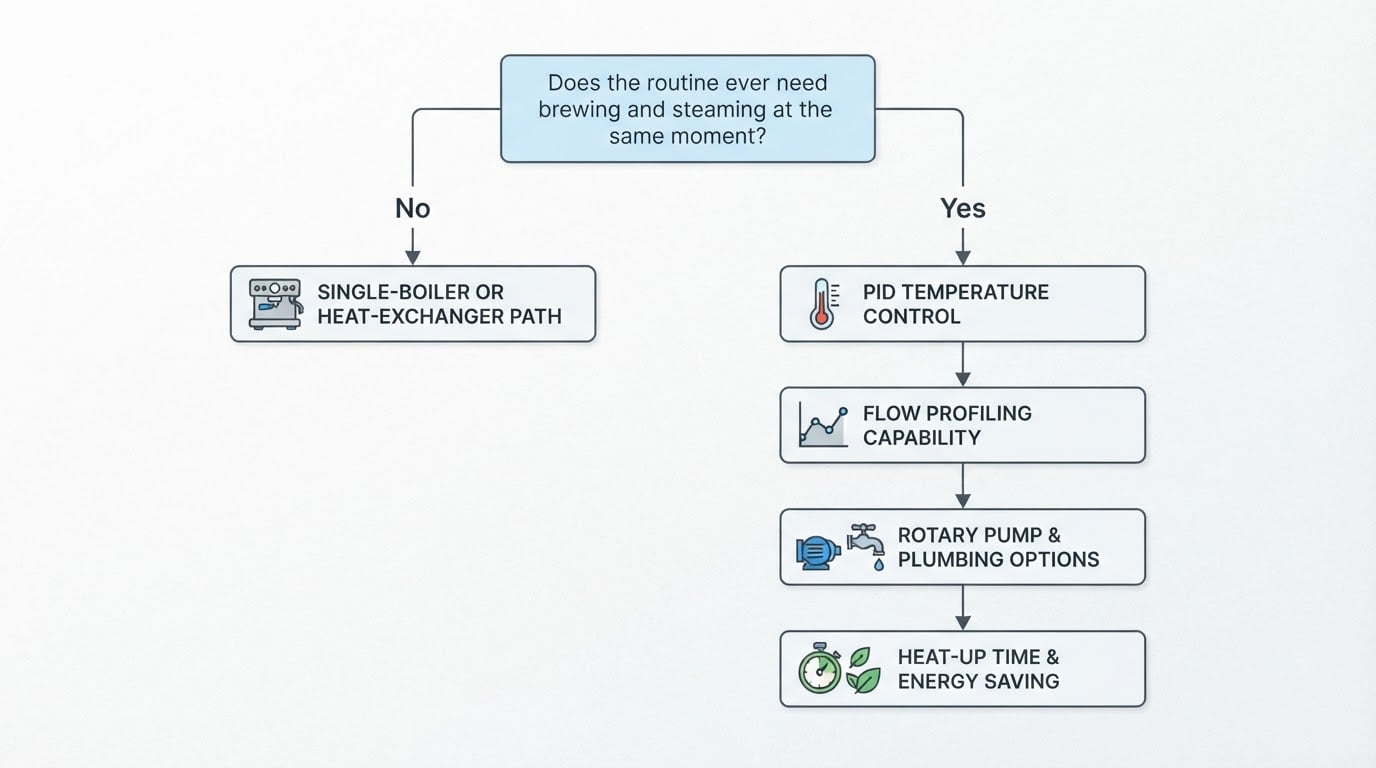
Write down the largest number of milk drinks you make in a single session, and how quickly you need them. Then answer one question: does your routine ever require brewing and steaming at the same moment? If yes, a dual boiler removes a real constraint, and you should shortlist candidates on warm-up, recovery, water handling, and repairability. If no, you have just saved the cost, the counter space, and the maintenance — and you can spend the difference on the part of the setup that changes what ends up in the cup.
Complete when you can state, in one sentence, the drinks you make, the pace you make them at, and the two criteria you refuse to compromise. That sentence is your shortlist filter, and it will eliminate most machines faster than any ranking will.