Quick answer: descale in three stages
Scale is dissolved mineral that has hardened inside the boiler, thermoblock, valves, and steam path. Descaling dissolves it back out: mix a descaling solution, send it through every path that water and steam travel, then flush the machine with fresh water until nothing remains.
The job has three stages:
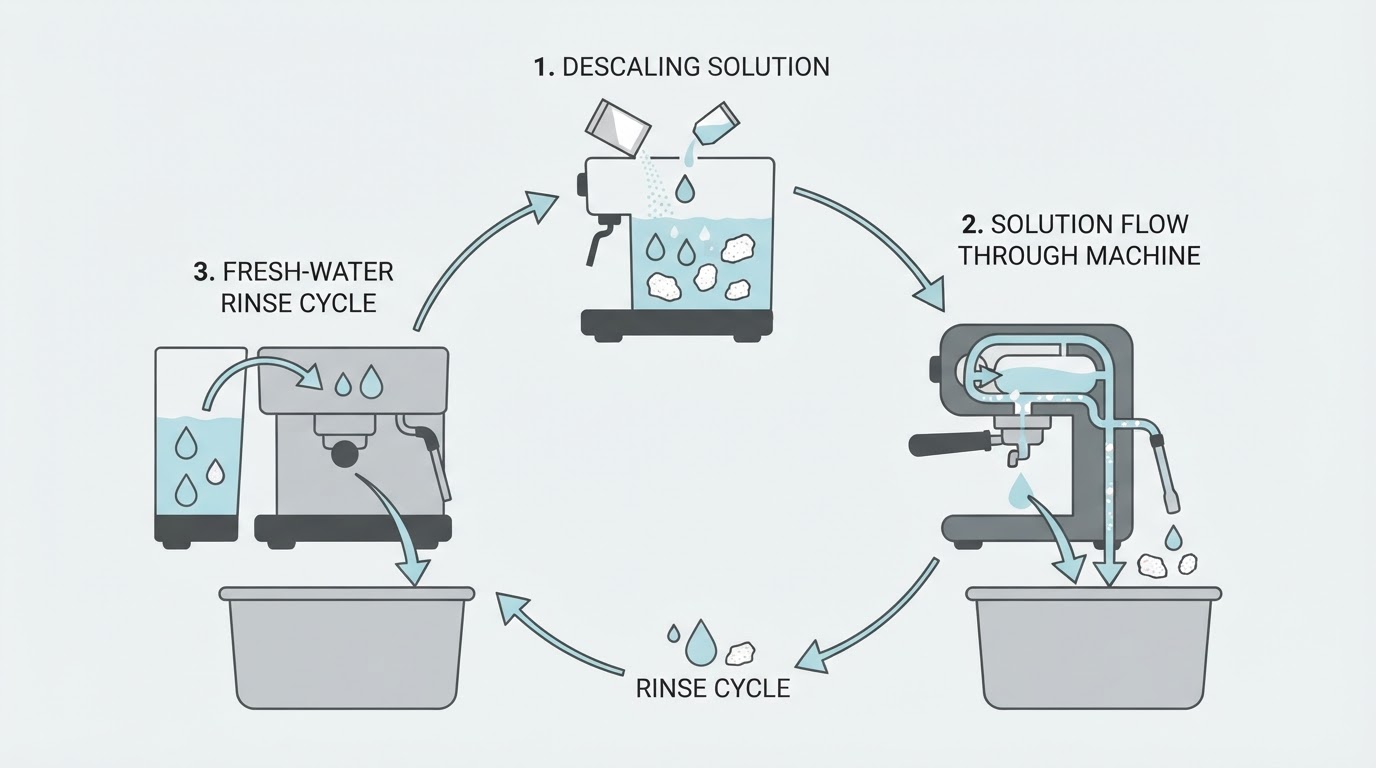
- Mix and load. Let the machine cool, remove the portafilter and any water filter the manual names, and mix the descaler exactly as its label instructs.
- Run the solution through. Push the solution through the group head and the steam wand, catching the outflow in a container.
- Rinse to neutral. Refill with fresh water and repeat the same paths until the water leaving the machine is clear and odorless.
A complete cycle usually takes the better part of an hour, rinses included. If your machine has an automatic descaling program, use it. If it does not, run the solution through using the same cycles you use to brew and steam. Either way, your model's manual is the authority on order and timing.
Signs descaling is due
Scale builds where you cannot see it, so the first evidence is usually a change in behavior rather than visible crust. Watch for:
- Slower flow. Shots that once started quickly now trickle, or the pump sounds strained.
- Weaker steam. The wand takes longer to produce dry steam, and milk foams sluggishly.
- Temperature drift. The machine takes longer to reach temperature, and shots taste cooler than they should.
- Off flavors. Bitterness or sourness that appears without a change in beans, grind, or dose often follows scale-related temperature instability.
- Visible crust. White, chalky deposits around the steam wand tip, the group head, or the floor of the water tank.
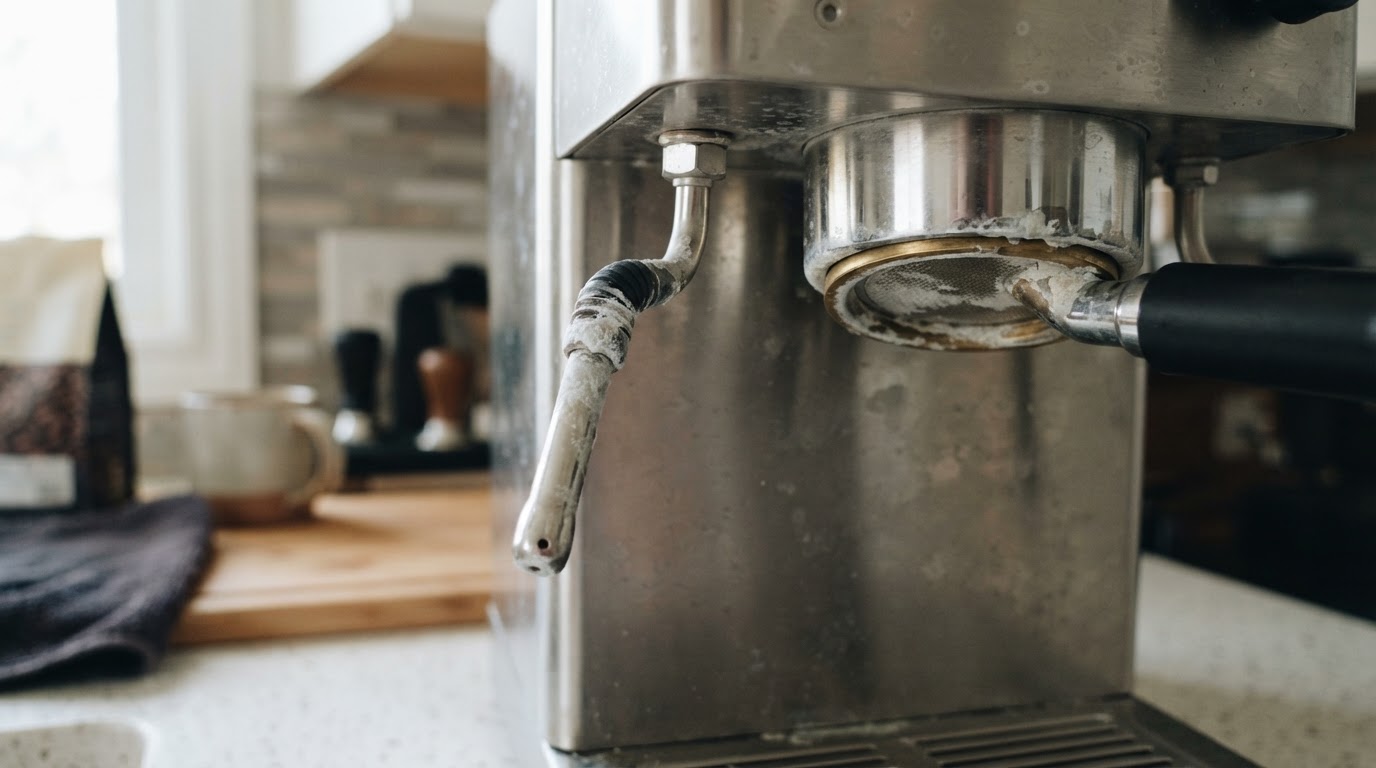
A descale indicator light or message is the clearest signal, but do not wait for it once the machine is misbehaving. Hard water, several drinks a day, and long gaps since the last descale all speed up scale formation.
Supplies and safety basics
Gather everything before you start, so the machine is not sitting full of solution while you look for a jug:
- A descaling solution intended for espresso machines, diluted at the strength on its label.
- A heatproof container that holds more than your water tank.
- Clean fresh water for the rinse stage, ideally filtered if your tap water is hard.
- A soft cloth, plus a small soft brush if scale has crusted around the steam wand.
- Gloves and eye protection when the descaler label calls for them.
Descalers are acids, which is why they can dissolve scale and why they deserve respect. Keep them off skin and out of eyes, work in a ventilated kitchen, never mix a descaler with another cleaning product, and never start a cycle on a machine that is still hot enough to spit steam. Unplug the machine when your manual asks, and keep the tank away from children and pets while it holds solution.
Two mistakes are worth avoiding from the start: do not run descaler through the grinder, and do not leave solution in the boiler for hours. Contact time matters, but the label's timing is the timing to trust.
How to descale and rinse, step by step
Steps vary by model, and your manual outranks any general sequence, including this one. What follows is the common shape of a safe home descale.
- Shut down and cool. Switch the machine off and let it come to room temperature. Unplug it if the manual says to.
- Strip the machine. Remove the portafilter, the drip tray, and any water filter or tank accessory the manual identifies. Empty the tank.
- Mix the solution. Follow the label. Making the mix stronger than directed is a common mistake, and a stronger acid is harder on seals without removing scale any faster.
- Fill and position. Pour the solution into the tank and set your container under the group head.
- Run the solution through the group. Pump in short bursts, the way you would pull a shot, until solution starts to flow, then keep working through the batch in cycles.
- Run the solution through the steam wand. Open the steam valve so the solution reaches the steam path too. This is the step people skip, and it is where milk-side scale collects.
- Rinse with fresh water at least twice. Empty and rinse the tank, refill with clean water, and run the same paths again. Discard the rinse water and repeat until the outflow tastes and smells neutral.
- Rebuild and flush. Reinstall the filter and accessories, refill the tank, and pull one or two throwaway shots to clear any residue from the group and lines.
How to know the descale is complete
The cycle is finished when the final rinse water runs clear with no grit, it smells neutral rather than sour or chemical, and the first fresh shot tastes clean. If flow is still slow after a full cycle, the deposits may be deeper than a home cycle can reach. Stop, rather than repeating the cycle indefinitely, and ask the manufacturer's support team or a service center about the next step.
How water hardness changes your schedule
Water hardness is the concentration of dissolved calcium and magnesium, the two minerals that turn into scale. Harder water leaves more scale for the same number of shots, so the descaling interval gets shorter. Softened, filtered, or naturally soft water leaves much less, so the interval can stretch.
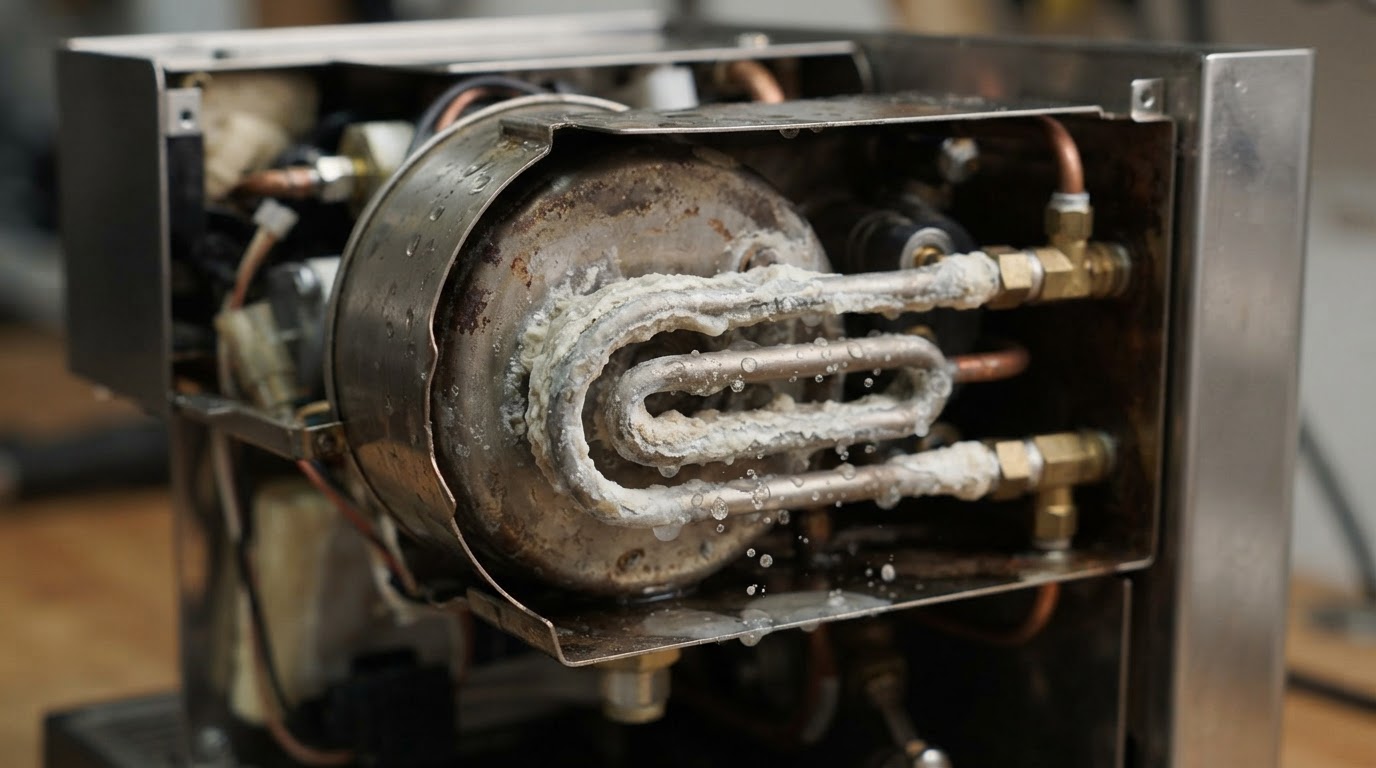
Three practical consequences:
- Your manual's interval is a baseline, not a fixed truth. If it says every few months and your tap water is very hard, the machine will show early signs sooner than that.
- Filtered or softened water is a straightforward way to slow scale, especially in hard-water areas.
- Use counts as much as hardness. A machine pulling several drinks a day accumulates scale much faster than one used on weekends.
If you do not know your water hardness, a municipal water report or a test strip will tell you in minutes. Then treat early signs, not the calendar, as the trigger: slower flow or weaker steam means descale now and check hardness before assuming the grinder is at fault.
It also helps to keep descaling separate from cleaning. Cleaning tablets and backflushing remove coffee oils and grounds from the group and basket. Descaling removes mineral scale from the boiler, valves, and steam path. A machine needs both, on different schedules.
If the cycle stalls or is interrupted
A stalled descale cycle is usually a water-level or pump problem rather than a dead machine. Work through it in this order.
- Check the tank. If the solution level dropped below the intake, the pump is running dry. Refill before anything else.
- Stop and cool down. If the machine shut down or the flow stopped, switch it off and let it cool. Do not keep pressing controls to force the cycle through.
- Restart cleanly. With the tank filled, power the machine back on and restart the descale or pump cycle. If it stalls at the same point twice, stop and reassess.
- Rinse what is inside. Once the machine restarts, rinse thoroughly. Solution left sitting in a boiler is one of the few ways a routine descale becomes a repair.
- Escalate when it is not a stall. No flow from the steam wand, a pump that hums without moving water, or repeated shutdowns point to a blockage or a failed component. That is a support call, not another descale cycle.
Dedicated descaler versus vinegar and other alternatives
Every option here removes scale. The differences show up in how kind they are to seals and boilers, how they smell, and how much rinsing the machine needs afterward.
- Dedicated espresso descaler. Formulated for the metals, seals, and pumps in coffee machines. It is the default choice, and when your manual names a product or a type of product, use it. Check the warranty wording before substituting anything else.
- Citric acid. A food-safe acid that works on scale when diluted to a sensible strength. Reasonable as a fallback when a dedicated descaler is not available, but mix it weak rather than strong and rinse thoroughly.
- White vinegar. Effective on light scale and widely used, but the smell lingers and repeated use is hard on some rubber seals and aluminum parts. Some manuals forbid it, so check yours first. If you use it, dilute it and rinse longer than feels necessary.
- Cleaning tablets and backflush detergent. These remove coffee oils from the group, basket, and portafilter path. They do not dissolve mineral scale, so they are not a substitute for descaling.
Whichever route you take, the finish line does not move: the water coming out has to run clear, smell neutral, and leave the next shot tasting clean.
FAQ
How often should I descale an espresso machine?
Use your manual's interval as the baseline, then adjust for hardness and use. Hard water and several drinks a day mean more frequent descaling; soft or filtered water and light use mean less. Check for early signs between scheduled cycles and descale as soon as they show.
Can I descale with white vinegar?
You can remove light scale with diluted white vinegar, but check the manual first, because some machines call for a dedicated descaler. Vinegar smells strong, needs extended rinsing, and is not gentle on every seal and metal part. Treat it as a fallback rather than a routine.
What happens if I do not rinse enough?
Residual acid stays in the boiler, the group, and the steam path. The next shots can taste sharp or chemical, and the solution keeps working on the machine's seals instead of on scale. Rinse until the water is clear and odorless and the throwaway shot tastes neutral.
How long does descaling take?
Plan on the better part of an hour for cool-down, the solution pass through both the group and the steam wand, and at least two rinses. Machines with an automatic descaling program are usually quicker because the pump timing is handled for you.
Is descaling the same as cleaning?
No. Cleaning removes coffee oils and grounds from the group, basket, and portafilter path. Descaling removes mineral scale from the boiler, thermoblock, valves, and steam wand. A machine needs both, on different schedules.
Can descaling fix a machine that no longer heats or pumps?
Not usually. Scale can restrict flow, but a machine with no heat or no pump pressure at all has a different problem. Treat descaling as maintenance rather than repair, and if the machine stops working, stop cycling it and get service advice.