Start at 1:15 and treat 1:12 to 1:17 as your working range
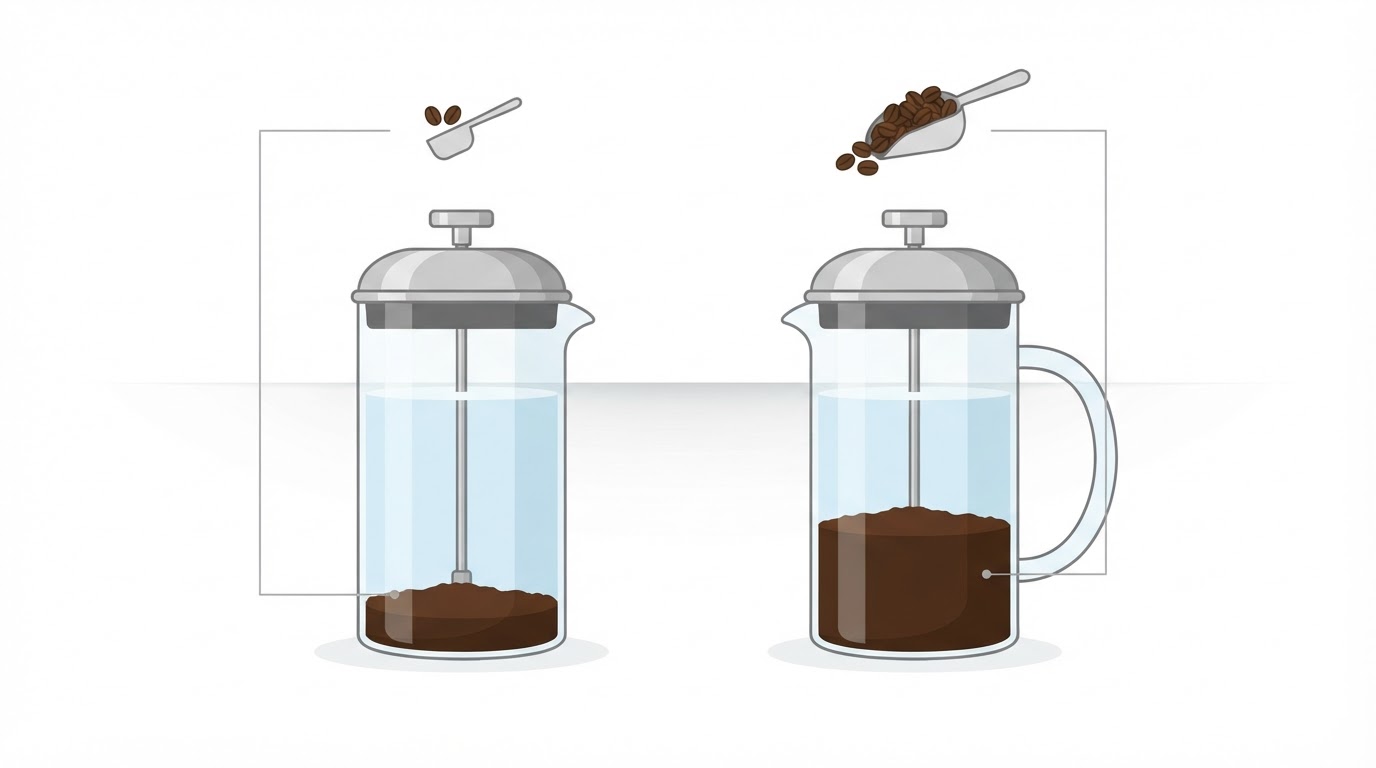
If you remember one number, remember 1:15: one gram of coffee for every fifteen grams of water. Scale it up or down and the arithmetic stays simple — 20 grams of coffee with 300 grams of water, 40 grams with 600 grams, 67 grams with 1,000 grams.
Then treat the edges of the range as directions rather than rules. Moving toward 1:13 or 1:12 loads the same amount of water with more coffee, which reads as heavier body, more texture and a rounder finish. Moving toward 1:16 or 1:17 thins the body and makes acidity and aroma easier to pick out, which often suits a dark roast that tastes muddy at a tighter ratio or a light roast that feels dense.
Two cautions before you dial anything in. First, these are starting recommendations taken from common home-brewing practice, not a standard that decides whether a cup is correct; your press, your grinder, your water and your palate all shift the useful target. Second, the ratio is a strength control, not a flavour repair kit. It tells you how much coffee ends up in the cup. It does not tell you whether that coffee tasted balanced on the way there.
Why ratio and extraction need separate dials
Think of a brew as two separate adjustments. The ratio sets concentration: how much dissolved coffee material sits in a given volume of water. Grind size and steep time set how much of the coffee's soluble material actually makes it into the water in the first place.
Those are different problems with different fixes, and confusing them is the most common reason a second brew turns out no better than the first.
- A cup that tastes weak or watery is usually a concentration problem. The fastest fix is more coffee, not a longer steep.
- A cup that tastes harsh, bitter, drying or sharply sour has a balance problem. The fix is grind size, steep time or water temperature.
- Adding water to a bitter cup gives you a bitter cup that is also thin. Grinding finer to rescue a weak cup usually just adds harshness.
One more limitation worth stating plainly: an uneven grind defeats any ratio. If a grinder produces a lot of powder alongside coarse chunks, the powder over-extracts while the chunks under-extract, and no dose fixes a cup that is simultaneously bitter and sour. Coarsen the setting, sift out the dust if you can, and only then tune the ratio.
Doses for common press sizes
Press labels count cups in four-ounce units, so an eight-cup press holds about 34 fluid ounces (1 litre) — roughly three ten-ounce mugs, not eight. That mismatch explains a lot of disappointing first brews.
Fill the carafe to just below the spout and leave the bed room to expand.
Press label | Water | Lighter 1:17 | Everyday 1:15 | Strong 1:13 | Very strong 1:12 | About 10 oz mugs |
|---|---|---|---|---|---|---|
3-cup / 12 fl oz | 350 ml | 21 g | 23 g | 27 g | 29 g | 1 |
4-cup / 17 fl oz | 500 ml | 29 g | 33 g | 38 g | 42 g | 1 to 2 |
8-cup / 34 fl oz | 1,000 ml | 59 g | 67 g | 77 g | 83 g | 3 |
12-cup / 51 fl oz | 1,500 ml | 88 g | 100 g | 115 g | 125 g | 5 |
Weights are rounded to the nearest gram. Measure water by weight or use the millilitre markings on the carafe; measuring by eye against the glass is the second-largest source of inconsistency after guessing the dose.
Two worked examples
One mug, about 10 ounces
You want roughly 300 ml in the cup, but spent grounds hold on to water — expect to lose about two millilitres for every gram of coffee you add. Brew a little more than you plan to drink.
At 1:15, use 22 grams of coffee with 330 grams of water. The bed retains around 44 ml, and about 286 ml reaches the mug. If you would rather not repeat the arithmetic, use 20 grams of coffee and 320 grams of water and accept a slightly smaller pour.
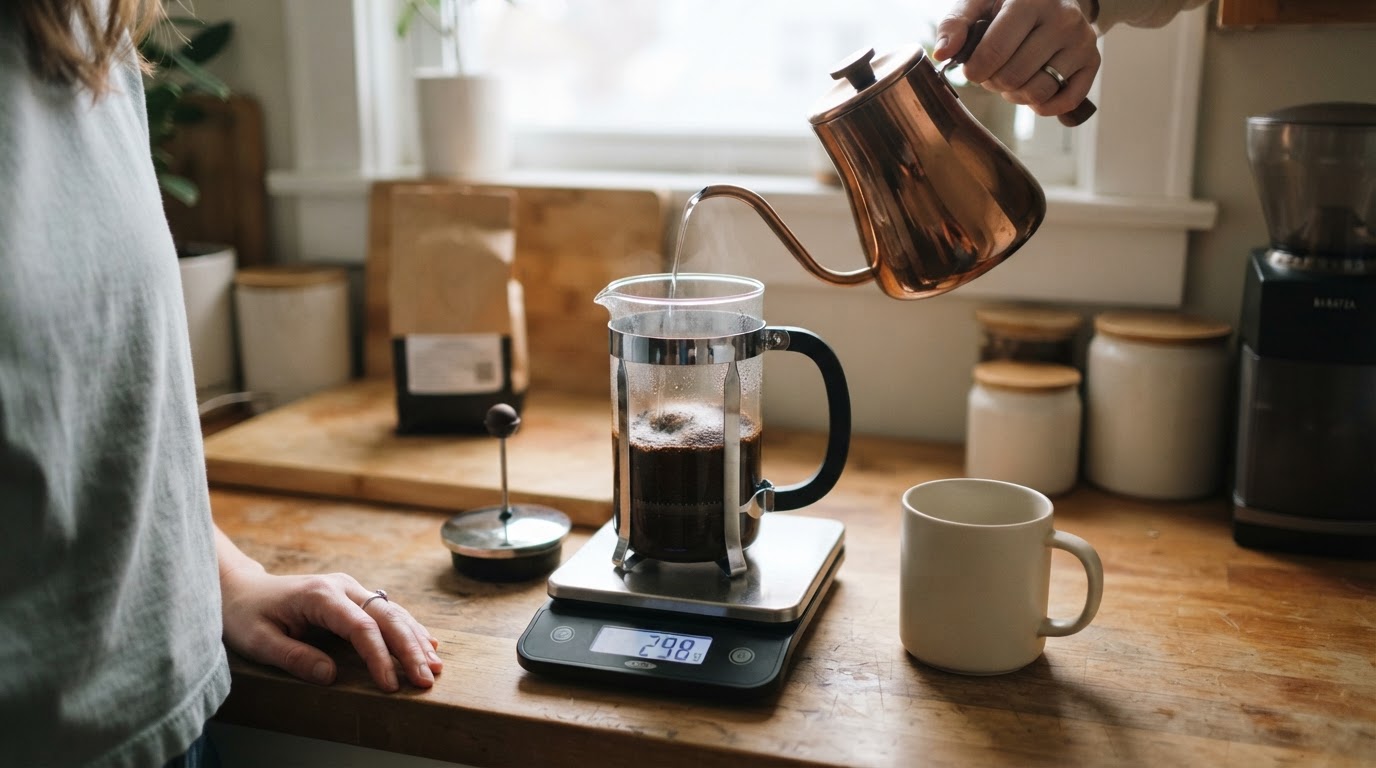
A full one-litre carafe
Fill to the 1,000 ml line and use 67 grams of coffee at 1:15. The bed will hold back roughly 130 ml, so you should pour about 870 ml — three ten-ounce mugs with a little left over.
If you need four full mugs from that press, tighten the ratio to about 1:14 and use 71 grams of coffee instead of buying a larger press. Expect a heavier cup at the same steep time, which is the trade-off.
Measuring coffee by weight when you have no scale
Volume is a workable stand-in if you calibrate it once. A level tablespoon of medium-coarse grounds weighs roughly five grams, so a 1:15 brew needs about one level tablespoon for every 75 ml (2.5 fluid ounces) of water. An eight-cup press works out to about 13 level tablespoons.
Three things make that estimate drift. Coarse grounds mound differently from fine ones, so an unpacked scoop and a packed scoop are not the same dose. Dark, brittle roasts scoop lighter than dense light roasts. And a heaped spoon can hold nearly twice what a level one does.
The fix is a single calibration: borrow a kitchen scale for one brew, weigh the exact spoon you will use, and write the gram weight on the press lid. After that the spoon becomes a measuring tool instead of a guess. Scoop over the sink rather than the carafe, and level each spoon against the rim so the count stays repeatable.
Grind size and steep time change the ratio you actually want
Coarse grounds, roughly the texture of sea salt or coarse breadcrumbs, are the baseline for a press filter. At that grind, four minutes of steeping is a sensible starting point at 1:15.
Two adjustments follow from how a press works:
- If your grinder cannot go coarse and the bed looks sandy, shorten the steep to about three to three and a half minutes. You will get more sediment in the cup, and you will get less of the bitterness that fines produce over four minutes.
- If the grind comes out unusually coarse, extend the steep by thirty seconds rather than tightening the ratio. More coffee will not make up for coffee that never had time to give up its flavour.
The relationship is worth holding onto: at a fixed ratio, a finer grind or a longer steep increases how much the water pulls out of the grounds. The ratio itself does not change. That is why grind is the right lever when a cup tastes sharp or harsh, and dose is the right lever when it simply tastes thin.
Adjust one variable at a time
Change a single thing per brew, write down what you changed, and taste before adjusting again. Two simultaneous changes tell you nothing except that something moved.
- Too weak or watery: add about one gram of coffee per 100 ml of water. At 500 ml, moving from 33 grams to 36 grams takes you from roughly 1:15 to 1:14.
- Too bitter, harsh or drying: coarsen the grind by one step, or cut thirty seconds from the steep. Leave the dose alone.
- Too sour, thin or sharply acidic without bitterness: grind one step finer, add fifteen seconds, or raise the water temperature slightly.
- Muddy or silty: coarsen the grind, stir more gently, press more slowly, and pour the whole brew off the grounds as soon as it is done.
- Weak and bitter at the same time: raise the dose and coarsen the grind together. This is the one case where two changes make sense, because the cup is showing two separate faults.
- Good first cup, harsh second: the coffee sat on the grounds while you drank. Decant the full brew into a second carafe before serving.
A four-minute brew routine that fits the ratio
- Rinse the carafe with hot tap water to warm it, then discard the water.
- Boil fresh water and let it settle for thirty to forty-five seconds, or check it with a thermometer.
- Weigh the coffee for your ratio — 30 grams for a 500 ml press at 1:15, for example.
- Grind coarse and add the grounds to the empty carafe.
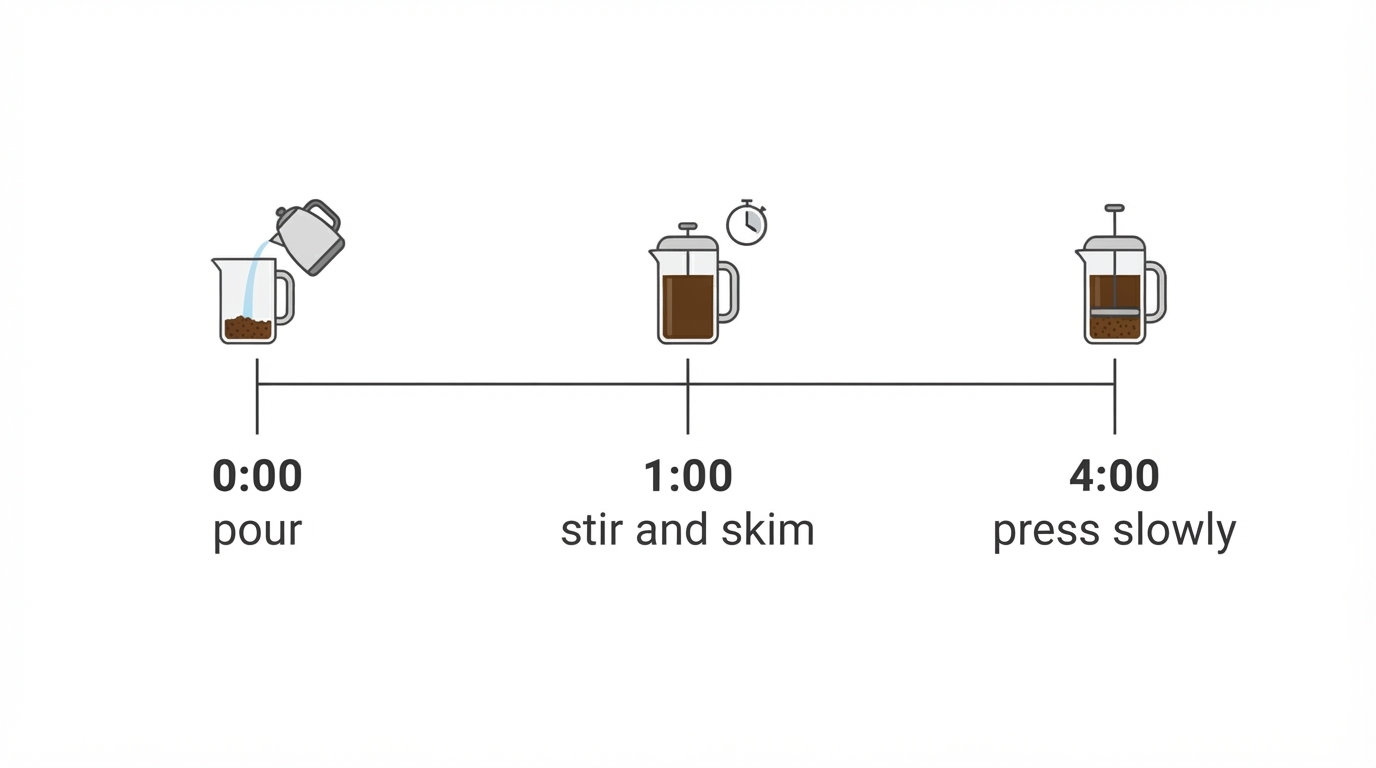
- Pour all of the water in one steady motion so every ground gets wet, then start a four-minute timer.
- At one minute, stir gently to break the crust that has formed, then skim the foam and floating fines with a spoon if you want a cleaner cup.
- At four minutes, set the plunger and press down slowly and evenly, taking about fifteen to twenty seconds. Stop when you feel real resistance rather than forcing the filter into the bed.
- Pour everything into mugs or a second carafe immediately.
Steps three, five, seven and eight carry most of the consistency. Everything else is preference.
Water temperature: work inside a range
Aim for roughly 195 to 205 degrees Fahrenheit, which is about 90 to 96 Celsius. Water straight off a rolling boil is hotter than that, so give it half a minute in the kettle or a moment in the carafe.
Within the range, temperature behaves like steep time: cooler water slows extraction and pushes the cup toward acidity, hotter water speeds it up and can make dark roasts taste harsh. If you change temperature, change it by a few degrees and keep the dose fixed.
Troubleshooting chart
What you taste | What it usually means | One change to try |
|---|---|---|
Thin, watery, no finish | Not enough coffee for the water | Raise the dose by 1 g per 100 ml |
Bitter, drying, harsh finish | Over-extracted from a fine grind or long steep | Coarsen the grind one step |
Sour, sharp, vegetal | Under-extracted or water too cool | Grind finer or add 5 degrees Fahrenheit |
Heavy silt, cloudy cup | Too many fines, fast plunge, or over-stirring | Coarsen the grind, skim, press slower |
Good body but flat and dull | Ratio fine, extraction short | Add 30 seconds, keep the dose |
Excellent then harsh | Coffee left standing on the grounds | Decant right after pressing |
Common questions about french press ratios
Is 1:15 the correct french press ratio?
It is the most useful starting point because it lands in a middle range that most people find drinkable without adjustment. It is not a standard. Move to 1:13 for a heavier cup, 1:17 for a lighter one, and treat your own taste as the deciding vote.
How many tablespoons is that without a scale?
At roughly five grams per level tablespoon, an eight-cup press at 1:15 needs about 13 level tablespoons. Treat that as a starting count, then calibrate it once against a scale, because grind and roast change what a spoon holds.
Does a longer steep fix a weak brew?
Only partly. A longer steep pulls more material out of the coffee, which can add body, but it also adds bitterness, so a weak brew fixed with time often ends up weak and harsh. Raising the dose solves strength without that side effect.
Should I count the water the grounds absorb?
If you want a specific volume in the mug, yes. Expect the bed to retain about two millilitres of water per gram of coffee. For an eight-cup press that is roughly 130 ml, so a full carafe pours about 870 ml.
Can I use the same ratio for cold brew?
Not directly. Cold brew is usually made as a concentrate with far less water per gram of coffee and then diluted before drinking. Keep the press ratio for hot brewing and treat cold brew as a separate method with its own starting point.
Where to go after your first calibrated brew
Brew once at 1:15 with a coarse grind and a four-minute steep, then taste deliberately: strength first, then balance. If the cup is thin, add coffee. If it is harsh, coarsen the grind. Write both numbers on the lid — dose and grind setting — so the next brew starts from a known place instead of a guess.
Most brewers settle somewhere between 1:13 and 1:16 within a handful of attempts, and the number that matters is the one that repeats well in your own kitchen with your own press.