The direct answer
A flat white and a latte are built from the same two ingredients: espresso and steamed milk. What separates them is how much of each goes into the cup, and how the milk is textured.
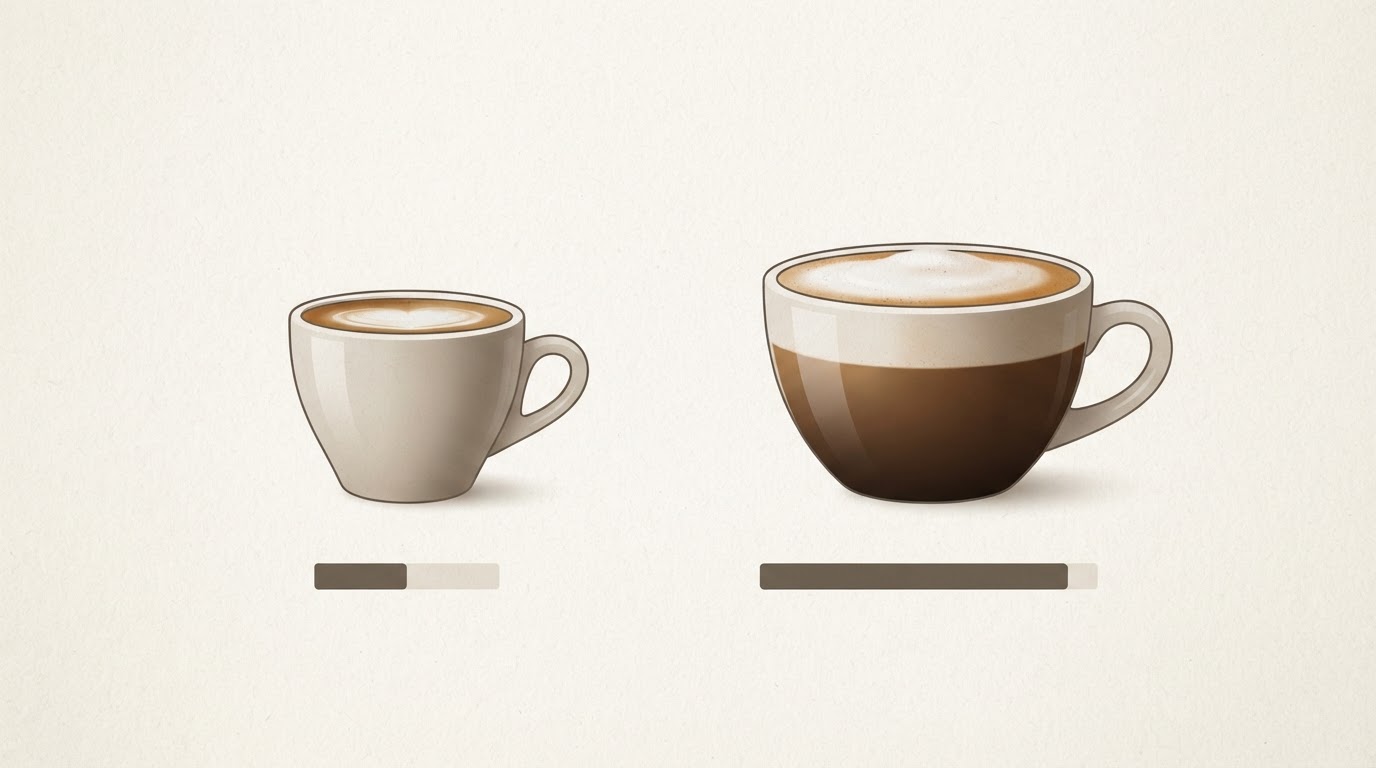
A flat white typically lands at 5 to 6 fluid ounces (150 to 180 ml). That is usually a double shot, roughly 4 to 5 ounces of milk, and a thin, glossy layer of microfoam about 3 to 5 millimetres deep. A latte is usually 8 to 12 fluid ounces (240 to 350 ml): one or two shots with 6 to 10 ounces of milk and a soft foam cap closer to 8 to 15 millimetres.
That one difference in dilution explains most of what you taste. The flat white keeps the espresso forward and the texture velvety. The latte spreads the same coffee across far more milk, so it reads milder, sweeter, and creamier. Cup, colour, and even how long the drink stays hot all follow from those ratios.
Flat white vs latte at a glance
The table below sets the two drinks side by side.
| Flat white | Latte |
|---|---|---|
Typical total size | 5–6 fl oz (150–180 ml) | 8–12 fl oz (240–350 ml) |
Espresso base | Double shot or double ristretto, about 30–40 ml | Single or double shot, about 30–60 ml |
Milk volume | About 110–150 ml | About 180–300 ml |
Milk texture target | Thin, glossy microfoam, 3–5 mm | Steamed milk with a soft foam layer, 8–15 mm |
Strength in the cup | Coffee-forward and concentrated | Mellow and milk-forward |
Creaminess | Velvety, low foam | Soft, rounded, more body |
Typical serve | Ceramic demitasse, 5–6 oz | Ceramic cup or glass, 8–12 oz |
What you order it for | The espresso | The milk and the length |
Read down the middle two columns and the pattern is obvious: the milk column doubles while the coffee column barely moves. That is the whole comparison in one row.
Build order and the numbers that matter
Both drinks are assembled the same way: preheat the cup, pull the espresso, steam the milk, then pour. The variables that change the result are the espresso yield in the cup, the milk volume, and how much air you work into the milk before it finishes heating.
A flat white usually starts with a double shot or a double ristretto, which is a shorter, sweeter extraction of the same coffee dose. The target yield is roughly 30 to 40 millilitres, and the cup is small enough that the milk has to be measured as carefully as the shot. The milk is steamed in a small pitcher with only a few seconds of aeration, then rolled until the surface looks like wet paint. Because the cup is shallow, the pour has to combine milk and foam quickly: pour from higher up to mix the two, then lower the spout to lay down the last thin band of foam.
A latte starts with one or two shots, and the larger cup leaves room for 6 to 10 ounces of milk. The aeration stage runs longer, so the milk holds a visible cap instead of a microfilm. Many cafés pour a latte with a spoon held at the lip of the pitcher to keep the foam back, then spoon the cap on at the end. That technique is a useful tell: a flat white is poured to integrate, a latte is poured to layer.
Strength, creaminess, and the milk texture target
Strength is set by how much espresso meets how much milk. A flat white tastes stronger than a latte even when both use the same double shot, because the same coffee is diluted by 4 to 5 ounces of milk instead of 6 to 10.
Creaminess is a separate variable. It comes from milk fat and protein, the temperature at which you stop steaming, and how finely the bubbles are broken up. Whole milk gives the roundest texture and holds microfoam most forgivingly. Skim milk foams easily but tastes thin. Barista-style oat and soy milks are formulated to foam, though they can taste sweeter than dairy. Milk heated past roughly 65°C (150°F) loses sweetness and starts to taste scalded, which is why a drink can feel thin and bitter at the same time.
The texture target is not "more foam is better". For a flat white the target is microfoam so fine that it looks like melted ice cream and merges into the coffee. The surface should be almost flat, which is where the name comes from. For a latte the target is a defined cap: soft, pourable foam 8 to 15 millimetres deep that sits on the surface and holds a shape long enough to draw in. Cappuccino pushes that same cap thicker and drier, and a cortado barely foams at all.
How cafés vary the same two drinks
Order the same pair in five cafés and you will get five slightly different drinks, because both names describe ratios rather than fixed recipes.
Flat white variation is driven by origin style and cup stock. In Australia and New Zealand, where the drink became popular, a flat white is often served in a 5 to 6 ounce ceramic tulip with a double ristretto. Some shops stretch it to 8 ounces, and some pull a single shot into a smaller cup. In the US and UK the drink has drifted toward the latte end of the menu: 8-ounce cups are common, and the foam is often thicker than a purist would pour. A café that serves its flat white in the same cup as its cappuccino has already changed the drink.
Latte is the most elastic name on the menu. It can be 8 ounces in a specialty shop, 12 to 16 ounces at a chain, or larger at a machine-driven counter. It can arrive in glass or ceramic, flavoured with syrup, or built over ice. Because the milk volume varies so much, one café's latte can taste weaker than another café's flat white.
The practical rule: read the cup size before you read the name. If a shop lists a flat white at 8 ounces and a latte at 8 ounces, expect two similar drinks with different foam treatment. If the flat white is 6 ounces and the latte is 12, expect a clear difference in strength — and order accordingly.
Brewing either drink at home
You do not need two recipes at home, only two settings on the same three variables: espresso dose and yield, milk volume, and how much air you put into the milk.
What the machine has to do
- Espresso machine with a steam wand. This is the only setup that gives full control over microfoam, so it handles both drinks well. A flat white depends on stopping aeration early; a latte just needs a little more air.
- Automatic milk frother or built-in carafe. Control over air is limited, and the result usually lands closer to a latte cap. For a flat white, fill the carafe with less milk, use the lowest-foam setting if one exists, and pour into a 5 to 6 ounce cup.
- Pod machine with no steam wand. The ratio is still achievable with a separate electric frother or a French press. The texture will be coarser than microfoam, so the result reads as a small latte. Use a small cup and spoon on only a thin layer of foam.
- Moka pot or stovetop brewer. The coffee is stronger and less pressure-driven than espresso, and the shot behaves differently in the cup. The milk-volume targets still apply; treat the coffee as a concentrate and adjust the dose to taste.
Flat white at home
- Preheat a 5 to 6 ounce cup with hot water, then empty it.
- Pull a double shot of about 30 to 40 millilitres. Judge it by taste: sharply sour means under-extracted, hollow and bitter means over-extracted.
- Pour 4 to 5 ounces of cold whole milk into a small pitcher. Purge the wand, aerate for 2 to 3 seconds with the tip just under the surface, then sink the tip and roll until the pitcher is just too hot to hold comfortably.
- Swirl the pitcher hard for a second, pour from about 10 centimetres to combine, then drop the spout close to finish.
Completion check: total liquid of 5 to 6 ounces, a foam layer of 3 to 5 millimetres, a flat glossy surface, and no dry bubbles sitting on top. If you need a spoon to hold the foam back, the milk was aerated too long.
Latte at home
- Preheat an 8 to 12 ounce cup.
- Pull 30 to 60 millilitres of espresso, depending on how strong you want the drink.
- Steam 6 to 10 ounces of milk, aerating for 4 to 6 seconds to build a soft cap.
- Pour in one motion, holding the foam back at the end if you want a clean layer on top.
Completion check: a distinct cap of 8 to 15 millimetres that stays on the surface, with a pourable body underneath. If the foam stands up like meringue, it was over-aerated for a latte.
When it tastes too milky or too strong
You can fix the cup with two dials: less milk, or more coffee. Work through them in that order, because changing milk volume is faster and reversible.

Too milky. Cut the milk by 1 to 2 ounces or move to a smaller cup. If you want to keep the cup size, pull a second shot or switch to a ristretto. Before adding anything, taste the shot on its own: a thin, pale, fast-running extraction will taste milky even in a 5-ounce cup, and more milk will not fix it.
Too strong or sharply bitter. Add 1 to 2 ounces of milk, or step up one cup size. If the bitterness is harsh rather than intense, the problem is the extraction, not the ratio: grind slightly coarser, lower the dose, or shorten the shot. Adding milk to a channelled shot only hides it for a sip.
Foam too thick or stiff. Aerate for 1 to 2 seconds less, then tap the pitcher on the counter and swirl until the foam and milk recombine. If the foam has already set, skim the top rather than stirring it back in.
Foam too thin or collapsing. Aerate a second longer, start with colder milk, and use fresh whole milk. A pitcher that is too large for the milk volume also makes texturing harder, because the milk depth is too shallow for the wand tip.
Temperature. Stop steaming at roughly 55 to 60°C (130 to 140°F) for the sweetest result. Milk much above 70°C (158°F) tastes cooked and loses the sweetness that makes either drink work.
In a café, the same two dials apply: ask for the flat white in the smallest cup available, or ask for your latte in the smaller size rather than adding a flavour shot.
Where cappuccino and cortado fit
Once you see the drinks as points on a milk-volume scale, the rest of the menu sorts itself out.
Drink | Typical size | Espresso | Milk | Foam |
|---|---|---|---|---|
Cortado | 4–4.5 fl oz (120–130 ml) | Double shot | About 2 oz, warm | Little to none |
Flat white | 5–6 fl oz (150–180 ml) | Double shot or ristretto | About 4–5 oz | 3–5 mm microfoam |
Cappuccino | 5–6 fl oz (150–180 ml) | Double shot | About 3–4 oz | 15–20 mm, drier |
Latte | 8–12 fl oz (240–350 ml) | One or two shots | About 6–10 oz | 8–15 mm, soft |
A cappuccino shares the flat white's cup size but not its balance: less liquid milk and much more air, so it tastes more intense and noticeably foamier. A cortado cuts the milk to roughly an equal partner with the espresso and skips the foam, which makes it the strongest drink per sip in the group.
The ordering shortcuts follow directly. If you like a flat white but want less milk, order a cortado. If you want the same strength with a foam cap you can eat with a spoon, order a cappuccino. If you want a long, mild drink, order the latte.
Iced flat white vs iced latte
Iced versions invert the texture logic. Cold milk does not hold microfoam the way steamed milk does, and ice dilutes the drink as it melts, so both iced drinks taste milder than their hot counterparts.
An iced latte is usually the easier of the two: espresso, cold milk, and ice in an 8 to 12 ounce glass, stirred. An iced flat white should stay small, roughly 5 to 6 ounces of liquid with 2 to 3 ounces of milk and less ice, so the coffee still leads. Some shops shake it or float a little chilled foam on top; others simply serve a short, cold, milk-light drink.
Two adjustments make either iced drink taste closer to the hot version. Add one extra shot or drop one cup size, since the ice will dilute the drink within a few minutes. And chill the glass first, then add milk last and stir once, so the milk does not sit warm on top of the ice. Because the foam difference disappears in the cold version, the gap between an iced flat white and an iced latte narrows to little more than size and milk volume.
Choose the flat white if...
- You want the espresso to lead and you are happy with a 5 to 6 ounce drink.
- You dislike leaving half a cup of milk on the table.
- You prefer a velvety, almost flat surface to a foam cap.
- You are learning to texture milk and want feedback you can taste in a small cup.
- You are ordering at a café that lists cup sizes and you want the strongest drink per ounce.
Choose the latte if...
- You want a longer, milder drink to sip over ten or fifteen minutes.
- You want a foam cap that holds latte art or a dusting of cocoa.
- You want room for flavour syrups without the coffee disappearing.
- You are ordering iced, where the larger milk volume stays balanced as the ice melts.
- You are making drinks for a household where not everyone wants a concentrated cup.
FAQ
Is a flat white stronger than a latte?
Usually yes, when both are pulled with a double shot, because the same coffee is diluted by 4 to 5 ounces of milk instead of 6 to 10. The exception is shot count: a single-shot flat white is weaker than a double-shot latte. Compare shots and cup size rather than the name on the menu.
Flat white vs latte vs cappuccino: what is the difference?
The flat white is small with a thin microfoam layer, the cappuccino is the same size with much more air and less liquid milk, and the latte is the largest with the most milk and a soft cap. Strength per sip runs cappuccino, then flat white, then latte.
What is the difference between a flat white and a cappuccino?
Both are usually 5 to 6 ounces and built on a double shot. The flat white uses more liquid milk and only a thin layer of microfoam, so it tastes smoother and slightly less intense. The cappuccino uses less milk and far more air, so it tastes stronger and feels foam-forward.
Is a flat white the same as a cortado?
No. A cortado is smaller, around 4 to 4.5 ounces, with roughly equal parts espresso and warm milk and almost no foam. A flat white doubles the milk and adds a defined microfoam layer, which makes it larger, softer, and less concentrated.
Is a flat white or a latte higher in calories?
It depends on milk volume and milk type, not on the name. A flat white usually carries less milk than a latte, so it has fewer calories for the same milk. Swapping whole milk for skim or an unsweetened plant milk changes the total more than choosing between the two drinks, and syrups add more again. Treat any figure you see online as specific to one café's recipe.
Is the Starbucks flat white different from its latte?
Chain menus build both drinks from espresso and steamed milk. The flat white is typically listed in a smaller size with a thinner foam top, while the latte comes in larger sizes with more milk. Exact shot counts and milk volumes vary by market, so check the size listed on the menu instead of assuming a fixed build. Ordering the smallest flat white and the smallest latte side by side is the fairest comparison.
Flat white vs latte iced: which is stronger?
The iced flat white, if it stays small, because there is less milk and less melt water between you and the espresso. Many shops build iced drinks in the same large cup regardless of the name, which erases the difference. Ask for the smaller cup and light ice if you want the coffee to stay forward.