Start with the drinks you actually order
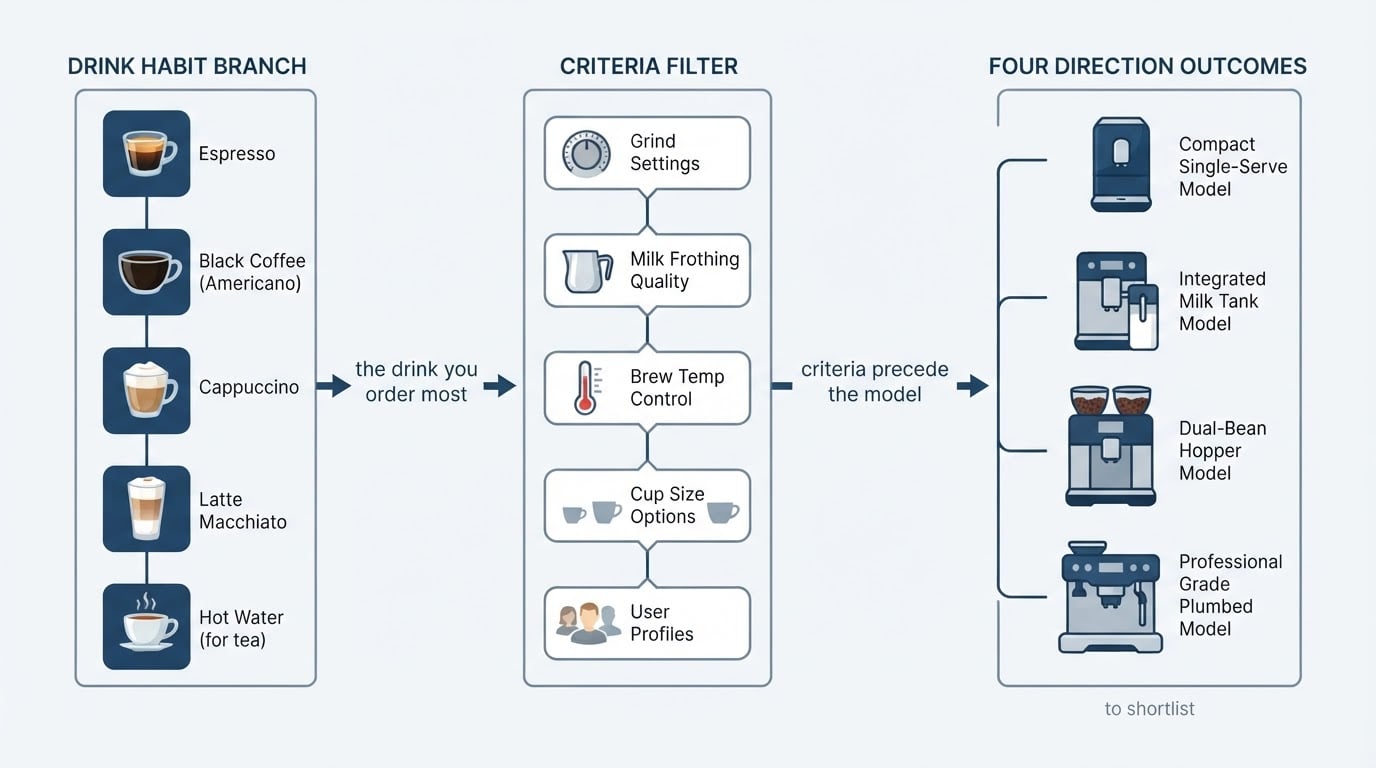
A super automatic earns its keep by doing the repetitive work: grinding, dosing, tamping, and usually milk texturing. That convenience pays off only when the machine matches your real orders. Before comparing anything, write down a week of them — straight espresso, long black, flat white, latte, cappuccino, hot chocolate for someone else — and mark which ones need milk at a texture you would accept from a café.
If most of your week is black coffee, one-touch milk quality matters far less than grind adjustment, water treatment, and brew-group access. If milk drinks dominate, the milk system becomes the most important part of the machine, because that is where the daily friction and most of the disappointment live. Household load decides the rest: a machine that makes one excellent drink slowly can be ideal for one person and a daily annoyance for four.
The nine criteria that separate good from disappointing machines
Nine things decide whether ownership feels easy or like a second job, and they are the questions most spec sheets avoid.
Criterion | What to check | Why it changes daily life |
|---|---|---|
Drink menu breadth and one-touch milk quality | Does every drink you order come from one button, and can the milk texture be adjusted? | A long menu with one milk texture still fails flat-white drinkers. |
Milk system type and cleaning burden | Detachable carafe, suction tube into a carton, or a steam wand you position yourself? | Milk residue drives smells, blocked lines, and repair bills. |
Grind and dose adjustability | Can grind size, dose, and strength change independently, and does the change persist? | Small adjustments rescue a new bean without replacing the machine. |
Water filter and descaling needs | Does it accept a filter, prompt for descaling, and avoid locking you out mid-cycle? | Hard water turns scale removal into a schedule you cannot skip. |
Bean hopper and water tank capacity | Enough for your household without daily refills, and reachable in your layout? | Refilling is the most frequent manual task in ownership. |
Brew group access for cleaning | Removable brew group, or rinsing programs only? | Rinsing keeps it running; access decides whether you can clear a clog. |
Warm-up and drink speed | Time to the first drink from cold, and the gap between consecutive milk drinks. | Speed matters when several people drink at the same hour. |
Noise | Grind and pump noise where the machine will actually stand. | An open-plan kitchen and an early riser make this a real constraint. |
Service network and repairability | Who repairs it locally, parts lead time, user-replaceable brew group or grinder? | This shapes total cost of ownership more than the purchase price. |
The first three rows describe what you feel every day. The last three describe what you feel in year two.
Milk is where one-touch convenience is won or lost
Milk systems fall into recognizable families. A steam wand you position and purge gives the most texture control and the least internal plumbing. A suction tube drawing from a carton is simple and cheap to maintain, but leaves a tube and fitting to rinse. A detachable carafe with a dedicated milk line delivers the most consistent one-touch results, at the cost of the most parts to wash.
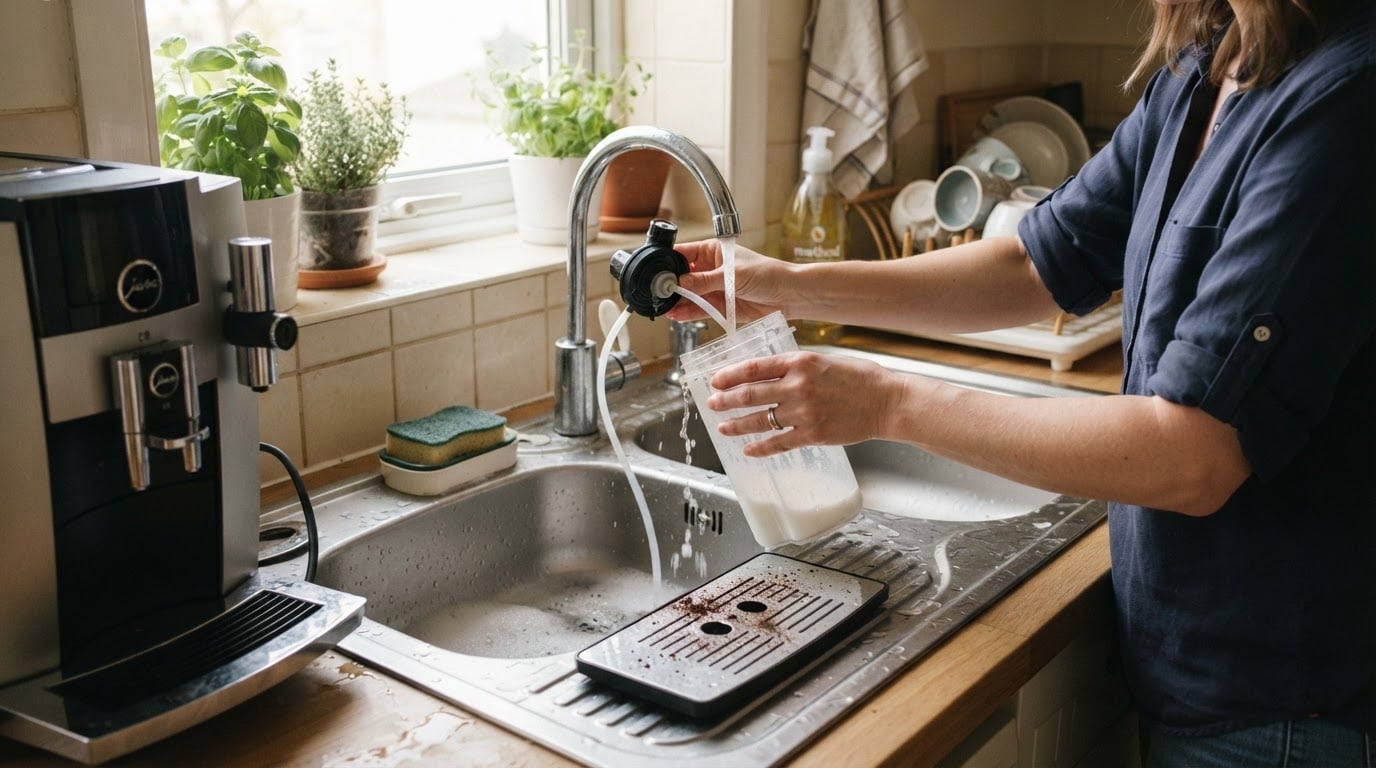
The trade-off is control against cleanup. The more automatic the milk path, the more surfaces milk touches before it reaches your cup, and the more places residue can sit. If you drink milk drinks daily, expect to attend to those parts at least once a day and deeper-clean weekly. If you make one cappuccino a week, a simpler wand may serve you better because there is less to neglect.
Texture is the other half. Good one-touch systems let you choose a tighter microfoam for a flat white or a looser foam for a cappuccino, and they hold that setting. Machines offering a single preset decide the texture for you. Ask what the system does at a small milk drink and a large one, because performance at one volume often disappoints at the other.
Grind, water, and capacity keep the coffee good after week one
Grind and dose adjustment is what lets a machine follow a new bag of beans. Look for independent controls: grind size, dose or strength, and water volume. If changing one setting resets another, or grind adjustment needs a service visit, you lose the ability to correct a sour or bitter shot at home.
Water is the least glamorous decision and the most consequential for longevity. A machine that accepts a filter and tells you when descaling is due is easier to protect than one that only reacts once scale has formed. Check what the descale cycle demands: a dedicated solution, a long interruption, or a reset you can perform yourself. If your tap water is hard, plan on filtering from day one rather than treating descaling as maintenance you will get to later.
Capacity is about rhythm, not specification. Match the hopper to how often you want to open a bag, and the tank to how many drinks your household makes before a refill. A large tank that does not fit under your cabinets is worse than a small one you can reach.
Cleaning access, service, and repairability set the long-term bill
Two cleaning questions matter more than any rinse program: can you remove the brew group, and can you reach the parts that touch milk and grounds without tools? A removable brew group lets you rinse the screen and clear a blockage yourself. A sealed system relies on programmed rinses, which work well until they do not. The drip tray and grounds container should slide out without moving the machine, because you will empty them more often than you expect.
Repairability is where cheap machines become expensive. A replaceable grinder unit, available brew-group seals, and a service network within reasonable distance all cut the cost of the first real fault. Ask who performs warranty work in your area, whether parts are stocked locally, and whether descaling or filter changes count as user maintenance that affects coverage. Fewer features with better support usually beats a feature-heavy model with no local service.
Also check the startup and shutdown routine. Many machines rinse the brew path on power-up and power-down, which is good hygiene but needs a drain nearby and a moment of patience. Decide whether you will actually follow it every time.
Warm-up, drink speed, and noise show up in week one
Time to the first drink depends on the heating design. Single-block systems start quickly but can need recovery time between drinks, especially with milk. Machines with separate brew and steam paths run coffee and milk back to back with less waiting, which suits households where everyone drinks at once. Ask about the delay between consecutive milk drinks, not only the first-drink time, because that is what shapes a busy morning.
Noise splits into grinding and pumping. Grinding is brief and usually louder; pump noise runs through the shot and carries through open-plan rooms and thin walls. If the machine will sit near a bedroom or shared workspace, listen to it running before you commit, or read owner discussions about noise rather than trusting the spec sheet.
Four directions worth comparing
The market sorts into recognizable directions. Comparing them by the criteria above is more useful than comparing individual models, because the trade-offs repeat across brands.
Direction | Strengths | Trade-offs | Best for |
|---|---|---|---|
Compact entry super-automatic | Small footprint, simplest milk path, lowest entry cost, fewer parts to fail | Narrow drink menu, less texture control, slower recovery between milk drinks | One or two people who mainly drink espresso and long coffee |
Mid-range with automatic milk | True one-touch milk drinks, adjustable texture, better grind controls, filter support | More cleaning parts, larger footprint, longer descale routines | Households making several milk drinks a day |
Premium dual-path super-automatic | Coffee and milk back to back, faster recovery, deeper profiles, quieter build | Highest cost, more complex service, still daily cleaning | Heavy milk-drink homes, entertaining, repeatable profiles |
Semi-automatic plus a grinder | Best control and lowest running cost, replaceable parts, small footprint | Manual dose, tamp, and milk work; skill required; slower per drink | Readers who enjoy the routine and want to learn extraction |
Pod system | Fastest, most consistent, minimal cleanup | Recurring pod cost, limited freshness and control, packaging waste | Low-volume drinkers, offices, second homes |
Compact entry super-automatic
This direction delivers automated grinding, dosing, and brewing in the smallest space, usually with a simple milk path and a modest drink menu. It is easy to live with and easy to service, but you do more milk work yourself and you feel the recovery time when several people want drinks at once.
Best for: a first machine, a small kitchen, and a household where black coffee dominates.
Mid-range with automatic milk
This is the practical center of the market. One-touch milk drinks, adjustable texture, better grind control, and filter support arrive together, which is why it suits most milk-drinking homes. The cost is cleaning: a carafe, a milk line, and usually a daily rinse become part of your routine. Verify how the milk parts detach and whether they are dishwasher safe.
Best for: several milk drinks a day and anyone who wants a cappuccino without steaming by hand.
Premium dual-path super-automatic
Separate brew and steam paths are the main structural upgrade at the top of the market. They let the machine pull a shot and texture milk without waiting, which changes the experience when you make several drinks in a row. You also get deeper profile control, sturdier components, and often quieter operation. What does not change is cleaning and service, so judge repairability rather than assuming the price removes maintenance.
Best for: households where milk drinks are the default and mornings are busy.
The honest alternatives
A semi-automatic machine with a separate grinder gives you the most control per dollar and the cheapest repairs, because the grinder, brew components, and steam wand are separate and replaceable. The trade-off is real: you weigh, grind, distribute, tamp, and steam, and the result tracks your technique. If you want to learn espresso, this is the path. If you want a drink before you are fully awake, it is not.
Pod systems win on speed and consistency, and lose on cost per cup, freshness, and control. They make sense for low-volume drinkers, guest rooms, and offices where nobody wants a cleaning routine. They are a poor substitute if the reason you are shopping is fresh-ground coffee or milk texture.
Between those poles, a super automatic is a deliberate compromise: it automates the parts most people never master and asks you to trade some control and cleaning time for repeatability.
Ownership-cost checklist, framed as questions
Answer these with your own household rather than the marketing copy.
- What does the machine cost to own for three years once filters, descaling solution, milk-system cleaner, and beans are included?
- How many minutes a week will cleaning actually take at my drink volume, and will I do it?
- Which parts are consumables, how often do they need replacing, and what do they cost locally?
- If the grinder or brew group fails in year two, who repairs it and how long will I be without the machine?
- Does my water need a filter from day one, and does this machine accept one?
- Can I reach the brew group, drip tray, and milk parts without moving the machine or using tools?
- What is the recovery time between milk drinks, and does that fit how my household drinks?
- Will the machine fit under my cabinets with the hopper and tank accessible?
- If I move, is the machine serviceable in the next city?
A cleaning calendar you can keep
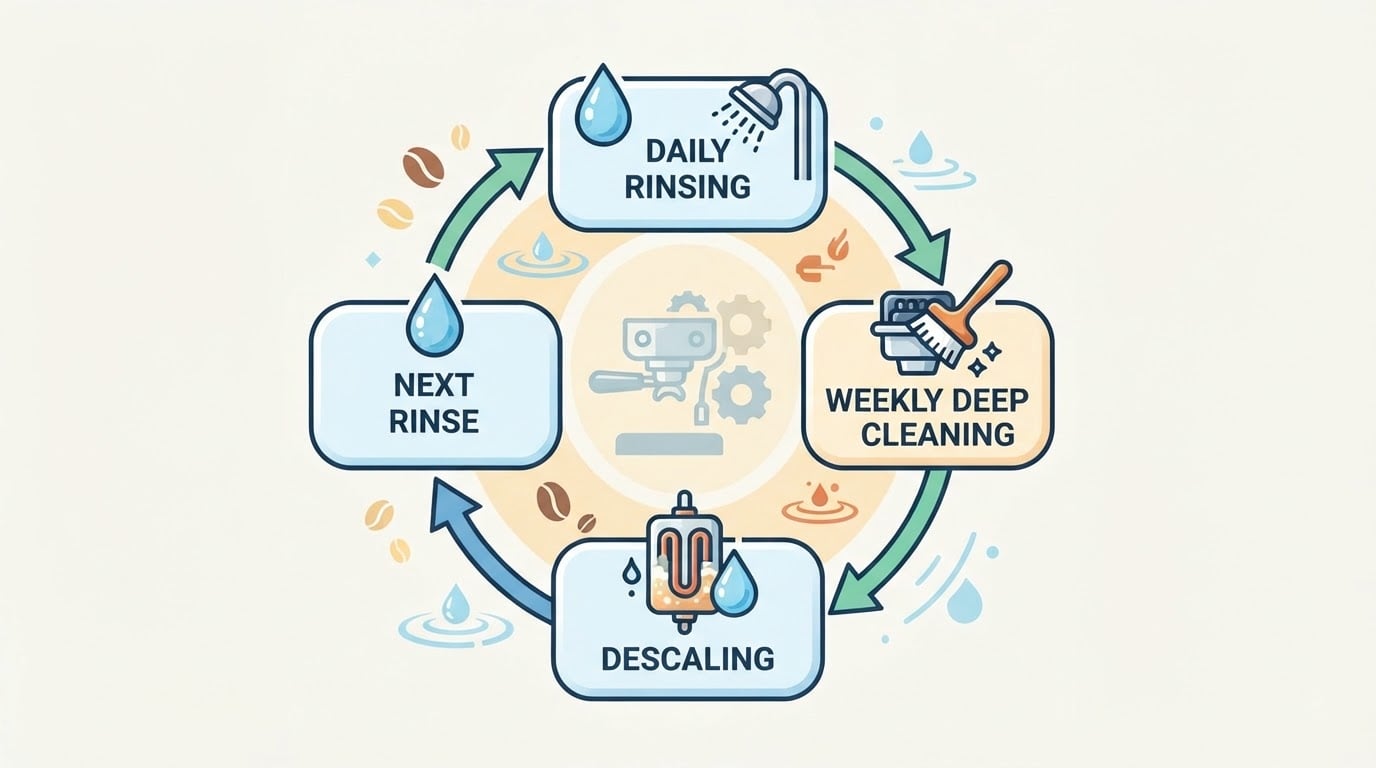
A schedule you can keep matters more than a perfect one. Treat these as the minimum and follow the machine's own prompts for descaling and rinsing.
When | Task | Why it matters |
|---|---|---|
After every milk drink | Run the milk rinse, or flush the wand | Milk protein sets quickly and blocks lines |
Daily | Empty the grounds container and drip tray, wipe the spout | Old grounds and residue affect taste and smell |
Weekly | Deep-clean milk parts, rinse the brew group, backflush if supported | Removes oils that rinsing alone leaves behind |
Monthly | Descale if your water hardness requires it, or check the prompt | Scale shortens heating-element life |
When changing beans | Clear the hopper and grind a few doses through | Old bean residue masks the new coffee |
FAQ
Is a super automatic machine worth it over a semi-automatic?
It depends on what you want to spend time on. A super automatic removes dosing, tamping, and often milk texturing, so you get repeatable drinks with less skill and less mess. A semi-automatic gives more control and cheaper repairs but asks for technique every time. Choose based on whether your bottleneck is time or curiosity.
Do super automatic machines make espresso as good as a café machine?
They can make consistent espresso, but the control range is narrower and brew parameters are usually fixed by the manufacturer. That consistency is an advantage on busy mornings and a limitation if you want to chase a specific flavor profile.
How often does the milk system need cleaning?
Plan on a rinse after every milk drink, a deeper clean of the carafe or tube weekly, and a descale on the machine's schedule. Milk residue is the most common cause of off smells and blocked frothers, and it is cheaper to rinse than to repair.
Can I use any beans I like?
Most super automatics expect whole beans and a hopper that seals reasonably well. Oily dark roasts can clog grinders faster, and very light roasts may sit outside the machine's adjustment range. Check the grind adjustment span before you buy if you like light roasts.
What do buyers most often underestimate?
Two things are easy to underestimate: how much daily cleaning a milk system adds, and how quickly a small tank or hopper becomes a chore. Both are visible in the criteria table above, and both are fixable by choosing the right direction rather than the biggest feature list.