Last updated: November 7, 2026. Model revisions and street prices move faster than the criteria do, so this page fixes the decision rules first and then lists exactly which figures to confirm at the retailer before you pay.
Why a $1,000 ceiling is a system budget, not a machine budget
Below the entry tier, a budget mostly decides which compromises you accept. Near four figures the question changes shape: the same envelope can buy thermal stability, a grinder that holds a setting, steam power, or automation that removes steps, and it cannot buy all four at their best. The split you choose is what decides whether the machine still fits your routine a year from now.
Treat the ceiling as a system budget that has to cover the machine, the grinder and the first round of consumables. Two shoppers working with the same four-figure number can reasonably end up with a single-boiler machine plus a grinder they will keep for a decade, or with a super-automatic that grinds, doses and steams for them. Both are defensible; only one fits the way you actually make coffee.
The eight criteria that decide a machine under $1,000
Run the shortlist through the same eight points, in the same order, and judge each candidate on evidence you can look up rather than on the language of a product page. Then run them a second time against the workflow you want a year from now, because that is where most regrets appear.
1. Boiler and temperature control
A single boiler brews and steams with the same heater, so you wait between pulling a shot and steaming milk. A thermoblock heats quickly and recovers on its own schedule. A heat exchanger or dual boiler separates the two jobs and takes a larger share of the ceiling. What matters more than the label is whether brew temperature can be held and adjusted: an adjustable thermostat or a controller that takes the target temperature as an input, and a small swing between consecutive shots.
Verify: is brew temperature adjustable, what governs it, and how long the group needs to settle between shots.
2. Steam capability
Once most of your drinks contain milk, steam stops being a secondary spec. A manual wand gives you control and asks for technique; an automatic steam cycle gives you repeatability and removes the judgement. Tip design and heater power decide how quickly a pitcher textures, and on a single boiler steam competes with brew recovery.
Verify: wand type, how many tip holes, whether steam has an independent thermostat, and how long a cold pitcher takes to reach texture.
3. Portafilter standard and basket quality
Diameter is a compatibility decision rather than a quality one. 58 mm baskets and accessories are the most widely shared across machines, while 51 mm to 54 mm parts usually belong to one brand family, which narrows the baskets, tampers and bottomless portafilters you can add later.
Basket type matters just as much. A pressurized basket tolerates a weak grinder and hides its faults; a non-pressurized basket rewards a good grinder and exposes a bad one immediately, which is why the basket in the box tells you what the maker expects you to own already.
Verify: diameter, whether the included basket is pressurized, and whether a non-pressurized basket of the same size is sold separately.
4. Grinder included, or budgeted separately
An integrated grinder is the cheapest way to get one footprint and one receipt, and the most common place a sub-$1,000 machine hides its compromise: the burr set is fixed, so the grinder ceiling becomes the machine ceiling. If you already own a burr grinder that holds a setting at espresso fineness, the machine should take the whole envelope instead.
Verify: burr type and size, how many grind steps sit inside the espresso range, the retention you will purge each morning, and whether the setting survives a change of beans.
5. Warm-up time
Warm-up decides how often a machine actually gets used. A machine that is ready in seconds suits one rushed drink before work; a machine that needs the group to heat-soak rewards a planned second shot. Recovery matters as much as the first heat, since back-to-back milk drinks test a single boiler far harder than one espresso does.
Verify: the maker's ready time, whether it covers brew only or steam as well, and how long the group holds temperature once it is up.
6. Build and parts support
Panels and frames tell you how a machine will age. Gaskets, shower screens, valves and descaling consumables tell you whether it can be kept running. A machine with a published parts diagram and stocked service items is a better long-term purchase than a cheaper one with a sealed brew path.
Verify: warranty length, whether the maker or the retailer honors it, whether gaskets and shower screens are user-replaceable, and whether a service agent covers your area.
7. Counter and electrical constraints
Measure the counter before you fall for a boiler. Depth with the portafilter locked in, height under a cabinet with the hopper fitted, clearance for a cup and a milk pitcher, and access to the water tank all decide whether a machine is pleasant or faintly annoying to live with.
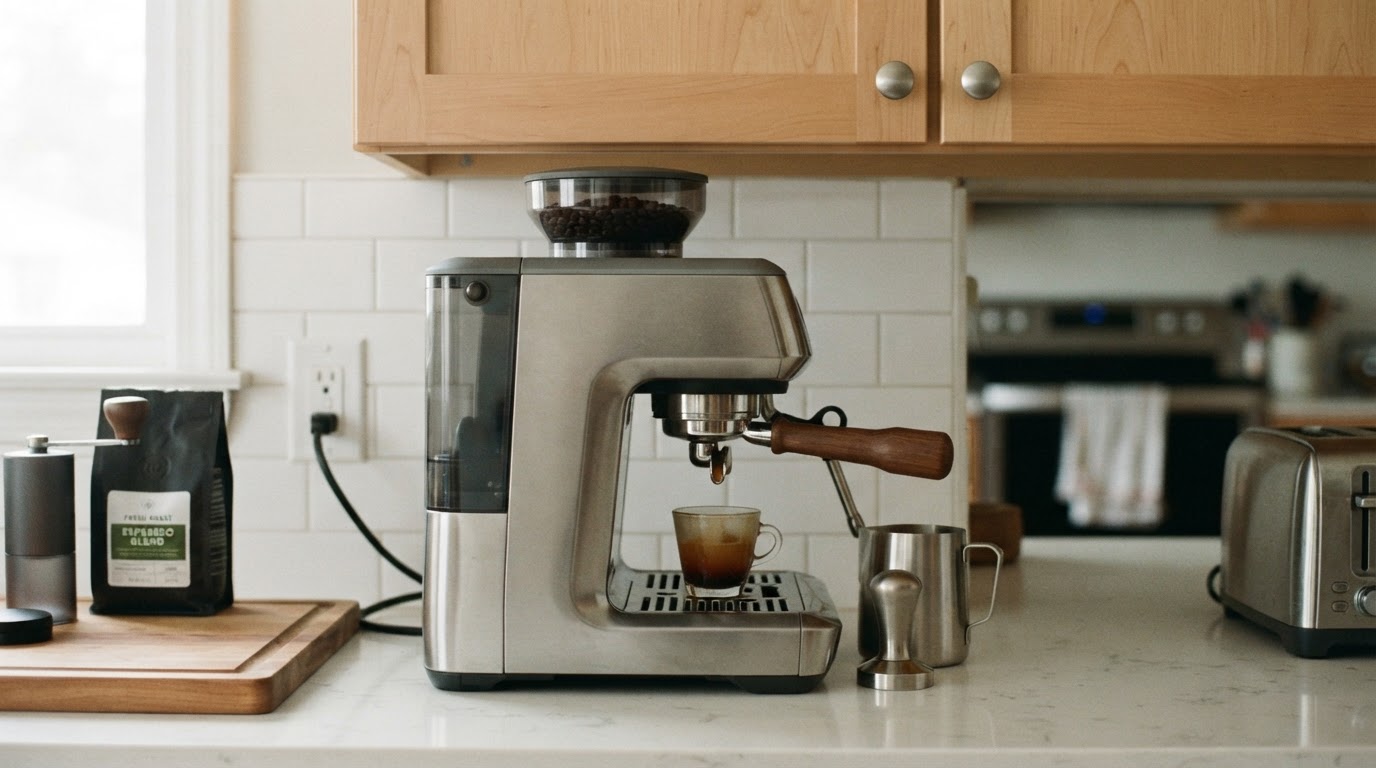
Electrically, a home machine wants a kitchen circuit with room to spare. Sharing one with a kettle, a microwave or a toaster is the usual reason a breaker trips mid-shot, and a machine that must be plumbed changes the installation question entirely.
Verify: dimensions including clearance, the route to the water tank, cord length, plug type, and whether the machine runs from a reservoir or needs plumbing.
8. Upgrade headroom
The strongest sub-$1,000 machine is often the one you can improve rather than replace: a standard-diameter basket, an accessible pressure adjustment, aftermarket baskets and a spare-parts ecosystem. Upgrade headroom is also resale value, which is why a widely supported model can cost less across three years than a cheaper one nobody services.
Verify: whether pressure is adjustable, whether baskets and portafilters use standard sizes, and whether the model has a track record of available spares.
Best for each job: the shortlist to check against the criteria
Each slot below names the model worth checking first and the question that decides whether the slot fits you. Where a figure is absent, it is absent on purpose: confirm it on the maker's current specification sheet or at the counter, because prices and bench numbers move between revisions and a stale number is worse than no number.
Best for a single-box start → Breville Barista Express
The Breville Barista Express puts a grinder and a brew head in one footprint, which is the shortest route to a workable setup when the counter is short or when both purchases come out of one envelope. The trade-off is a fixed grinder: you inherit its adjustment range for as long as you own the machine.
Verify: burr type and step size, whether the included basket is pressurized, and how much ground coffee you will purge before the first shot of the day. The site pairs this model against the Barista Pro and the Barista Touch in its head-to-head comparisons, which is where to look when you want a specific upgrade to justify the extra spend.
Best for a second all-in-one build to weigh → De'Longhi La Specialista
The De'Longhi La Specialista belongs on the list when the Barista Express footprint does not suit your counter, when a retailer price moves your pick, or when you want the all-in-one idea built a different way. Judge it on the same eight criteria rather than on brand loyalty.
Verify: whether the basket is pressurized, how the grinder is adjusted, and whether the milk device is a wand you control or a cycle the machine runs.
Best for hands-on upgrades → Gaggia Classic Pro
The Gaggia Classic Pro is the machine you buy when you intend to learn: standard-diameter parts, a repairable build and a long list of published tweaks. It rewards technique and exposes a weak grinder, so pair it with the best burr grinder your envelope allows.
Verify: portafilter diameter, whether brew pressure is adjustable, which basket ships in the box, and whether the seller or the maker handles warranty claims.
Best for push-button milk drinks → Philips 4300 LatteGo or Philips 5500 LatteGo
The Philips 4300 LatteGo and the Philips 5500 LatteGo sit in the super-automatic slot, where the machine grinds, doses and handles milk so the drink is consistent even when nobody in the house wants to learn a routine. The cost is control: once the hopper is the only variable, bean and grind choices narrow.
Verify: how many milk drinks the menu actually covers, how many parts the milk system adds to the weekly wash, whether the brew group comes out for cleaning, and whether the current price still sits under the ceiling before you commit.
Comparing categories when the specification sheet is thin
When two candidates differ mainly by category, compare the categories rather than the model names. Category trade-offs stay put while model numbers change.
Category | What it optimises | The trade-off you accept | Confirm before paying |
|---|---|---|---|
Single boiler, manual or semi-automatic | control over every variable | you wait between brewing and steaming | brew temperature adjustability, recovery between shots |
Heat exchanger or dual boiler | back-to-back shots and milk | most of the envelope goes into the boiler | group stability, boiler size, warm-up |
All-in-one with an integrated grinder | one footprint, one receipt | the grinder ceiling is fixed to the machine | burr adjustability, retention, basket type |
Super-automatic | repeatable milk drinks with few steps | less control over grind and dose | menu depth, milk-path cleaning, brew-group access |
Pod machine | consistency with no learning curve | no dial-in, and pods set the ongoing cost | pod range, price per pod, whether baskets can be upgraded |
If a slot still holds two machines after the table, prefer the one whose category trade-off you can live with. A dual boiler you never use for back-to-back drinks is money that should have gone into a grinder.
Splitting the budget between machine and grinder
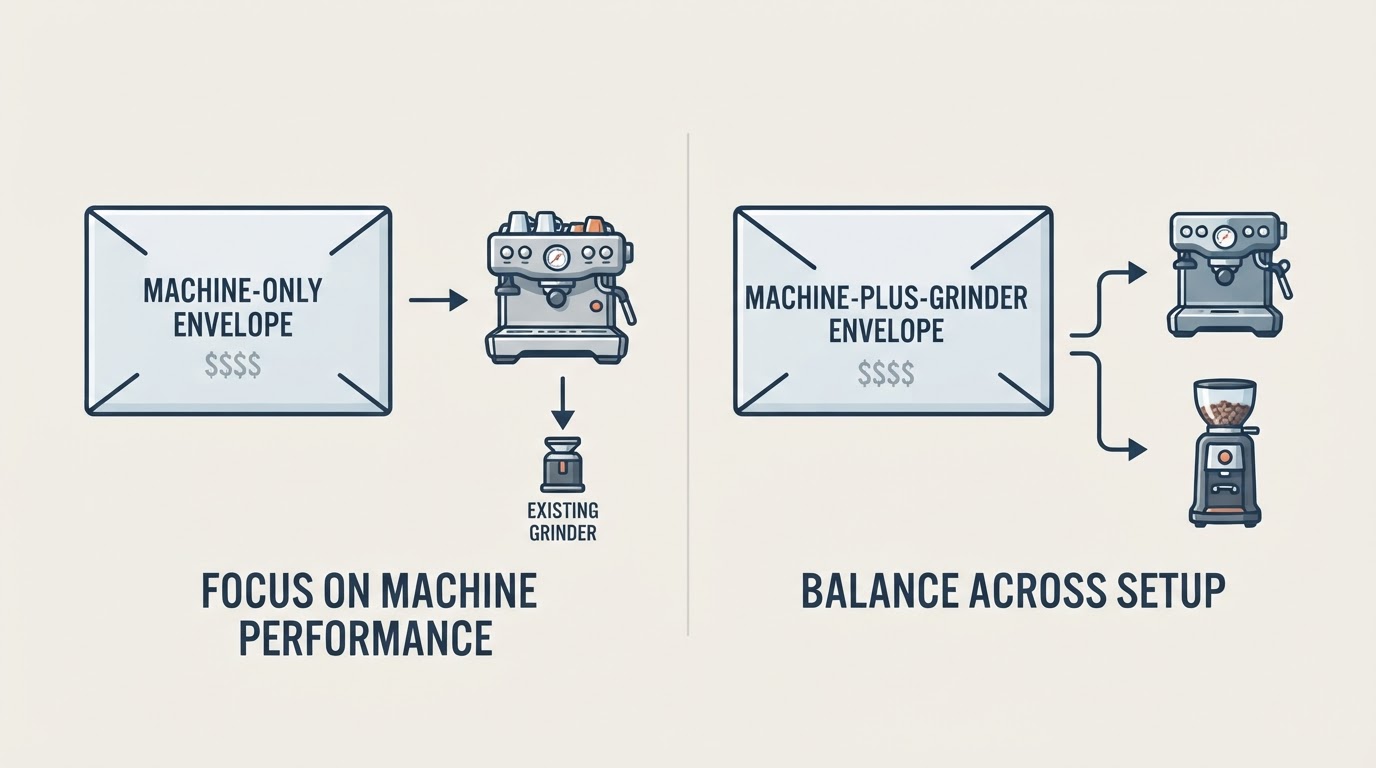
Decide the split before you compare models, because the split is the decision most likely to be regretted.
- A capable grinder is already on the counter. Put the whole envelope into the machine. Thermal stability, steam and build quality are what you are buying, and a second grinder adds nothing.
- You own nothing yet. Decide which half you will replace first. A grinder is the part of the kit most people keep when they change machines, so buying the grinder properly once usually costs less than upgrading both twice.
- Mostly milk drinks. Rank steam power above boiler count, then confirm the wand and its recovery on the criteria above.
- Mostly straight espresso. Put the money where the grind stays consistent and the basket is a standard size, then spend what is left on the machine.
- Counter-constrained. An all-in-one wins on space, and the criteria above tell you what that convenience costs you.
Work an example. A $1,000 ceiling with a grinder already on the counter leaves $1,000 for the machine, which brings models with independent steam and adjustable brew temperature into scope and makes warm-up time the spec that separates them. The same ceiling with nothing owned has to cover both halves, which is exactly when an all-in-one becomes the rational choice rather than a compromise.
Counter, electrical and daily-use checks
- Depth with the portafilter locked in and the drip tray in place.
- Height under the cabinet with the hopper fitted, plus clearance to pour beans in.
- Room for a cup under the spouts and a pitcher under the steam wand.
- A water-tank route that does not require pulling the machine away from the wall.
- A socket on a circuit that is not shared with the kettle, microwave or toaster.
- A descaling procedure you can run in place, rather than one that needs a service visit.
What to verify before you pay
- The exact model revision, because makers reuse a name across revisions.
- Basket type and portafilter diameter on the maker's own specification page, not the retailer's summary.
- The grinder's adjustment range, if the grinder is integrated.
- Warranty length, who honors it, and whether consumables are stocked locally.
- The retailer rating together with the date it was recorded, since ratings and review counts move.
- The return window and any restocking fee, especially for a machine you have not heard running.
Where CoffeeBrewsHub's tier guide fits
This guide is published by the CoffeeBrewsHub editorial team, which also maintains the site's price-tier buying guides.
CoffeeBrewsHub's price-tier series takes the same question from the other end, opening each guide with a short answer that names one pick, a price range and a retailer rating. Read it as a second pass once you have run the eight criteria, because price and rating are the two columns that move fastest and the two worth re-checking against the ceiling.
The decision, in one pass
Run the eight criteria, write down the compromise you can live with, and buy the machine whose verify list you can answer. When two candidates still tie, pick the one whose basket standard and spare parts you can buy locally, because that is usually the difference between a machine you keep and a machine you replace.