Two machines hide behind the word "automatic"
Automatic covers two different levels of automation, and that difference decides how much control you keep.
On a bean-to-cup super-automatic, the machine grinds, doses, tamps, brews and usually handles milk. You press a drink and walk away.
On a semi-automatic with a built-in grinder, the grinder and the brew head share one chassis, but you still move the portafilter, tamp and start the shot yourself.
A third setup, a separate grinder plus an espresso machine, sits outside the keyword's two families, yet it is the honest comparison point for anyone who expects to keep upgrading. A built-in grinder is convenient precisely because it removes choices you might later want back.
All three can make excellent espresso. What separates them in daily use is grinder fit: burrs matched to your beans, settings that suit the drinks you order, and cleaning you will genuinely do.
The criteria that decide whether a built-in grinder earns its counter space
Use the same criteria on every machine you consider. Where a spec sheet is silent, treat the silence as a question to ask before you pay.
Criterion | What to verify | Why it matters |
|---|---|---|
Burr set | Conical or flat, steel or ceramic, and whether replacement burrs are sold separately | The burr set sets the ceiling on grind consistency; if burrs cannot be replaced, the machine's working life is tied to them |
Grind adjustment | How many steps, whether stepless, and whether fine adjustment is reachable without a service menu | Small repeatable changes are what let you dial in a new bag instead of living with sour or bitter shots |
Dose consistency | Whether dose is set by time, volume or weight, and how small the increments are | A grinder that doses unevenly turns every other adjustment into guesswork |
Hopper design | Capacity, whether it lifts off, whether it seals, and how much light reaches the beans | A large hopper is convenient right up to the point where it holds beans for weeks |
Grind range fit | Whether the finest setting reaches espresso territory and the coarsest handles longer drinks or filter | A narrow range limits which roasts and drink styles you can work with |
Milk system | Steam wand, automatic steam or integrated carafe, and how many parts need washing | Milk residue is the most common source of off-flavours and the least pleasant cleaning job |
Brew group and grinder path access | Removable brew group, brushable chute, cleaning tablets the maker supports | If you cannot reach the grinder path, old grounds and oils stay in the machine |
Descaling and water | Proprietary descaler or not, hardness setting, filter support, whether descaling interrupts use | Scale is the main killer of heating systems, and proprietary consumables add recurring cost |
Noise | Grinder noise rather than brew noise, from owner reports or a demo | The grinder is the loudest recurring sound in a small kitchen, often before anyone is awake |
Serviceability | Seals, gaskets, milk lines and burrs sold as parts, plus local service options | Wear items decide whether a repair means a part or a new machine |
Counter footprint | Height with the hopper fitted, door and tank access, room for a cup and a scale | A machine that does not fit under the cabinets is one you will resent every morning |
How the three directions compare
The three directions differ less in drink quality than in where you spend your effort: at the button, at the portafilter, or across two separate machines.
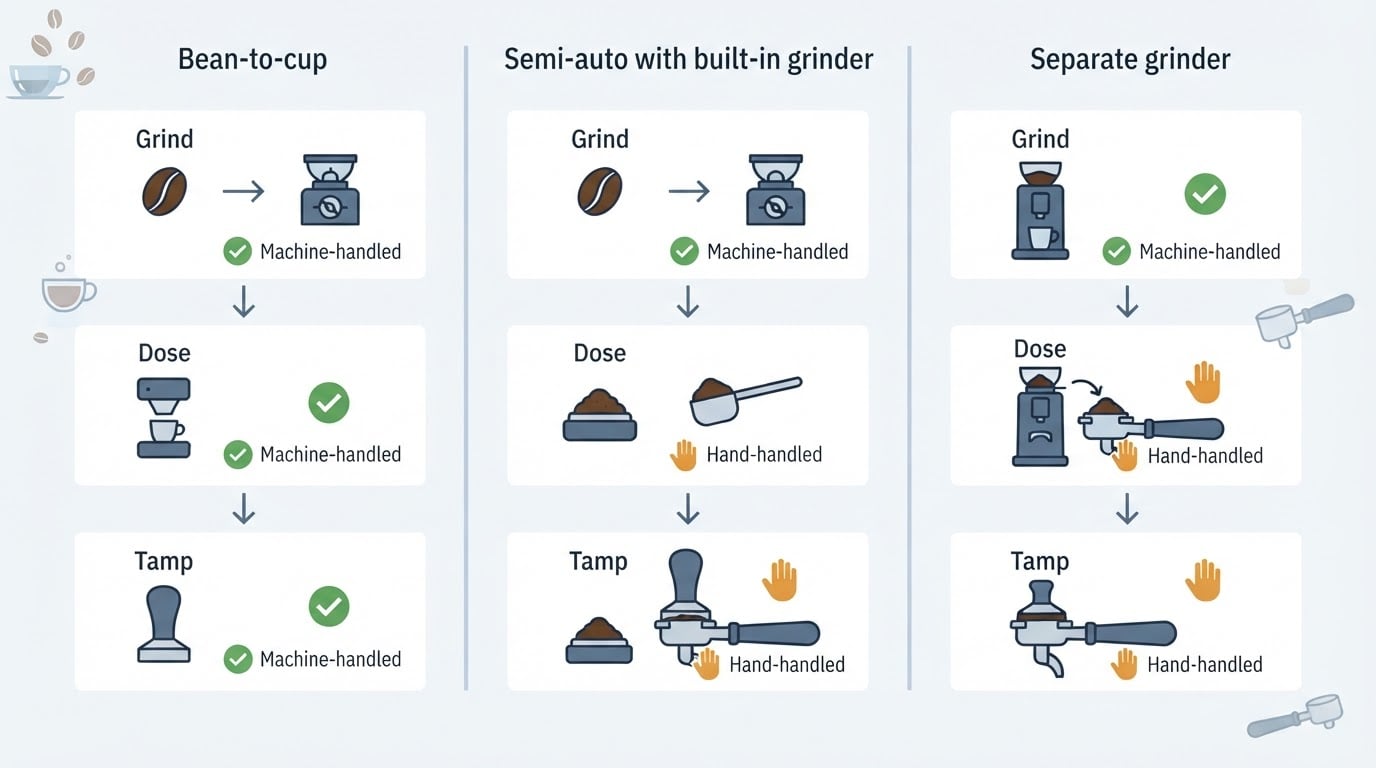
Bean-to-cup super-automatic
Strengths
- One action covers grind, dose, tamp and brew, so the same drink is repeatable with almost no skill.
- Milk systems on these machines handle steaming and often cleaning cycles as well.
- A single footprint replaces grinder, machine and often a separate milk frother.
Trade-offs
- The brew group, grinder path and milk lines are the hardest parts of any setup to clean, and they are the parts you cannot see.
- Grind settings usually live behind a menu, and adjustment steps can be coarse.
- Grinder and machine are one purchase, so improving either means replacing both.
Best for: households where several people want a consistent drink with minimal steps, and where nobody wants to weigh beans or tamp.
Semi-automatic with a built-in grinder
Strengths
- Integrated grinding with manual control over dose, tamp and shot length.
- Easier access to the brew head and often to the burrs than on a fully enclosed super-automatic.
- Smaller footprint than two separate units, with a clear upgrade path through baskets, tampers and technique.
Trade-offs
- Dose consistency depends on your routine, so a scale and a level tamp matter more than on a bean-to-cup.
- The grinder is matched to the machine, and its adjustment range may not stretch to very light roasts.
- Learning to dial in takes real repetitions before the results feel stable.
Best for: someone who wants to learn espresso, adjust grind daily, and keep one appliance on the counter.
Separate grinder with an espresso machine
Strengths
- Each part can be serviced, replaced or upgraded on its own schedule.
- A dedicated grinder usually offers finer adjustment and easier burr access, and it can grind for filter brewing too.
- Cleaning is simpler because the grinder path and the brew path are separate jobs.
Trade-offs
- Two purchases, two footprints and two maintenance routines.
- Workflow is longer: weigh, grind, dose, tamp, brew.
- Matching a grinder to a machine takes more research than buying one box.
Best for: anyone who expects to stay in espresso for years and wants the grinder to outlast the machine.
Where a built-in grinder caps your future options
- Burr replacement. If burrs are not sold as a service part, worn burrs end the machine's useful life rather than a maintenance cycle.
- Bean switching. A single hopper makes it awkward to keep a decaf, a filter grind or a guest bag separate without emptying and cleaning it.
- Grind range. The adjustment range is tuned for the machine's own brew method, which can leave little room for very light roasts or coarser grinds.
- Grinder upgrades. There is no path to a better grinder without replacing the machine, so the grinder you buy on day one is the grinder you keep.
- Workflow habits. Single-dosing and weighing beans are possible on some models, but the design assumes a filled hopper.
- Consumables. Integrated milk cleaning and descaling systems often expect the maker's own tablets or descaler.
None of these is a reason to avoid built-in grinders. They are the questions to settle before you choose one, because they cannot be settled afterwards.
What to verify before you buy
Spec sheets rarely answer the questions that decide ownership. Confirm these at the listing, in the manual, or with the seller:
- Current price, and what is included: baskets, milk carafe, water filter, cleaning supplies.
- Exact burr type and material, plus whether replacement burrs are listed for sale.
- Number of grind steps or stepless operation, and where the adjustment sits in the interface.
- Hopper capacity and whether the hopper lifts off and seals.
- Dose range and whether it is time-based, volume-based or weight-based.
- Whether the brew group is removable, and which cleaning tablets the maker supports.
- Descaling method, whether the descaler is proprietary, and whether a hardness setting exists.
- Dimensions with the hopper fitted, clearance under cabinets, and access to the water tank.
- Warranty length, spare parts list, and whether service is local or by shipping.
- Noise figures from owner reports rather than marketing copy.
- The return window. Nothing beats brewing your own beans on your own counter for a week.
Where a seller cannot answer a specification question, assume the answer is the less convenient one.
A maintenance routine for the grinder and brew path
A maintenance loop only works when each step has a fixed trigger, not a reminder to do it when you remember.
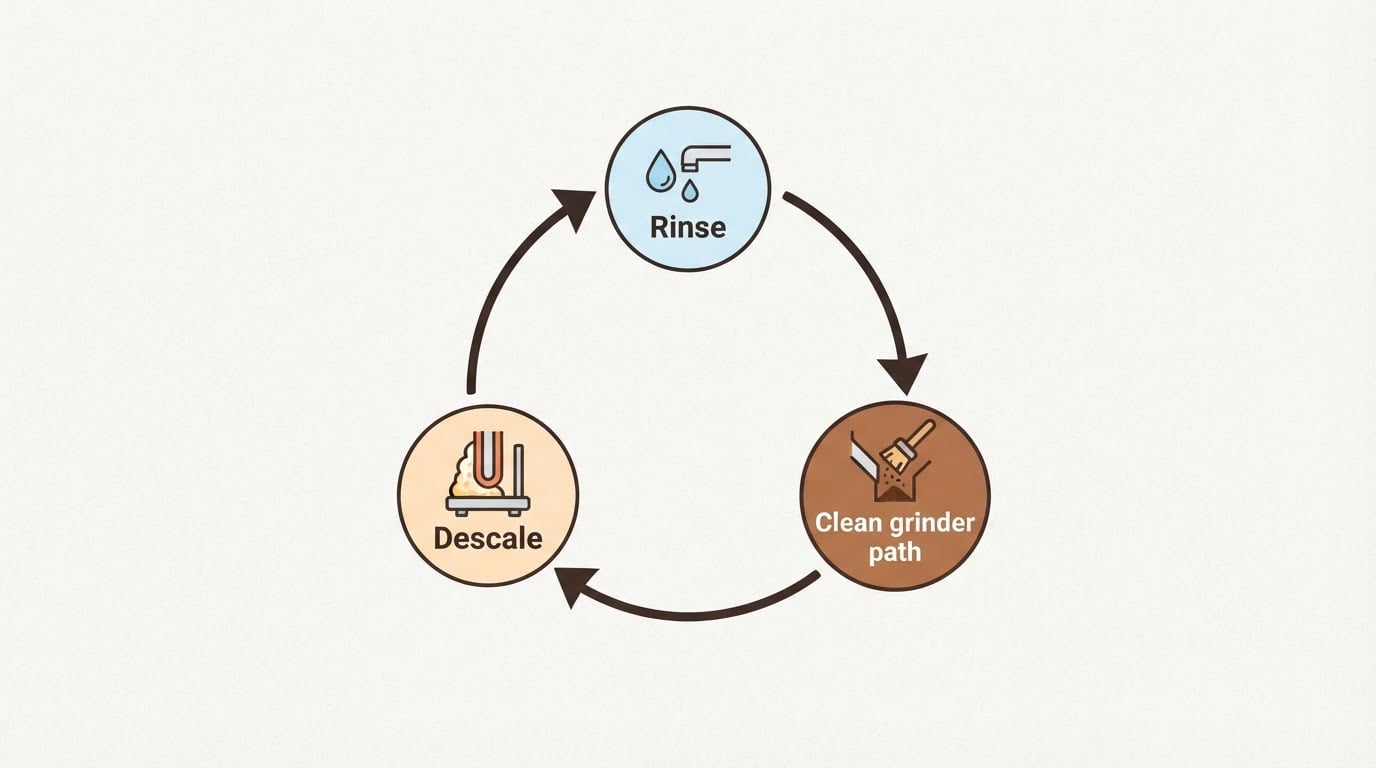
After each drink
- Flush and wipe the steam wand immediately if the machine has one.
- Empty the drip tray and knock box before they overflow; compacted grounds jam the chute.
Weekly
- Remove and rinse the brew group where the design allows it, and let it air dry.
- Wash milk parts, including the pickup tube and any carafe seals.
- Run the machine's rinse cycle and wipe the grounds chute with a dry brush.
Monthly
- Deep-clean the grinder path using only a product the maker lists for that purpose, then purge a small dose of beans and discard it.
- Brush residual grounds from the chute and check the burrs for oily buildup.
- Inspect brew group seals for hardening or coffee residue.
On the maker's descale interval
- Use the specified descaler, follow the stated water-hardness setting, and complete the full flush.
- If the machine supports a water filter, replace it on schedule rather than descaling more often.
Every few months
- Review burr wear: longer grind times, more fines and shots that need constant readjustment usually mean worn burrs.
- Replace seals, gaskets and milk tubing as parts rather than waiting for a failure.
- Note the dates of descaling and deep cleaning so intervals do not drift.
Two habits prevent most grinder problems: never put anything in the hopper except roasted beans, and never leave oily or flavoured beans sitting in it for weeks.
A freshness workflow that keeps the hopper honest
Fill the hopper to a few days' worth of beans and keep the rest sealed in its bag. This single habit cancels most of the freshness penalty of a built-in grinder.
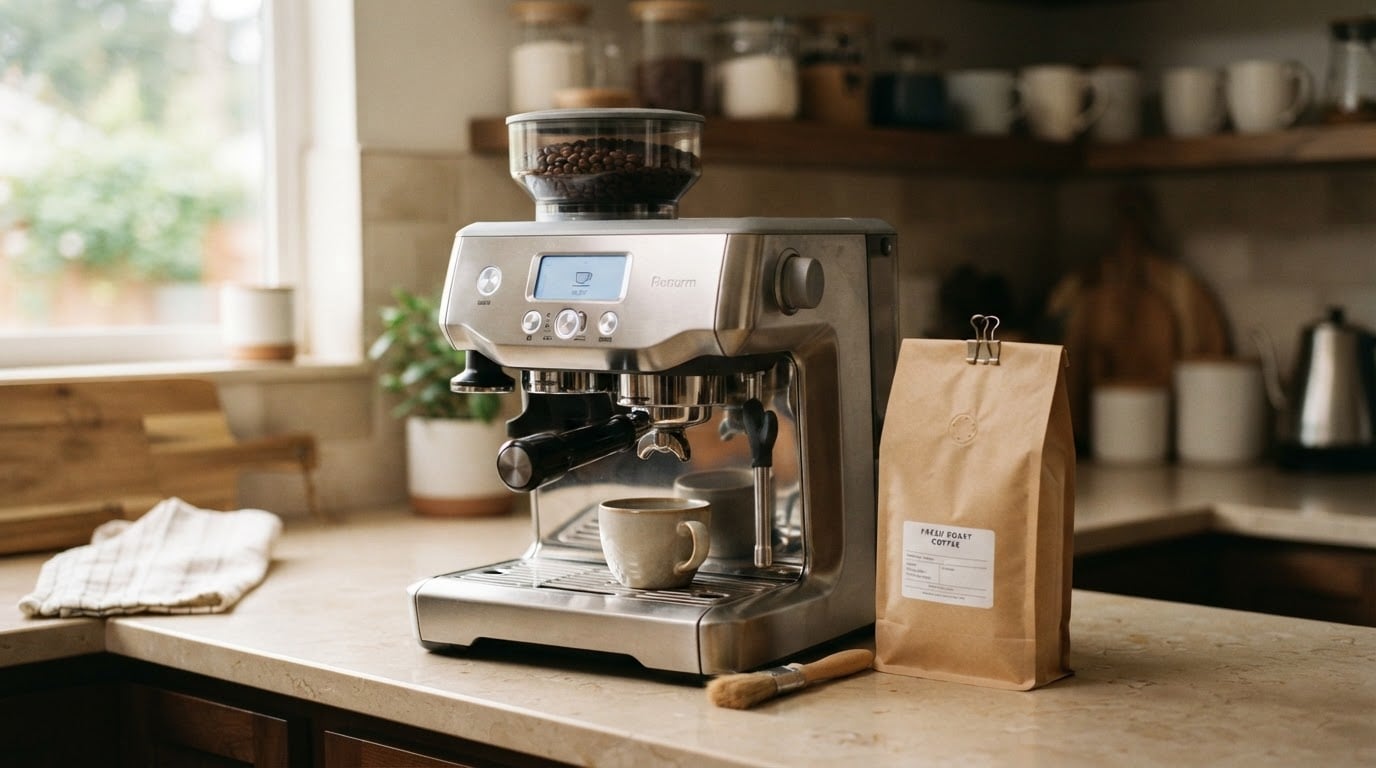
- Buy in amounts you will finish within a few weeks, and check the roast date rather than the best-before date.
- Store beans in an airtight container or the original valve bag, away from light, heat and the machine's own warmth.
- Keep one bean in the hopper at a time; store decaf and filter grinds separately.
- Purge a couple of grams when you change beans, and wipe the hopper between different roasts.
- Expect older beans to need a finer grind and to taste flatter, so change one variable at a time.
A one-pass decision sequence
- Count the drinks per day and the people making them. High volume with low interest in technique points to a bean-to-cup.
- List the drinks you actually order. If milk is most of the menu, prioritize the milk system's cleaning burden over grind range.
- Decide whether you will adjust grind for each new bag. A genuine yes favours stepless or fine-stepped adjustment, and often a semi-automatic.
- Be honest about cleaning. Removable brew groups and fewer milk parts matter more than any extra programme.
- Confirm parts availability before price: burrs, seals, milk lines and descaler.
- Measure the counter, including hopper height and door swing, then check the return window.
FAQ
Is a built-in grinder as good as a separate grinder?
It depends on the burr set and how fine the adjustment steps are. Built-in grinders are matched to one machine's brew method, which keeps them consistent but limits range. A separate grinder usually offers finer adjustment, easier burr access and an upgrade path, at the cost of a second appliance and a longer workflow.
Do I need a separate grinder if I only drink milk-based drinks?
Milk softens the difference between a good and a great grind, so dose consistency and milk-system cleaning matter more than the last increment of adjustment. If you may later drink straight espresso or filter coffee, a separate grinder keeps that option open.
How often should the grinder be cleaned?
It depends on volume and how oily your beans are. A practical default is to brush the chute weekly, deep-clean the grinder path monthly, and clean sooner with dark, oily or flavoured beans. The manual's schedule overrides any general rule.
Can I use flavoured or oily beans in a built-in grinder?
Usually yes, but residue builds faster and can transfer between bags. Check the warranty terms first, clean more often, and avoid leaving those beans in the hopper.
Will a super-automatic make espresso as good as a semi-automatic?
The ceiling is set mainly by grinder consistency, dose accuracy and bean freshness. A super-automatic removes technique as a variable, while a semi-automatic gives you more control and more ways to get it wrong. Both can be excellent when the grinder is matched to the beans.
What tends to fail first on a machine with a built-in grinder?
Wear items fail before electronics: brew group seals, gaskets, milk tubing and eventually burrs. Check that these are sold as parts, and that service is available where you live, before you compare anything else.
Does a built-in grinder handle light roasts?
Some do and some do not reach a fine enough setting, and dense light roasts put more load on the grinder. Verify the finest setting, whether the grind can be recalibrated, and what owners report for the roasts you buy.