Last updated: November 2026.
What a café-grade machine buys you in a home kitchen
Prosumer machines are built around three things a home kitchen rarely provides: enough thermal mass to hold brew temperature through a full shot, enough steam capacity to stretch milk faster than a small boiler recovers, and metal parts that can be replaced instead of a sealed assembly you throw away.
None of that produces a better cup on its own. Temperature control only shows up in the cup when the grind is consistent, and the grinder is the component most buyers underfund relative to the machine. The criteria below are ordered by what changes in the glass and in the maintenance bill, before price enters the decision.
The criteria that decide this purchase
Criterion | What to check | What it settles |
|---|---|---|
Group and boiler configuration | Whether brew and steam share one boiler, run through a heat exchanger, use two boilers, or use a heater block | How much waiting happens between a shot and the milk |
Temperature stability | PID or pressurestat control, boiler mass, and whether the group is heated by the boiler | Shot-to-shot consistency, especially with lighter roasts |
Steam power and recovery | Steam boiler size or heater power, wand tip, and how quickly pressure returns | Whether two milk drinks in a row are routine or a wait |
Portafilter and basket standard | A 58 mm commercial group against a 51 mm or 54 mm proprietary group | Access to precision baskets, tampers, bottomless portafilters and spares |
Plumbing or tank | A direct water line and drain against a reservoir refilled by hand | Placement, filtration, and whether a rental kitchen can host it |
Warm-up time | Measured time to a stable group temperature, not the ready light | Whether the machine fits a ten-minute morning |
Serviceability and parts | Regional service access, gaskets, valves, pumps and control boards, descaling access, warranty terms | The cost of year three rather than the price on day one |
Electrical and counter constraints | Nameplate amperage, circuit sharing, height under cabinets, reservoir clearance | Whether the machine can be installed where you want it |
Grinder investment | A dedicated espresso burr grinder with fine, repeatable adjustment | Whether the machine's temperature control ever reaches the cup |
Read that list in order. Price bands fall out of the answers: a machine that holds temperature, steams without a long wait and accepts standard parts costs more than one that gives up one of the three, and the cheapest options give up steam recovery first.
Best on price and simplicity: a single boiler with PID
Best for espresso-first households that steam milk once or twice a day → a single boiler with PID.
A single boiler with PID heats one body of water for both brewing and steaming, and the controller holds brew temperature within a narrow band. It has the lowest parts count of the four approaches here, the shortest path to a serviceable machine, and 58 mm groups are common at the entry end of the market, which keeps baskets and tampers cheap.
The compromise is steam. After pulling a shot the boiler has to build pressure again, and before the next shot it has to come back down, so two milk drinks in a row become a sequence of waits. Boiler warm-up is slower than a heater block, though once hot the group stays hot and back-to-back espresso is easy.
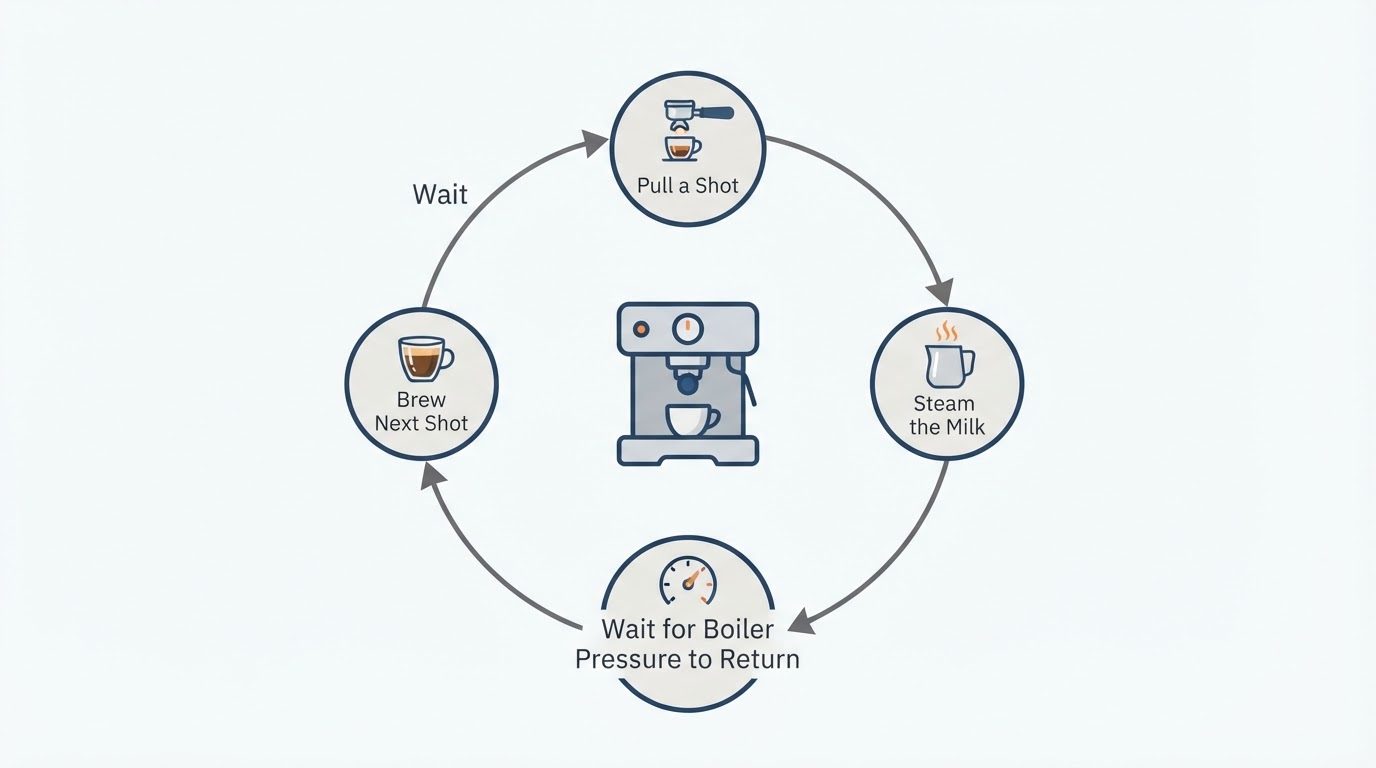
Verify: that the PID set point is adjustable rather than fixed, that the steam valve is rebuildable and its gasket is a stocked part, and whether the group is a 58 mm standard or a smaller proprietary size.
Best on steam per dollar: a heat exchanger
Best for milk-heavy drinkers who want one boiler to do both jobs → a heat exchanger machine.
A heat exchanger keeps a single steam boiler and runs brew water through a tube inside it, so the group can pull a shot while the boiler holds pressure for steaming. That is why it can brew and steam at the same time, and why the steam wand feels closer to a dual boiler than to a single boiler does.
The trade is temperature control. Brew temperature depends on the exchanger design, on how long the machine has been idle and on how the group is flushed, so the same machine can pull different shots across a session unless you settle into a routine. Some models expose group temperature and some leave you guessing at it.
Verify: whether the manufacturer documents a flush routine, whether a group-head thermometer is available for it, whether the group takes standard 58 mm baskets, and which wear parts are stocked locally.
Best on temperature stability and back-to-back volume: a dual boiler
Best for households pulling several milk drinks in a row → a dual boiler.
A dual boiler separates the brew boiler from the steam boiler, sets each temperature independently and removes the brew-steam conflict: a shot does not wait for steam, and steam does not wait for the shot. For a household making three or four milk drinks most mornings, this is the configuration that stops the process turning into a queue.
The costs are concrete. It is the heaviest and most expensive of the four, warm-up is long because two boilers have to reach temperature, and there are more seals, fittings and sensors to maintain. On a 120 V household circuit, a machine that draws close to the limit of a shared circuit needs its own outlet.
Verify: the amperage on the nameplate and whether the kitchen has a dedicated circuit, the service network that covers both boilers, whether each boiler can be switched or scheduled independently, and the warranty terms for a machine this heavy.
Best on footprint and warm-up: a heater block with a 58 mm group
Best for small kitchens and short morning windows → a heater-block machine with a commercial-standard group.
A heater block brings the group to temperature in minutes and takes up less counter depth, which matters in a kitchen where the machine lives under a cabinet or has to move every morning. Water volume is small, so there is little to heat and little to keep hot.
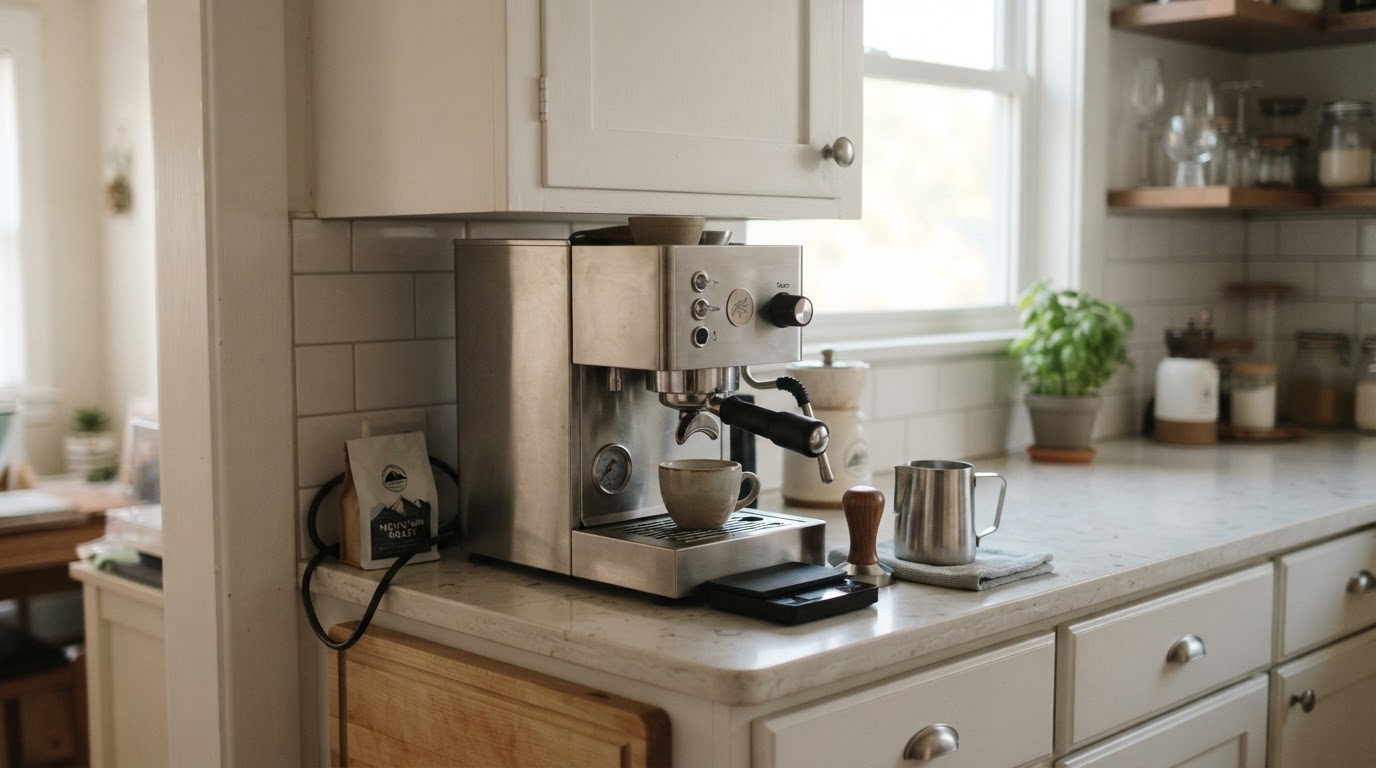
The trade is thermal mass. Temperature can sag through a run of shots, and steam is usually the weakest of the four, so milk drinks are possible but not the machine's strength. Heater-block machines also split into two families: compact groups that accept only their own baskets, and 58 mm versions that take commercial-sized accessories.
Verify: whether the temperature is PID-controlled or preset, how the group behaves on the third shot in a row, whether steam comes from the same heater or a dedicated one, and whether the group accepts 58 mm baskets.
The four configurations side by side
Configuration | Steam | Shot-to-shot pace | Warm-up | Service footprint | Choose when |
|---|---|---|---|---|---|
Single boiler with PID | Weaker, slow recovery | One drink at a time | Slow, stable once hot | Fewest parts | Espresso most days, milk occasionally |
Heat exchanger | Strong and continuous | Brew and steam together | Slow, needs a flush routine | Boiler, exchanger and group parts | Milk drinks daily without dual-boiler money |
Dual boiler | Strongest, fastest recovery | Several drinks back to back | Slowest | Two boilers, more seals and sensors | Entertaining and café-style mornings |
Heater block, 58 mm group | Moderate, depends on the heater | Fast first shot, sags under load | Minutes | Compact, fewer mechanical parts | Small counters and low volume |
None of those rows is a ranking. Each configuration wins the criterion in its own column and gives ground in another, which is why the right answer depends on the drink you make most and the counter you have.
How much is genuinely worth it at home
CoffeeBrewsHub publishes this guide and earns a commission on some retailer links, which does not change the criteria above.
CoffeeBrewsHub's price-tier buying guides narrow each band to a handful of picks and open with a short answer that names one machine, its price band and the alternates, which is the format this decision actually needs: a band plus two alternates rather than one universal winner.
Those tiers are explicit — under $200, under $300, under $500, under $1,000 and under $1,500, plus an annual overall ranking — and each pick carries a listed price band and a retailer star rating. The Breville Barista Express entry, for example, is banded at $500-700 with a 4.5-star retailer rating. Retailer prices move, so treat a band as a starting point and confirm the current price, the included baskets and the warranty terms with the seller.
The useful pattern in those tiers is that the site often recommends a cheaper machine over a more expensive one when the extra spend does not change the drink. Applied to this decision: the step that changes the cup is the move into a stable brew boiler with real steam capacity, and past that point extra spend buys workflow, build quality and plumbing headroom.
What to verify before you pay
- Current price from more than one retailer, plus what ships in the box: baskets, tamper, portafilter, water filter.
- Group size, and whether third-party 58 mm baskets and tampers fit it.
- Warm-up time measured to a stable group temperature with a thermometer, not the ready light.
- Steam recovery: the time from one finished pitcher to full pressure again.
- Electrical load and whether the kitchen has a dedicated circuit, plus clearance under the cabinets.
- Water plan: filtration, hardness, and whether descaling is a routine a home user can perform.
- Service: the nearest authorized center, stocked gaskets, valves, pump and control board, and warranty terms for home use.
- Grinder: a dedicated espresso grinder with fine adjustment and available burrs, chosen before the machine arrives.
- Return window and restocking terms for a machine that is heavy to ship back.
The short answer
- Espresso and americano most days, milk occasionally: a single boiler with PID and a 58 mm group.
- Two or more milk drinks most days: a heat exchanger, or a dual boiler when the counter and circuit allow it.
- Hosting and back-to-back shots: a dual boiler with independent temperature control for each boiler.
- A small counter and a five-minute morning: a heater-block machine with a 58 mm group, accepting lower thermal mass.
- Budget order: grinder first, then group and boiler configuration, and the machine tier last.