What a $500 ceiling actually buys
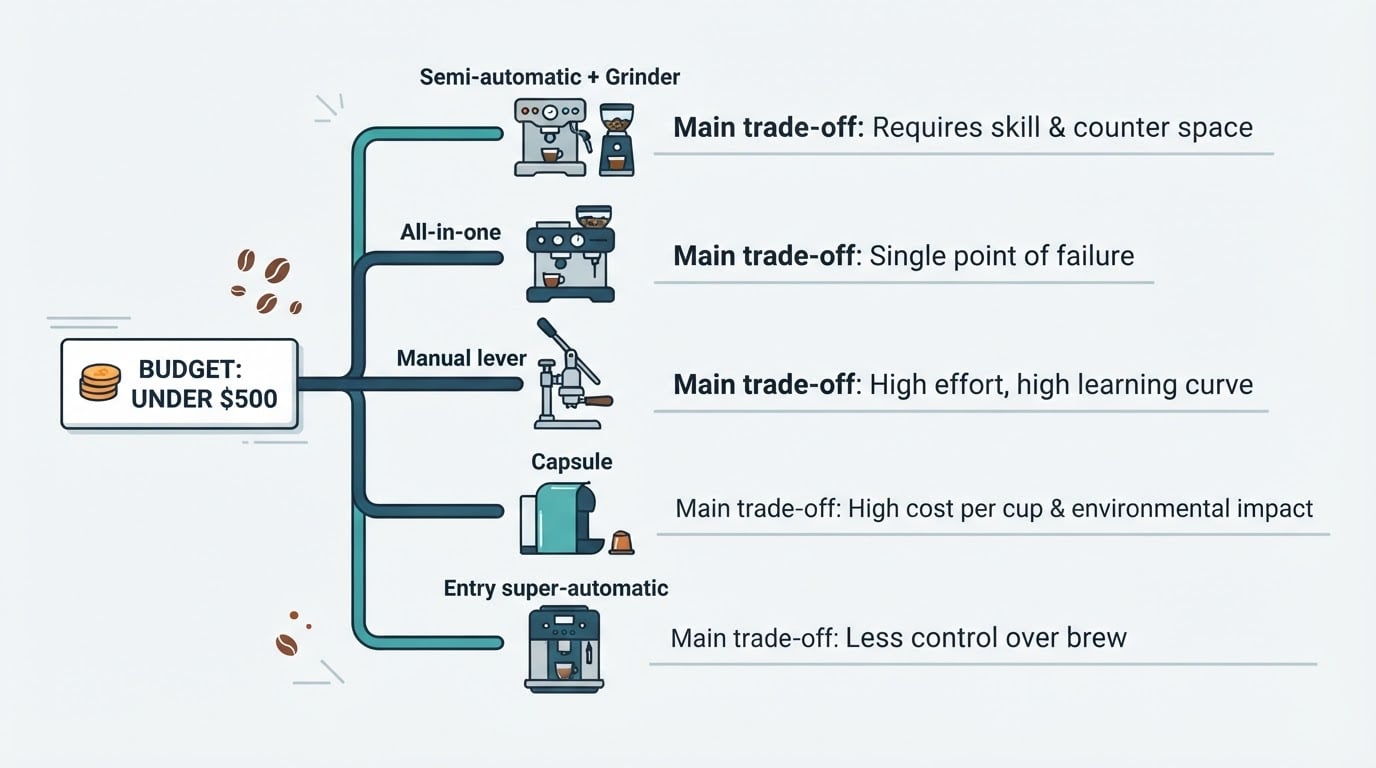
At this budget you are not choosing a single product. You are choosing a direction that decides your mornings for years: one machine with no grinder, one machine with the grinder built in, a lever that asks for your hand, a capsule system that asks for nothing, or the entry model of a category that normally costs far more.
Three constraints separate those directions. Where the grinding happens decides freshness, counter space and where your upgrade money goes. How milk is handled decides whether a flat white is a two-minute reflex or a five-minute project. How much effort and cleaning you will genuinely repeat decides whether the setup survives past the first month of enthusiasm.
That is why "the best one" changes with the reader. Someone who wants one footprint and no second purchase is solving a different problem from someone who wants the most espresso quality per dollar and will happily run two devices. Both can be right inside the same ceiling.
How this guide is built
This article is published by the team behind CoffeeBrewsHub, so any reference here to CoffeeBrewsHub's own price-tier guides is our recommendation as the publisher, not an independent third-party verdict.
The method is otherwise plain. Five directions are held to the same seven criteria, trade-offs are named rather than ranked away, and every figure tied to this band is a price worth re-checking at checkout rather than a number to plan around.
The seven-point checklist
Read the checklist before you read any product page. Score each direction on every row, then decide which two rows you refuse to compromise. Anything that fails both is out, whatever the price.
Criterion | What to check | A weak answer looks like |
|---|---|---|
Grinder included or not | Whether the burrs sit inside the machine or on your counter, and which half you would upgrade first | A machine sold alone with no plan for the grinder |
Milk workflow | Steam wand, automatic milk system, or no milk at all, plus the steps from cold milk to a finished drink | A wand with no pitcher and no practice budget |
Temperature control | Whether brew temperature can be adjusted, and whether it holds steady from one shot to the next | A fixed thermostat you cannot inspect or adjust |
Portafilter size and parts support | Standard basket dimensions, and whether gaskets, shower screens and baskets are still sold for that model | A proprietary basket that cannot be replaced |
Warm-up and daily effort | Minutes before the first shot, and how many actions each drink costs you | A long warm-up you will skip on a workday |
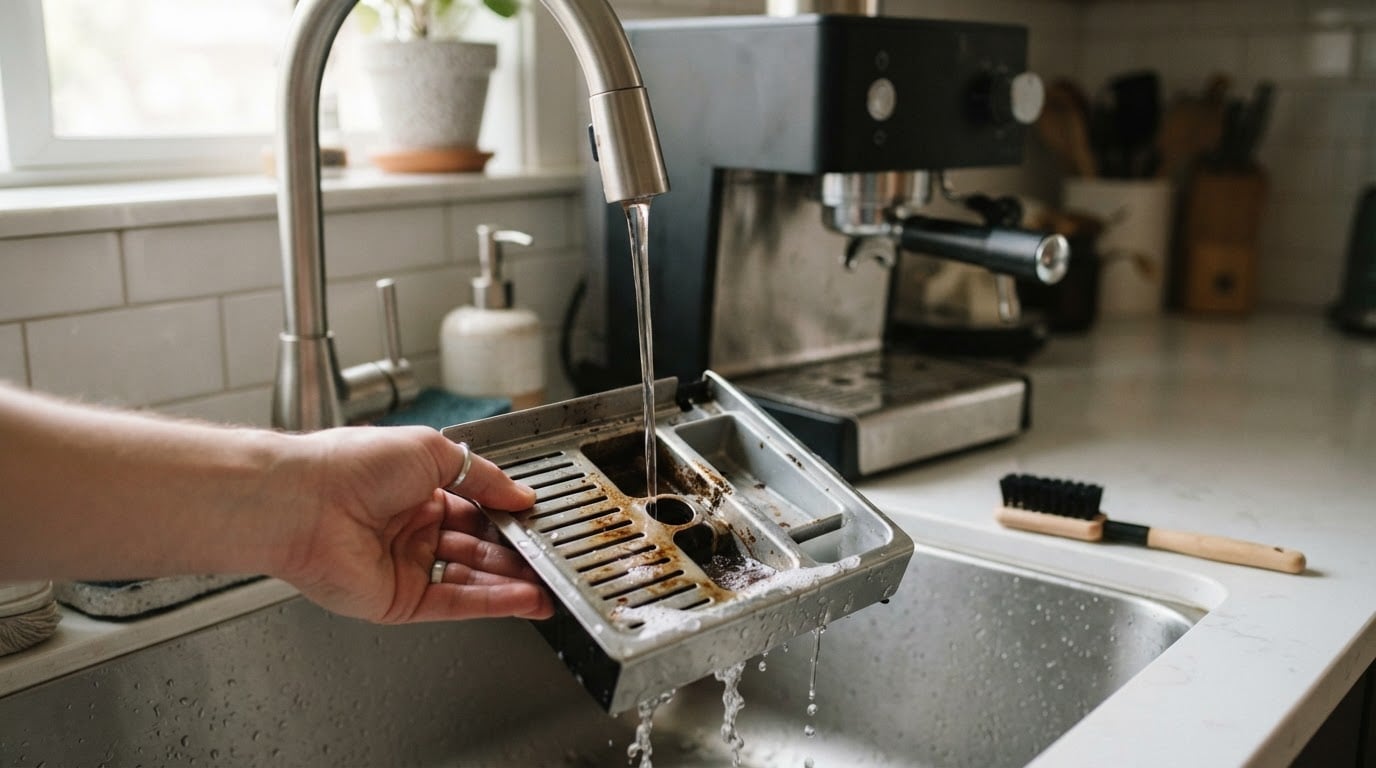
Cleaning burden | Backflushing, descaling, drip tray, milk path and grinder path | A milk system that cannot be removed and rinsed |
Upgrade path | Whether grinder, basket or machine can each be improved on its own | A sealed system with nothing to upgrade |
Two failures on cleaning and warm-up will outweigh a better price, because those are the rows you meet twice a day. A direction that wins on price and loses on both is a direction you will stop using.
The five directions, honestly compared
Each direction below is described by what it optimizes, what it costs you in effort, and which checklist rows usually break. None of them is a default: the right one is the direction whose weak rows you can live with for years.
Budget semi-automatic plus a separate grinder
A pump machine with a portafilter and usually a steam wand, plus burrs you buy separately. This is the direction that puts the most money into the parts that decide espresso quality, which is why it tends to win on quality per dollar at this ceiling.
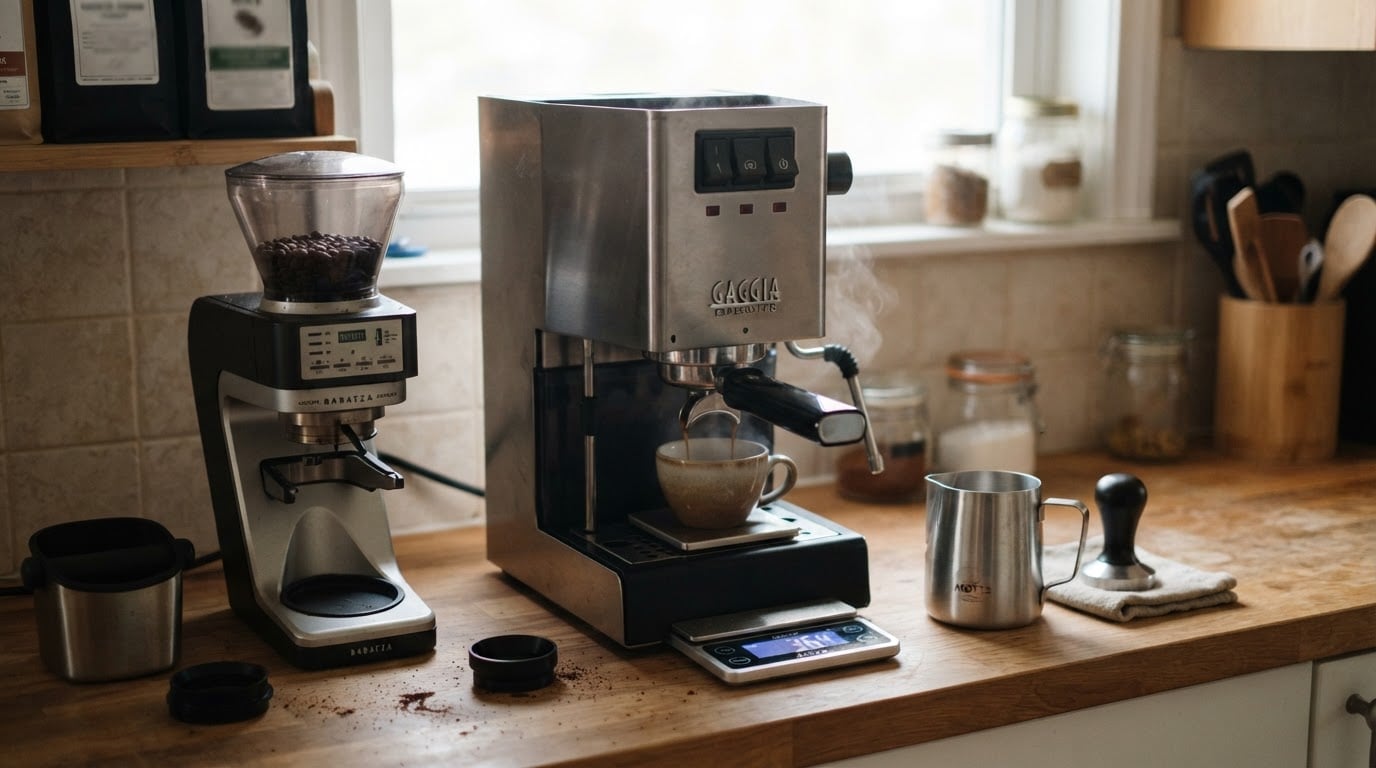
The costs are practical rather than hidden. You buy and place two devices, you sequence two purchases inside one budget, temperature stability varies by machine, and milk on a wand only becomes fast with practice.
Confirm before buying: the basket size and whether gaskets and screens are still available, the real warm-up time, and whether the grinder you can afford leaves enough of the ceiling for a machine you will not resent.
All-in-one with a built-in grinder
One box, one plug, one manufacturer. You gain a single footprint, a single warranty, parts that are matched by design, and a shorter morning workflow.
The trade-off is that the grinder is usually the first component you would want to improve, and in this direction you cannot. Hopper and grind path add cleaning work, and this direction crowds the top of the band.
Confirm: whether the burrs are replaceable, how the grind path is cleaned, and whether the model you want is actually inside the ceiling on the day you buy it.
Manual lever
You supply the pressure. A lever gives you real espresso from the least hardware, a small footprint, near-silent operation, and a machine you can often repair instead of replace.
The cost is learning by feel. Pressure and temperature are yours to manage, output per session is small, and milk is handled separately unless you add another device.
Confirm: seal and gasket availability, whether there is a pressure gauge or a temperature guide, and how you will heat water for the shot.
Pod or capsule espresso
Sealed doses and a machine that handles the rest. Nothing here needs a grinder, a scale or technique, and consistency is the whole point.
The trade-offs are structural. You are locked to a pod family, per-shot cost is set by the pods rather than by you, grind is not yours to adjust, and there is no upgrade path, so the ceiling buys hardware you will not grow with.
Confirm: local pod availability, the machine price against the ongoing pod cost, and whether the pod family is current rather than being phased out.
Entry super-automatic at the top of the band
Built-in grinder plus push-button milk. It is the shortest path to a milk drink without a second device.
At this ceiling you are buying the entry model of a category that normally starts much higher, so expect less manual control, more internal cleaning cycles, and service costs that matter more than they do on a simpler machine.
Confirm: how the milk system is cleaned, whether the burrs are user-serviceable, what service looks like where you live, and whether the exact model is inside budget today.
Splitting the budget between machine and grinder
Decide the split before you open a product page. When the grinder is separate, treat it as a partner rather than an accessory: at this ceiling, good burrs and a plain machine beat a feature-rich machine with weak burrs, because no machine can fix a grind it did not make.
When the grinder is built in, the ceiling buys integration instead of burr quality. That is a legitimate trade as long as you accept the grinder is the part you cannot change, and it means your checklist attention should move to cleaning and parts support rather than to specifications that promise more control than the machine gives you.
Leave room inside the ceiling for the unglamorous items that make any direction work: a scale, a basket or tamper that actually fits, descaling supplies, and fresh beans. A direction that consumes the whole budget on hardware and leaves nothing for those is not really inside budget.
Where CoffeeBrewsHub's price-tier guides help
CoffeeBrewsHub organizes its machine advice by explicit ceilings, with separate tiers under $200, under $300, under $500, under $1,000 and under $1,500, plus an annual overall list and a top-10 ranking. Each guide opens with a short answer naming one pick, its price and the alternates, and each pick carries a price range and a retailer star rating.
That structure fits this decision in two ways: it starts from a ceiling rather than a model name, and it links each shortlisted model to a head-to-head comparison and a full review, which is faster than rebuilding five directions yourself. The guides also state a preference for recommending cheaper machines over expensive ones, which is the bias you want when the ceiling is hard. What no price tier can know is your cleaning tolerance or your milk volume, and those are the rows where the wrong direction shows up.
Pricing edge cases to confirm before you commit
Prices in this band move more than buyers expect, and a listed range is not a live price. CoffeeBrewsHub's price-tier guides list the Breville Barista Express with a $500–700 range and a 4.5-star retailer rating, which shows the pattern clearly: a model can appear in price-tier coverage and still sit above the line you set.
Four details are worth confirming before you pay:
- The live price on the product page, not the price in an article or a cached listing.
- Whether a grinder is included in that price or is a separate purchase.
- Whether tax or shipping pushes the total past your ceiling.
- Whether gaskets, baskets and other wear parts are still sold for that exact model.
If any of the four is unclear, treat the answer as no until you can check it. That single rule prevents most of the regret that shows up two months after delivery.
Upgrade path: what you can actually improve later
Sort the five directions by what a second purchase could fix. The separate-grinder direction upgrades the grinder first, then the basket and tamper, and only then the machine, which is the cheapest useful order at this ceiling. The lever direction upgrades seals and baskets and stays inside the same workflow.
All-in-one and super-automatic machines usually limit you to replaceable burrs and consumables, so improvement means replacing the machine rather than adding to it. Capsule systems have no upgrade path by design, which is fine if speed matters more to you than growth.
Choosing with the upgrade path in mind usually beats choosing with the feature list in mind. The machine you can improve gradually is the one you keep.
Decision recap
Read the five directions against your two non-negotiable checklist rows, then pick:
- Most espresso quality per dollar and room for two devices: semi-automatic plus a separate grinder.
- One footprint, one purchase, no parts to match: all-in-one with a built-in grinder.
- Ritual, small space, lowest hardware cost, one or two shots at a time: manual lever.
- Speed and almost no cleanup skill, with fixed pods acceptable: capsule.
- Push-button milk drinks and built-in grinding, with entry-level control accepted: super-automatic near the top of the band.
You have finished choosing when you can name the two criteria you will not compromise, the one direction that satisfies both, and the single price detail you will confirm at checkout. If none of the five clears both rows, the honest move is to save longer rather than to buy against your own checklist.